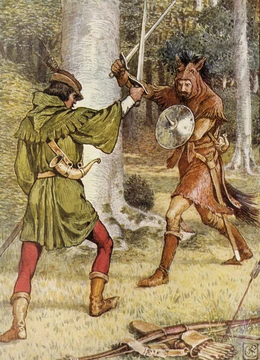
Fehérlófia (folk tale)
A Hungarian folk hero born of a white mare.

Fehérlófia—meaning "Son of the White Horse" or "Son of the White Mare"—is a Hungarian folk tale first published by László Arany in his 1862 collection *Eredeti Népmesék*. The story follows a youth of the same name, described as a Hungarian folk hero. In folklore classification systems, it falls under Aarne–Thompson–Uther type ATU 301, "The Three Stolen Princesses," while the Hungarian National Catalogue of Folktales (MNK) designates it as AaTh 301B.
The tale begins with a white mare nursing her human child for fourteen years, until the boy gains enough strength to uproot a tree. The mare dies, and the boy sets off to see the world. He meets three other exceptionally strong individuals: Fanyüvő, Kőmorzsoló, and Vasgyúró. After wrestling, they become friends and move into a hut in the forest. They agree that one will stay behind to cook while the others hunt.
One day, a dwarf named Hétszűnyű Kapanyányimonyók invades the hut, beats Fehérlófia's companions, and steals a cauldron of porridge. Fehérlófia later traps the dwarf's beard in a tree trunk, but when he leads his friends to the spot, the dwarf has vanished. Following a pit or hole leading deep underground, Fehérlófia's companions are too frightened to descend, so he climbs down alone in a basket.
Below, he finds the dwarf, who directs him to three castles: one of copper, one of silver, and one of gold. Each holds a princess captive by a serpentine or draconic enemy. Fehérlófia kills a three-headed dragon in the copper castle, a seven-headed dragon in the silver castle, and a twelve-headed dragon in the golden castle, freeing all three princesses. They return to the basket, and Fehérlófia sends the princesses up first, knowing the basket cannot carry all four. The basket never comes back for him.
Wandering the underworld, Fehérlófia finds a nest of griffin chicks and shields them from rain with a bush. The griffin mother thanks him, and he asks for help returning to the surface. She agrees, but requires food during the ascent. Near the top, supplies run out, so Fehérlófia cuts his own hand and leg to feed the bird. Once they land, the griffin gives him a vial of magical liquid that restores his strength. He then hunts down his traitorous companions, who die of fright at seeing him alive. Fehérlófia takes the princesses to their father and marries the youngest.
Variants exist across Europe.
Quick Facts
- Folk Tale Name
- Fehérlófia
- Aarne-Thompson Grouping
- ATU 301 (Three Stolen Princesses)
- Aka
- The Son of the White Horse; The Son of the White Mare
- Region
- Hungary
- Published In
- Eredeti népmesék by László Arany (1862)
- Related
- Jean de l'Ours / Three Princesses
Facts from the source article.
Lore & Background
Fehérlófia descends into the underworld via a basket and finds three castles: copper, silver, and gold. In each castle, a princess is held captive by a dragon. He kills a three-headed dragon in the copper castle, a seven-headed dragon in the silver castle, and a twelve-headed dragon in the golden castle. The princesses ascend to the upper world, but the basket does not return for Fehérlófia. He protects a nest of griffin chicks from rain, and the griffin carries him upward, fed by the hero's own flesh when supplies run out. The griffin gives him a magical liquid to restore his strength. Fehérlófia then confronts his traitorous companions, who die of fright, and marries the youngest princess.
Reader's Guide
Fehérlófia is significant as a central example of the Hungarian folk hero archetype and as a variant of the widespread ATU 301 tale type, 'The Three Stolen Princesses'. The tale's publication by László Arany in 1862 helped preserve and disseminate Hungarian oral tradition. Its classification under both the Aarne–Thompson–Uther Index and the Hungarian National Catalogue of Folktales highlights its cross-cultural resonance and national specificity. The story's motifs—supernatural birth, companions with extraordinary strength, descent to an underworld, rescue of princesses from dragons, and betrayal—appear in numerous European and Romani variants, as documented in the source article. The tale's legacy lies in its role as a touchstone for comparative folklore studies and its enduring place in Hungarian cultural identity.
Did You Know?
- The tale is classified as ATU 301 by the Aarne–Thompson–Uther Index, but as AaTh 301B by the Hungarian National Catalogue of Folktales.
- The hero Fehérlófia is nursed by a white mare for fourteen years before gaining the strength to uproot a tree.
- The dwarf antagonist is named Hétszűnyű Kapanyányimonyók.
- Variants of the tale exist among Romani, Russian, Mari, and Czech traditions.
More in European folklore 1-24
Spotted an error? Know more?
Reader corrections go straight into our review queue. Suggest an edit · How this site is sourced