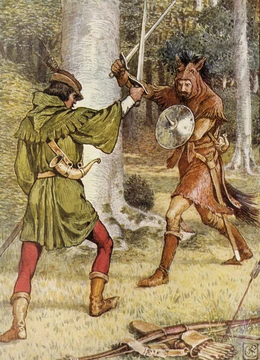
English folklore
Myths and legends of England passed through generations.

English folklore consists of the myths and legends of England, including mythical creatures, traditional recipes, urban legends, proverbs, superstitions, dance, balladry, and folktales passed down through generations. It reflects the cultural heritage of the country and has been shaped by historical experiences and influences from Celtic, Roman, Anglo-Saxon, Norse, and Norman cultures. The folklore conveys themes of justice, loyalty, bravery, and the supernatural, often with a moral imperative stemming from Christian values, and explores the relationship between humans and the natural world.
- Key figures
- Robin Hood, King Arthur, Green Man, Black Shuck
Lore & Background
English folklore includes a diverse array of characters such as heroic figures like Robin Hood, legendary kings like Arthur, and mythical creatures like the Green Man and Black Shuck. These tales have been influenced by historical events, such as the witch trials of the early modern period reflected in stories like that of the Pendle witches. During the Renaissance, artists captured these customs in written works, such as Shakespearean plays reflecting English folklore through witches, fairies, folk medicine, and superstitions. In the 19th century, William Thoms coined the term 'folklore' and compiled English legends, contributing to a growing sense of national identity, though the widespread integration of such stories into the English school curriculum throughout the 19th century is not historically supported.
Folktales often convey themes of justice, loyalty, bravery, and the supernatural, and frequently contain a moral imperative from Christian values. They explore the relationship between humans and the natural world, as seen in legends of the Green Man or Herne the Hunter, or the consequences of human actions in tales like the Lambton Worm. English folklore has continued to differ according to region, though shared elements exist across the country. The folktales, characters, and creatures are often derived from aspects of English experience, such as topography, architecture, real people, or real events.
Reader's Guide
English folklore has had a lasting impact on English culture, literature, and identity. Many traditional stories have been retold in various forms, from medieval manuscripts to modern films and literature. Traditional folk festivals such as May Day, Plough Monday, Bonfire Night, Allhallowtide, and Harvest festival continue to be practised. Morris dancing, Mummers' plays, and Maypole dancing remain popular forms of folk traditions, often depicting or echoing themes from English folklore. The folklore teaches that through an upright and virtuous character, a person can achieve a successful life. Lullabies, songs, dances, games, folktales, and superstitions imparted religious and moral education, forming a person's sense of justice and Christianity. English folklore also included beliefs in the supernatural, including premonitions, curses, and magic, common across all social classes. Most folklorists agree that the purpose of English folklore is to protect, entertain, and instruct on how to participate in a just and fair society.
Did You Know?
- The black dog is a creature that foreshadows calamity or causes it, and is a native English folkloric figure with no direct established links to Greek or Norse mythology.
- The Abbots Bromley Horn Dance may represent a pre-Christian festival.
- William Thoms coined the term 'folklore' in 1846 and compiled English legends, contributing to a sense of national identity.
More in European folklore 1-24
Spotted an error? Know more?
Reader corrections go straight into our review queue. Suggest an edit · How this site is sourced