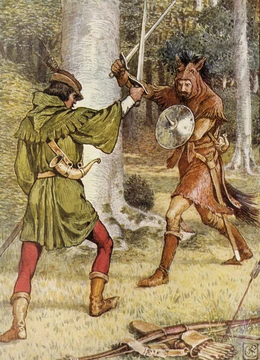
Dawn, Midnight and Twilight
Three brothers born at different times rescue princesses from an underground realm.

Dawn, Midnight and Twilight (also known as Dawn, Evening and Midnight; Russian: Зорька, Вечорка и Полуночка) are the three heroic brothers in a Russian fairy tale collected by Alexander Afanasyev and published as number 139 in his compilation Russian Fairy Tales (though numbering varies by edition). The tale is classified as Aarne-Thompson-Uther type ATU 301, 'The Three Stolen Princesses,' and is noted for its unusual variant in which the brothers cooperate rather than betray one another.
Quick Facts
- Folk Tale Name
- Dawn, Twilight and Midnight
- Aarne-Thompson Grouping
- ATU 301, "The Three Stolen Princesses"
- Region
- Russia
- Published In
- Russian Fairy Tales by Alexander Afanasyev (1865) / Fairy Tales of Eastern Europe, by Jeremiah Curtin (1914)
- Related
- The Three Kingdoms · fr · Les Trois Royaumes (conte) / The Norka
Facts from the source article.
Lore & Background
The three brothers are named after the times of day when they were born: Dawn (Zorka), Twilight (Vechorka), and Midnight (Polunochka). In the tale, a king builds an underground palace to protect his three daughters, but they are kidnapped by a whirlwind while strolling in the garden. The king issues a proclamation for heroes to rescue them. The three brothers, sons of an old widow, answer the call. While traveling, they take turns staying at a hut to cook while the others hunt. The older brothers, Midnight and Twilight, are defeated by a small but powerful man, but Dawn defeats him, and the creature escapes into a crevasse on a mountain. Dawn fashions a rope from tree bark, descends into the hole, and finds three palaces—copper, silver, and gold—each containing one of the princesses and a many-headed serpent. Dawn kills the serpents and lifts the princesses back to the surface via the rope.
Reader's Guide
The tale of Dawn, Midnight and Twilight is significant as a representative of the widespread East Slavic folktale type 'Three Underground Tsardoms' (SUS 301A,B), which corresponds to the international ATU 301, 'The Three Stolen Princesses.' Unlike many variants where the hero is betrayed by his companions, this version features the brothers working together to rescue the princesses, a detail noted as unusual by scholars. The motif of triplets born at different times of the day is characteristic of East Slavic folklore, as observed by folklorists Lev Barag and Jack V. Haney. The tale also contains the recurrent motif of the princesses' castles being transformed into portable objects such as eggs or apples, a feature linked by Vladimir Toporov to Balto-Finnic cosmogonic myths. The story has been translated by Jeremiah Curtin and adapted by Arthur Ransome, and its variants are found across Europe, including among Selkup storytellers and in the White Sea region.
Did You Know?
- The tale is classified as ATU 301, 'The Three Stolen Princesses,' but unusually features the brothers cooperating rather than betraying the hero.
- Russian folklorist Lev Barag noted that the motif of three brothers born at different times of the day is 'characteristic' of East Slavic folklore.
- The tale includes the motif of the princesses' castles being transformed into portable objects such as eggs or apples, which Vladimir Toporov linked to the 'cosmic egg' myth.
Frequently Asked Questions
Who are Dawn, Midnight and Twilight?
They are three heroic brothers in a Russian fairy tale, each born at a different hour of the day. Their Russian names are Zorka, Vechorka, and Polunochnka, and together they set out to free three princesses from an underground kingdom.
What happens in the story of Dawn, Midnight and Twilight?
The three brothers journey into an underground realm to rescue three stolen princesses. What sets their tale apart is that the brothers work as a united team throughout the quest rather than turning on each other the way siblings often do in similar stories.
Where does the Dawn, Midnight and Twilight tale come from?
It was gathered by Alexander Afanasyev and included in his compilation Russian Fairy Tales, listed as number 139 in some editions. Jeremiah Curtin later produced an English translation that made the story accessible to a wider audience.
How is the tale classified in folklore scholarship?
It falls under Aarne-Thompson-Uther type 301, 'The Three Stolen Princesses,' and more specifically under the East Slavic subtypes SUS 301A and 301B, which deal with three underground tsardoms. Scholars note it as an unusual variant because of the brothers' cooperation rather than mutual betrayal.
Why do fans find Dawn, Midnight and Twilight notable among European folk tales?
The brothers' names—Dawn, Evening, and Midnight—tie them symbolically to the cycle of the day, giving the trio a cohesive identity rooted in time itself. Their story is celebrated for subverting the typical sibling-rivalry pattern found in most ATU 301 variants, making it a fan favorite for its theme of unity.
More in European folklore 1-24
Spotted an error? Know more?
Reader corrections go straight into our review queue. Suggest an edit · How this site is sourced