Pictor
Last updated

Albertus Pictor · Public domain
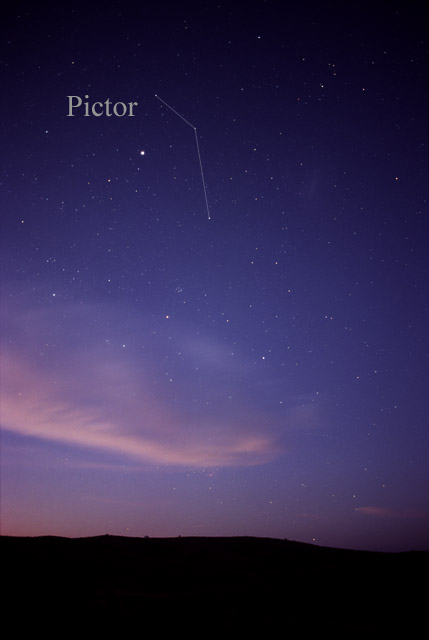
The constellation is best known for its second-brightest star Beta Pictoris, which hosts a debris disk and three exoplanets.[1][2] In 1922, the International Astronomical Union adopted "Pic" as the three-letter abbreviation for Pictor.[3]
Key facts and history
French astronomer Abbé Nicolas-Louis de Lacaille first described Pictor as le Chevalet et la Palette (the easel and palette) in 1756 after observing southern stars from the Cape of Good Hope.[4] Kapteyn's Star, the nearest star in Pictor to Earth, is a red dwarf 12.76 light-years away.[1] NGC 1705 is an irregular dwarf galaxy 17 million light-years from Earth and one of the most active star-forming galaxies in the nearby universe.[5] Lacaille created 14 new constellations in areas of the Southern Celestial Hemisphere that had not been charted, and all but one of these represented instruments from the Age of Enlightenment.[6]
The English astronomer Francis Baily, acting on a suggestion from Sir John Herschel, shortened the name to Pictor in 1845.[4] Every year on 17 March at 9 p.m., Pictor reaches its highest point in the sky; observers south of latitude 26°N can see the entire constellation.[7] Alpha Pictoris, with an apparent magnitude of 3.3, is the constellation's most luminous star.[8]
What the cited sources add
The existence of two super-Earths around Kapteyn's Star, proposed in 2014, was disproven in 2021.[9] The first star found to possess a debris disk was Beta Pictoris, a discovery made in 1984.[2] Using direct imaging and spectral template matching, astronomers discovered Beta Pictoris d, a third planet around Beta Pictoris, in 2026.[2] On 9 June 1925, the cataclysmic variable RR Pictoris erupted as a nova and reached a magnitude of 1.2.[10]
First observed on 29 July 2006, the gamma-ray burst GRB 060729 is thought to be the signature of a type Ic supernova.[11]
References
- Wikipedia, "Pictor" (CC BY-SA 4.0), which cites: Bortle, "A Gaussian Process Regression Reveals No Evidence for Planets Orbiting Kapteyn's Star", The Astronomical Journal, 2021-05-01, p. 230 (original not read by us) en.wikipedia.org
- Wikipedia, "Pictor" (CC BY-SA 4.0), which cites: SIMBAD Beta Pictoris; Zuckerman 2001; Smith Terrile 1984; ; ; .; Lagrange, "Evidence for an additional planet in the β Pictoris system", Nature Astronomy, 19 August 2019, p. 1135–1142; Sutlieff, "Direct Imaging Discovery of Giant Exoplanet <i>β</i> Pictoris d: A Decade-long Game of Hide-and-seek", The Astrophysical Journal Letters, 2026-07-15, p. L10; Gibbs, "Discovery of an Exterior Third Planet Orbiting <i>β</i> Pictoris", The Astrophysical Journal Letters, 2026-07-15, p. L11 (original not read by us) en.wikipedia.org
- Wikipedia, "Pictor" (CC BY-SA 4.0), which cites: Russell 1922, p. 469 (original not read by us) en.wikipedia.org
- Wikipedia, "Pictor" (CC BY-SA 4.0) en.wikipedia.org
- Wikipedia, "Pictor" (CC BY-SA 4.0), which cites: Wilkins Dunn 2006; NED Pictor A; Perley et al. 1997; ChandraPR; Ghosts of the Future (original not read by us) en.wikipedia.org
- Wikipedia, "Pictor" (CC BY-SA 4.0), which cites: Wagman 2003, p. 6–7 (original not read by us) en.wikipedia.org
- Wikipedia, "Pictor" (CC BY-SA 4.0), which cites: The Constellations : Part 2 Culmination Times; Ridpath, Constellations: Lacerta–Vulpecula; Heifetz Tirion 2007, p. 106 (original not read by us) en.wikipedia.org
- Wikipedia, "Pictor" (CC BY-SA 4.0), which cites: Ridpath, Constellations: Lacerta–Vulpecula; SIMBAD Alpha Pictoris; Goldin, "Astrometric Orbits for Hipparcos Stochastic Binaries", The Astrophysical Journal Supplement Series, November 2007, p. 137–142; Gray 2006; Royer 2007; Hempel 2003 (original not read by us) en.wikipedia.org
- Wikipedia, "Pictor" (CC BY-SA 4.0), which cites: Motz Nathanson 1988, p. 374–75; Kotoneva et al. 2005; Bortle, "A Gaussian Process Regression Reveals No Evidence for Planets Orbiting Kapteyn's Star", The Astronomical Journal, 2021-05-01, p. 230; Bortle, "A Gaussian Process Regression Reveals No Evidence for Planets Orbiting Kapteyn's Star", The Astronomical Journal, 2021-05-01, p. 230 (original not read by us) en.wikipedia.org
- Wikipedia, "Pictor" (CC BY-SA 4.0), which cites: Motz Nathanson 1988, p. 374–75; Burham 2013, p. 1460–62 (original not read by us) en.wikipedia.org
- Wikipedia, "Pictor" (CC BY-SA 4.0), which cites: Cano et al. 2011; Grupe et al. 2010; Cano et al. 2011 (original not read by us) en.wikipedia.org
Each numbered sentence above was checked against the source it cites before publication. Sentences citing Wikipedia adapt text from the English Wikipedia article Pictor (contributors), used under CC BY-SA 4.0; this entry is available under the same licence. Other sources were used for facts only; no text or images are copied from them.
More in Constellations
Sources
Compiled from Wikipedia and the sources listed below. Text from Wikipedia is available under CC BY-SA 4.0; this entry is adapted from it.
- Wikipedia: Pictor (CC BY-SA 4.0).
- Word definitions: the Codexery glossary, each quoted from its Wikipedia article.
Spotted an error? Know more?
Reader corrections go straight into our review queue. Suggest an edit · How this site is sourced