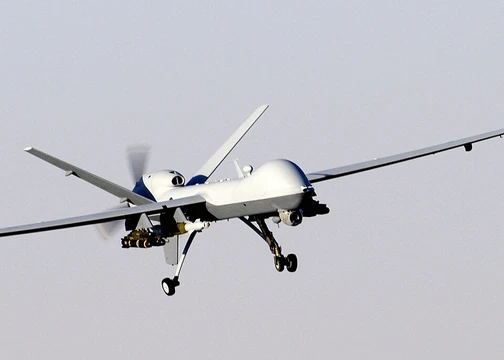
Regulation of UAVs in the United Kingdom
UK drone regulation is enforced by the Civil Aviation Authority.

The regulation of unmanned aerial vehicles (UAVs), commonly known as drones, in the United Kingdom is governed by the Civil Aviation Authority (CAA). The rules have evolved through a series of legislative acts and codes, addressing safety, airspace restrictions, and operator responsibilities.
- First drone code published
- 2015
- Maximum altitude for small unmanned airc
- 400 ft (120 m) above ground level
- Minimum distance from congested area (as
- 150 m
- Minimum distance from a person or vehicl
- 50 m
- Minimum distance from an airport or airf
- 1 km
- Minimum distance from a runway (legislat
- 5 km
- Operator id renewal period
- Annually
- Flyer id renewal period
- Every three years
Lore & Background
The UK's regulation of drones began to take shape in August 2012, when the CAA stated that non-military drones larger than 20 kg would need to automatically sense other aircraft and avoid them. By 2013, the CAA required that UAVs under 20 kg remain in direct visual contact with the pilot, stay at least 150 m from congested areas and 50 m from people or vehicles, and could not be used for commercial activity. In July 2018, the CAA forbade flying above 400 ft and within 1 km of an airport or airfield boundary.
A significant incident occurred between 19 and 21 December 2018, when flights were canceled at Gatwick Airport following reports of drone sightings near the runway. In response, the Department for Transport announced legislation on 20 February 2019 to extend the no-fly zone around airports to 5 km from runways. The Air Traffic Management and Unmanned Aircraft Act 2021 later gave police powers to require landing of unmanned aircraft, issue fixed penalty notices, and conduct stop-and-search for certain offences, as well as placing restrictions near prisons and airports.
The regulatory framework includes the Air Navigation Order 2009, which prohibited flying within 50 m of any vessel, vehicle, or structure not under the individual's control without CAA permission. This was replaced by the Air Navigation Order 2016, which prohibited endangering aircraft or people and, under Article 94, banned small unmanned aircraft over 400 ft above ground for those with a mass of 7 kg. The Air Navigation Order (Amendment) 2018 extended that ban to all small unmanned aircraft via Article 94A and established two categories: the remote pilot (operating flight controls) and the SUA operator (managing the aircraft).
Reader's Guide
The UK's drone regulation is notable for its layered approach, combining historical orders with modern amendments and a three-category operations system. The Open Category covers low-risk, non-commercial flights with key rules including maintaining visual line of sight, staying below 120 m (400 ft), avoiding restricted airspace, and keeping at least 50 m from uninvolved people (30 m during takeoff and landing). Drones over 250 g must be registered, and operators must obtain an Operator ID and Flyer ID after passing an online theory test. The Specific Category applies to higher-risk or commercial operations, such as flights over crowds, dropping objects, operating heavier drones near people, exceeding altitude or range limits, or flying beyond visual line of sight, requiring specific CAA authorization. The Certified Category is for the highest-risk drones, including those over 3 m in span or dimension over crowds, transporting people, or carrying dangerous goods, requiring full CAA certification. The Drone Code, first published in 2015 and updated in 2016, summarizes key regulations with the acronym DRONE. The legacy of these regulations is a structured system that balances safety, privacy, and operational flexibility, shaped by incidents like the Gatwick disruption and evolving technology.
Did You Know?
- Children under 18 cannot obtain an Operator ID but can be registered as flyers under a parent or legal guardian's drone.
- The Air Navigation Order (Amendment) 2018 extended the ban on flying above 400 ft to all small unmanned aircraft, not just those over 7 kg.
- The Drone Code acronym DRONE stands for Don’t fly near airports, Remember to stay below 400 ft, Observe your drone at all times, Never fly near aircraft, and Enjoy responsibly.
- The Air Traffic Management and Unmanned Aircraft Act 2021 gave police stop-and-search powers for certain unmanned aircraft offences.
More in Drone Regulation 1-24
Spotted an error? Know more?
Reader corrections go straight into our review queue. Suggest an edit · How this site is sourced