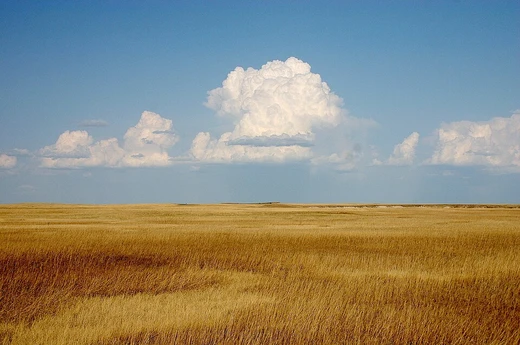
Patagonian Desert
Cold winter desert formed by Andes rain shadow.
The Patagonian Desert, often called the Patagonian Steppe, stretches across southern Argentina and into parts of Chile, making it Argentina’s largest desert and the world’s eighth biggest, covering roughly 673,000 square kilometers (260,000 square miles). Its western edge is marked by the Andes, while the Atlantic Ocean borders it to the east. This desert first appeared during the Middle Miocene, about 14 to 12 million years ago, when the rising Andes created a rain shadow that blocks moisture from the southern Pacific. As a cold winter desert, temperatures here rarely climb above 12 °C, with an average of just 3 °C. To the north, the desert blends into the Cuyo Region and the Monte. The landscape is a mix of tablelands and massifs cut by river valleys and canyons, with shrubby and herbaceous plants dominating the central steppe; toward the west, where more rain falls, grasses take over. Glacial lakes appear in the western parts, which gradually give way to barren mountains or cold temperate forests along valleys. Hunter-gatherers lived here before Spanish contact, but in the 19th century, Argentines, Welsh, and other Europeans migrated in, shifting the area from a contested borderland into an integral part of Argentina, where cattle, sheep, and horse ranching became the main land uses.
The desert’s climate varies by location. North of the 45th parallel, the coast is milder thanks to warm currents from Brazil, and the entire northern half sees hotter summers with sunny weather. Summer highs reach 31 °C near the Río Colorado, 26 °C to 29 °C along the northern coast, and 24 °C to 28 °C on the northern plain, with nights between 12 °C and 15 °C on the coast and 7 °C to 10 °C inland. In the south, summer temperatures drop to 22 °C to 16 °C on the coast and 24 °C to 17 °C in the steppe, with nights from 8 °C to 11 °C along the coast and 6 °C to 10 °C inland. Winter conditions depend on altitude and coastal proximity: northern coastal areas see mild winters with nighttime lows around 2 °C and daytime highs near 11 °C, while southern Santa Cruz ranges from -2 °C to 5 °C, and Tierra del Fuego from -3 °C to 3 °C, averaging 0 °C. Inland, northern low areas range from 0 °C to 10 °C, and plateaus from -5 °C to 5 °C (mean near 0 °C); southern low areas span -3 °C to 4 °C, with higher spots clearly below 0 °C. The coldest recorded temperature is -33.9 °C in Chubut province, though some towns claim readings around -35 °C. Frost can occur even in summer everywhere except the northern coast, and sleet or light snow may fall during the warm season. Winds are constant and strong, mostly from the west, driven by the rain shadow and descending cool mountain air, making the Patagonian a major source of dust over the South Atlantic.
Before the Andes rose, temperate forests likely covered the region. After the mountains formed, volcanic ash buried the forests, and mineral-rich waters seeped into the logs, fossilizing them into one of the world’s best-preserved petrified forests, found in the desert’s center. The landscape today consists mainly of gravel plains and plateaus, with sandstone canyons and clay formations shaped by wind. Ephemeral rivers, lakes, and drainage deposits from Andean spring melt appear annually, supporting waterfowl and aquatic grasses. Glacial, fluvial, and volcanic deposits are common, especially gravel sediments that cover parts of the desert. Volcanic rocks span over 120,000 square kilometers, mainly in the Somún Cura Massif (North Patagonian Massif) and the Deseado Massif, with other areas like the Pali-Aike Volcanic Field near the Strait of Magellan. These rocks come from back-arc volcanism in two main episodes: one during the Eocene and Miocene, and another from the Late Miocene to Pleistocene. On the western side, the desert’s grasslands border the nothofagus forests of the Magellanic subpolar forests. Despite the harsh conditions, various animals live here, with some species found only in the more humid parts.
- area
- approx. 673,000 km² (260,000 mi²)
- location
- primarily Argentina, also Chile
- type
- cold winter desert
- formation
- Middle Miocene (14–12 million years ago)
- average_temperature
- 3 °C
- largest_desert_south_of_40_parallel
- True
- primary_land_uses
- cattle, sheep, horse husbandry
Verified Timeline
Lore & Background
Inhabited by hunter-gatherers since Pre-Hispanic times, the desert faced migration in the 19th century of Argentines, Welsh, and other European peoples, transforming it from a conflictive borderland zone to an integral part of Argentina, with cattle, sheep, and horse husbandry being the primary land uses. The earliest inhabitants of the desert known by name are those of the Tehuelche complex. Tehuelches lived as hunter-gatherers and did not practise agriculture in lush valleys found in the desert. In the 18th and 19th centuries the northern part of the desert came under Mapuche influence during a process of Araucanization. Mapuches came to practise horse husbandry in the northern part of the Patagonian steppe. From the mid-19th century onwards several Argentine and European settlements appeared at the edges of the desert; the most important was established at Chubut River's outflow by Welsh immigrants in 1860. In the 1870s the Argentine army undertook the Conquest of the Desert campaign, massively defeating Mapuche warlords. The Conquest of the Desert was followed by a sharp decline in the indigenous population of the desert; it is estimated that the Conquest of the Desert caused the death of about 1,000 Native Americans. Additionally 10,000 Native Americans were taken prisoner of whom 3,000 ended up in Buenos Aires separated by sexes to avoid their procreation. The boundary treaty of 1881 between Chile and Argentina brought most of the desert under definitive Argentine sovereignty. In the few decades before and after 1900 the less dry parts of the Patagonian steppe experienced a sheep farming boom, transforming the region into one of the world's greatest exporters of ovine products.
Reader's Guide
The Patagonian Desert is the largest desert south of the 40° parallel and is a large cold winter desert, where the temperature rarely exceeds 12 °C and averages just 3 °C. The region experiences about seven months of winter and five months of summer. Frost is not uncommon but, due to the very dry condition year round, snow is rare. The Andes, to the desert's west, are the primary reason for the Patagonian desert status as they inhibit the westerly flow of moisture from the southern Pacific from reaching inland, creating a rain shadow. The cold Falkland Current off the Atlantic coast also contributes to the area's aridity. Different climates can be distinguished: the coast north of the 45th parallel is much milder because of warm currents from Brazil. Daily temperatures in the summer reach 31 °C in the Rio Colorado region, a general 26 °C to 29 °C in the northern coast, and 24 °C to 28 °C in the northern plain. In the south, summer temperatures decrease from 22 °C to only 16 °C along the coast, and from 24 °C to 17 °C along the steppes. During the winter, northern coastal areas have mild winters from 2 °C at night to about 11 °C during the day, while southern Santa Cruz ranges from -2 °C to 5 °C, and Tierra del Fuego from -3 °C to 3 °C. The coldest spots usually register temperatures between -20 °C and -25 °C during cold waves, and the official record is -33.9 °C in Chubut province. Winds are constant and very strong, from the west in most cases. The desert is quite windy, a result of the rain shadow effect and descending cool mountain air, making it one of the largest sources of dust over the South Atlantic Ocean. Volcanic rocks cover more than 120,000 km2 of the Patagonian Desert, mainly in the Somún Cura Massif and the Deseado Massif. A 2017 assessment found that 70,970 km2, or 12%, of the ecoregion is in protected areas, including Bosques Petrificados de Jaramillo National Park, Los Glaciares National Park, and Monte León National Park.
Did You Know?
- The Patagonian Desert is the largest desert south of the 40° parallel.
- The official cold record is -33.9 °C in Chubut province.
- Volcanic rocks cover more than 120,000 km2 of the desert, mainly in the Somún Cura Massif and the Deseado Massif.
- The Conquest of the Desert campaign in the 1870s caused the death of about 1,000 Native Americans and took 10,000 prisoners.
- The desert is one of the largest sources of dust over the South Atlantic Ocean.
More in Desert Landscapes 1-18
Spotted an error? Know more?
This is a living reference — every entry is fact-audited, and reader corrections feed straight into our audit queue. Suggest an edit · See this site's audit record