
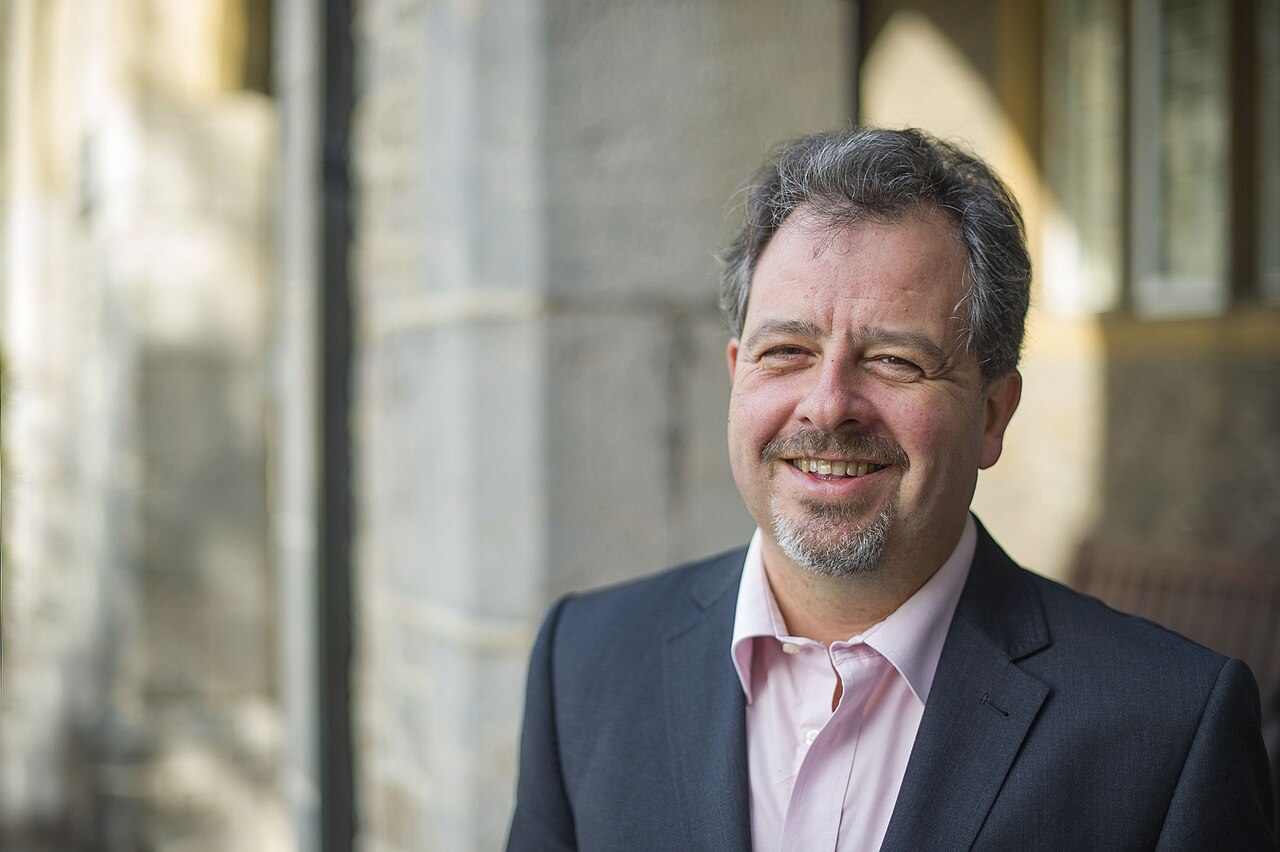
Clive Ballard
British dementia expert; led PROTECT and antipsychotic reduction trials.

Jh790 · CC BY-SA 4.0
Clive Ballard (born August 1964) is a British dementia specialist. He holds the position of professor of age-related diseases at the University of Exeter and serves as Pro-Vice-Chancellor and Executive Dean of the University of Exeter Medical School. His research focuses on treating dementia with Lewy bodies and Parkinson’s disease, the risks of antipsychotic drugs for people with dementia, non-drug approaches to managing agitation, and dementia prevention—including the PROTECT programme, an online tool for preserving cognitive health in later life. He has authored over 600 scientific papers, with an H index above 115 and more than 55,000 citations.
Ballard was born in Wales in August 1964. He studied medicine at the University of Leicester, graduating in 1987, then trained in psychiatry at the University of Birmingham, earning an MD in neuropsychiatric symptoms in dementia in 1991. He later specialised in old-age psychiatry. In 1995, he moved to Newcastle as an MRC clinical fellow and senior lecturer, joining a research group on dementia with Lewy bodies.
In 2003, Ballard became Professor of Age-Related Diseases at King’s College London’s Institute of Psychiatry. There, he directed the NIHR Biomedical Research Unit for Dementia and co-directed the Wolfson Centre for Age-Related Diseases. From 2003 to 2013, he also served as director of research at the Alzheimer’s Society, helping lead a successful campaign to reverse a NICE decision, thereby making anti-dementia drugs available. During this period, he published over 200 papers on clinical trials for dementia with Lewy bodies, dementia in people with Down’s syndrome, vascular dementia, and neuropsychiatric symptoms. In November 2016, he joined the University of Exeter Medical School as Pro-Vice-Chancellor and Executive Dean.
In 2006, Ballard contributed to developing a non-pharmacological training programme to improve person-centred care in nursing homes. This work led to a 50% reduction in antipsychotic use without worsening neuropsychiatric symptoms. Partnering with the Alzheimer’s Society, the programme was turned into an intervention manual and implemented in 500 UK care homes.
Ballard worked with *The Lancet* to identify key targets for dementia prevention. This group created an online platform for large randomised controlled trials of prevention interventions. With the MRC, Alzheimer’s Society
- born
- August 1964
- field
- Dementia research, psychiatry
- nationality
- British
- known_for
- Treatment of dementia with Lewy bodies, antipsychotic harms, PROTECT programme, non-pharmacological agitation management
Quick Facts
- Birth Date
- August 1964
- Education
- University of Leicester
- Occupation
- Pro-Vice Chancellor and Executive Dean
- Employer
- University of Exeter
- Title
- Professor of Age-Related Diseases
Facts from the source article.
Lore & Background
Clive Ballard was born in August 1964 in Wales. He studied medicine at the University of Leicester in 1987, then psychiatry at the University of Birmingham in 1991, earning an MD in neuropsychiatric symptoms in dementia. He moved to Newcastle in 1995 as an MRC clinical fellow and senior lecturer, joining the dementia with Lewy bodies research group.
In 2003, Ballard became Professor of Age-Related Diseases at the Institute of Psychiatry, King's College London, where he directed the NIHR Biomedical Research Unit for Dementia and co-directed the Wolfson Centre for Age-Related Diseases. From 2003 to 2013, he was also director of research at Alzheimer's Society, playing a key role in a campaign that overturned a NICE decision, making anti-dementia drugs available. In November 2016, he joined the University of Exeter Medical School as Pro-Vice-Chancellor and Executive Dean.
Reader's Guide
Clive Ballard's significance lies in his contributions to dementia care, particularly in reducing antipsychotic use through non-pharmacological interventions and advancing understanding of dementia with Lewy bodies. His work on the PROTECT platform has enabled large-scale online trials for dementia prevention, and his involvement in the Lancet commission helped identify key prevention targets. His research has influenced clinical practice, especially in nursing homes, and his advocacy with the Alzheimer's Society changed UK drug access policies. With over 600 papers and an H-index over 115, his legacy is in translating research into practical, scalable interventions for cognitive health.
Did You Know?
- Ballard's person-centred care training led to a 50% reduction in antipsychotic use in nursing homes.
- He co-developed the PROTECT online platform, which has more than 25,000 UK participants.
- He played a key role in overturning a NICE decision to make anti-dementia drugs available in the UK.
- Ballard was elected a Fellow of the Academy of Medical Sciences in 2015.
From Welsh Roots to the Front Line of Dementia Research
Clive Ballard was born in Wales in August 1964 and went on to study medicine at the University of Leicester, graduating in 1987. He then pursued psychiatry at the University of Birmingham, where he completed his MD with a focus on neuropsychiatric symptoms in dementia and developed a lasting specialisation in the psychiatry of older adults. A 1995 move to Newcastle placed him in the MRC-funded dementia with Lewy Bodies research group as a clinical fellow and senior lecturer, sharpening his focus on one of the condition's most diagnostically complex variants. In 2003 he took up the chair of Age-Related Diseases at the Institute of Psychiatry, King's College London, where he directed the NIHR and BMRU Unit for Dementia and co-directed the Wolfson Centre. Simultaneously, he served as director of research at the Alzheimer's Society until 2013, playing a key role in a successful campaign to overturn a NICE decision and make anti-dementia drugs more widely available. In November 2016 he joined the University of Exeter Medical School as Pro-Vice Chancellor and Executive Dean, a role he continues to hold alongside his professorship in age-related diseases and his current position as interim deputy pro-vice-chancellor and dean.
Reducing Antipsychotics: A Person-Centred Revolution in Care
One of Ballard's most consequential contributions to dementia care emerged from a 2006 investigation into non-pharmacological training for person-centred care in nursing homes. The study demonstrated that structured staff training, combined with person-centred activities, could cut antipsychotic use by half without any deterioration in the neuropsychiatric symptoms that often drive such prescriptions. Working in partnership with the Alzheimer's Society, Ballard and his team translated the findings into a practical intervention manual that has since been rolled out across 500 care homes in the UK. This work sits within a broader research agenda examining the harms of antipsychotic medications in people living with dementia, including the long-term follow-up of the DART-AD randomised trial and a BMJ cluster-randomised trial showing that treating pain can reduce behavioural disturbances in nursing home residents. His 2007 New England Journal of Medicine paper on donepezil for agitation in Alzheimer's disease further underscored the need to question default pharmacological responses, helping shift the clinical conversation toward non-drug strategies as first-line approaches.
Prevention and the PROTECT Platform
Ballard has been a driving force in the push to shift dementia research from treatment toward prevention. Working alongside The Lancet, he helped identify the most important modifiable targets for dementia prevention interventions. That collaboration also produced an online platform designed to facilitate large randomised controlled trials of potential prevention strategies. In parallel, Ballard partnered with the Medical Research Council, the Alzheimer's Society, and the BBC to run UK-wide trials promoting cognitive health in adults over fifty, including a landmark Nature paper that put popular brain-training games to rigorous scientific scrutiny. His most ambitious prevention project is the PROTECT platform, an online cohort study now adopted as part of Dementia Platform UK. PROTECT conducts nested clinical trials and provides evidence-based cognitive training to every participant. The platform has attracted more than 25,000 participants in the UK and has since been launched in the United States, extending Ballard's prevention agenda onto an international stage.
A Prolific Output and National Recognition
The sheer volume and breadth of Ballard's scientific output is remarkable. He has published more than 600 peer-reviewed papers, accumulated an H-index exceeding 115, and garnered over 55,000 citations for his work. His publications span some of the most prestigious journals in medicine and neuroscience, including multiple papers in The Lancet, The Lancet Neurology, the New England Journal of Medicine, Nature, and BMJ. Among his most cited contributions are the third DLB Consortium report on diagnosing and managing dementia with Lewy bodies, phase 2 and phase 3 trials of pimavanserin for psychosis in Alzheimer's and Parkinson's disease, the MEADOWS trial examining memantine in adults with Down's syndrome, and the HTA-SADD trial comparing sertraline and mirtazapine for depression in dementia. His 2011 Lancet review of Alzheimer's disease and his Nature Reviews Neuroscience paper on the benefits and harms of neuroleptic drugs in dementia have become standard references in the field. In 2015, his standing in the scientific community was formally recognised when he was elected a Fellow of the Academy of Medical Sciences.
Gallery
Frequently Asked Questions
Who is Clive Ballard?
Clive Ballard is a British psychiatrist and ageing researcher born in August 1964. He is based at the University of Exeter, where he holds a professorship in age-related diseases and also serves as Pro-Vice-Chancellor and Executive Dean of the medical school.
What research areas is Clive Ballard most associated with?
His work centres on improving care for people with dementia with Lewy bodies and Parkinson's disease, as well as identifying safer alternatives to antipsychotic medication for agitated patients. He has also championed non-drug strategies for behavioural symptoms and broader dementia-prevention efforts.
What is the PROTECT programme?
PROTECT is an online cognitive-health tool that Ballard developed to help people preserve their mental sharpness as they grow older. It represents one of his most visible contributions to dementia prevention outside the clinical setting.
How many publications has Clive Ballard produced?
He has authored more than 600 scientific papers across his career, spanning psychiatry, neurology, and public-health policy related to ageing and cognitive decline.
Why is Clive Ballard's antipsychotic research considered important?
His trials showed that antipsychotic drugs carry serious safety risks for people living with dementia, pushing the field toward reducing unnecessary prescriptions. This evidence has directly shaped clinical guidelines and patient-safety standards.
More in Dementia 1-24
Spotted an error? Know more?
This is a living reference — every entry is fact-audited, and reader corrections feed straight into our audit queue. Suggest an edit · See this site's audit record