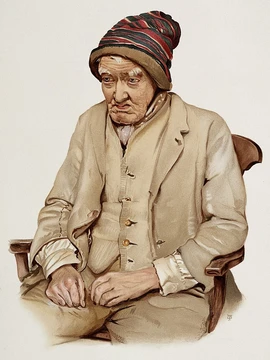
Anosognosia
A deficit of self-awareness regarding one's own disability.

Anosognosia is a neuropsychiatric condition in which a person with a disability is cognitively unaware of having it due to physiological damage to brain structures, typically to the parietal lobe or a diffuse lesion on the fronto-temporal-parietal area in the right hemisphere. It is one of several types of agnosia and is considered a disorder that makes treatment more difficult, as it may negatively affect the therapeutic relationship.
- coined_by
- Joseph Babinski
- year_coined
- 1914
- field
- Neurology, Neuropsychiatry
- type
- Neuropsychiatric disorder
- related_conditions
- Asomatognosia, unilateral neglect, receptive aphasia
- common_causes
- Stroke, traumatic brain injury
Quick Facts
- Specialty
- Psychiatry, Neurology
- Pronounce
- æ · ˌ · n · ɒ · s · ɒ · g · ˈ · n · oʊ · z · i · ə, æ · ˌ · n · ɒ · s · ɒ · g · ˈ · n · oʊ · ʒ · ə
Facts from the source article.
Lore & Background
The term anosognosia was coined by neurologist Joseph Babinski in 1914 to describe the unawareness of hemiplegia. The name derives from Ancient Greek: ἀ- (a-, 'without'), νόσος (nosos, 'disease'), and γνῶσις (gnōsis, 'knowledge'). Phenomenologically, it has similarities to denial, a psychological defense mechanism, and attempts have been made at a unified explanation. Anosognosia results from physiological damage to brain structures, typically to the parietal lobe or a diffuse lesion on the fronto-temporal-parietal area in the right hemisphere.
Reader's Guide
Anosognosia is significant because it impairs a patient's desire to seek medical aid and rehabilitation, making neurorehabilitation difficult. It is relatively common after stroke and traumatic brain injury; for example, anosognosia for hemiparesis with onset of acute stroke is estimated at between 10% and 18%. The condition can be selective, with an affected person seeming unaware of only one handicap while fully aware of others. No long-term treatments exist, though caloric reflex testing can temporarily ameliorate unawareness. Most cases appear to disappear over time, while others can last indefinitely. The condition highlights the complex relationship between brain damage, self-awareness, and the monitoring of specific physical or cognitive functions.
Did You Know?
- Anosognosia is sometimes accompanied by asomatognosia, a form of neglect in which patients deny ownership of body parts such as their limbs.
- Vestibular stimulation can temporarily improve both spatial unilateral neglect and anosognosia for left hemiplegia.
- The term was coined by neurologist Joseph Babinski in 1914.
- Anosognosia for hemiparesis with onset of acute stroke is estimated at between 10% and 18%.
Origins & Naming
Anosognosia entered the medical lexicon in 1914 when neurologist Joseph Babinski introduced the term to capture a puzzling clinical observation: patients who had lost the use of one side of their body simply did not register that the loss had occurred. The term is built from three Ancient Greek roots: the negative prefix a- (signifying absence), nosos (disease), and gnōsis (knowledge), together conveying a mind that lacks recognition of its own affliction. Babinski's original focus was on hemiplegia, but the concept has since broadened to encompass a wider family of agnosias, all rooted in a fundamental deficit of self-awareness. Crucially, the condition is not psychological in origin; it is a neuropsychiatric disorder produced by physiological damage to specific brain structures. The most commonly implicated sites are the parietal lobe or a more diffuse lesion spanning the fronto-temporal-parietal region of the right cerebral hemisphere, underscoring that anosognosia is, at its core, a problem of damaged neural circuitry rather than willful ignorance.
Neurological Underpinnings & Selectivity
Modern research treats anosognosia not as a single deficit but as a multi-componential syndrome capable of masking a wide range of specific impairments—motor weakness, sensory loss, spatial neglect, memory decline, and even receptive language breakdown. Each of these may correspond to damage in anatomo-functionally discrete monitoring systems within the brain. The condition is relatively common after stroke and traumatic brain injury; for instance, acute stroke patients show anosognosia for hemiparesis in roughly ten to eighteen percent of cases. It tends to be more prominent during the acute phase and more frequently observed with right-hemisphere lesions than left. Importantly, the mechanism does not appear to stem from simple sensory loss but from disruption of higher-order neurocognitive processes that integrate sensory input with spatial and bodily representations. A striking feature is selectivity: a patient may be completely unaware of a paralyzed arm while retaining full awareness of a co-occurring visual field cut, a pattern known as double dissociation. This suggests that brain injury can target the self-monitoring module for one specific function without affecting others. Some studies have even shown that vestibular stimulation can temporarily alleviate both unilateral neglect and anosognosia for left-sided weakness, hinting at a shared spatial component in the underlying neural mechanism.
Clinical Assessment & the Awareness Gap
Evaluating anosognosia in the clinic presents a persistent methodological challenge. The standard approach involves administering a questionnaire designed to probe a patient's metacognitive knowledge of their deficits. However, neither of the two existing instruments was constructed to capture the full multidimensional complexity of the phenomenon, and the responses gathered through such offline self-report tools often fail to reveal the true gap in awareness. The discrepancy becomes apparent only when clinicians move to online task performance: a patient who calmly denies any problem on paper may, when asked to execute a bimanual activity, suddenly offer excuses or engage in verbal circumlocution to avoid using the affected limb. The same pattern emerges in patients with cognitive deficits following traumatic brain injury, where monitoring errors in memory and attention tasks exposes an emergent awareness that the questionnaire never surfaced. In some presentations, anosognosia is accompanied by asomatognosia, a form of neglect in which the patient outright denies ownership of a body part such as a limb, further complicating the clinical picture and the clinician's ability to establish a therapeutic rapport.
Therapeutic Complications & Broader Applications
Perhaps the most consequential clinical implication of anosognosia is the way it undermines the therapeutic relationship. Because the patient genuinely does not perceive the deficit, standard rehabilitation strategies that rely on motivation and self-correction are significantly hampered. Phenomenologically, the condition can resemble denial—a psychological defense mechanism—and researchers have attempted to build unified explanations bridging the two, though the neurological substrate of anosognosia clearly distinguishes it from purely psychological processes. The term has also been extended beyond brain-injury contexts: it is occasionally applied to describe the lack of insight seen in some individuals with anorexia nervosa, and evidence links anosognosia in schizophrenia to frontal lobe damage. In the domain of language, anosognosia can manifest within receptive aphasia, where damage to the posterior superior temporal gyrus distorts internal representations of word sounds, leaving patients unable to detect their own phonetic errors. Such patients may express frustration and anger at conversational partners who fail to understand them, a reaction that reflects a genuine monitoring failure rather than simple inattention to the problem.
Frequently Asked Questions
Who is Anosognosia?
Anosognosia is a neuropsychiatric disorder first named by neurologist Joseph Babinski in 1914. It describes a state in which a person with a cognitive or physical impairment is completely unaware that the impairment exists.
What are Anosognosia's powers or role?
It functions as a deficit of self-awareness about one's own disability, typically arising from damage to the parietal lobe or a diffuse lesion spanning the fronto-temporal-parietal region of the right hemisphere. It is classified as one of several subtypes of agnosia.
How does Anosognosia's story end?
Because the affected individual cannot recognize their own deficit, the condition makes therapeutic engagement and treatment delivery markedly more difficult. It can also strain the working relationship between the patient and their care team.
Why is Anosognosia important?
It sits at the crossroads of neurology and neuropsychiatry and is closely linked to related conditions such as asomatognosia, unilateral neglect, and receptive aphasia. Recognizing it helps clinicians understand why a patient may resist interventions they objectively need.
What caused Anosognosia?
The most common triggers are stroke and traumatic brain injury, both of which can produce the specific right-hemisphere or parietal damage that gives rise to the condition.
More in Dementia 1-24
Spotted an error? Know more?
This is a living reference — every entry is fact-audited, and reader corrections feed straight into our audit queue. Suggest an edit · See this site's audit record