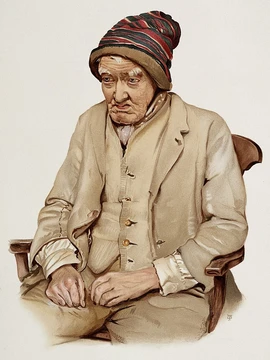
Art and dementia
Art enriches lives of people with dementia through creative expression.

1597 artist · Public domain
Art and dementia refers to the use of visual and performing arts as a non-pharmaceutical approach to enrich the lives of people with dementia. Engagement with the arts provides opportunities for creative expression, access to memories and emotions, and can help alleviate anxiety and confusion for both individuals with dementia and their caregivers.
- field
- Dementia care and art therapy
- known_for
- Using visual and performing arts to improve quality of life for people with dementia
- benefits
- Reduces anxiety, facilitates social connection, creates new memories, enables communication
Lore & Background
Art therapy often involves creating works of art through painting or sculpting, but may also involve viewing art. Some people with dementia experience a boost in creativity, especially in visual arts, which can serve as a tool for communication and self-expression, fostering new strength and self-confidence. Guidelines for art therapy include providing encouragement, being patient, offering basic guidance, avoiding toxic substances, and avoiding projects that feel too childish or demeaning.
Reader's Guide
The significance of art in dementia care lies in its ability to provide a non-pharmaceutical approach that helps alleviate anxiety and confusion, offering respite for individuals and caregivers. Engagement with the arts is a positive way to maintain or improve quality of life. Neurocognitive benefits include increasing neural connections in the hippocampus and amygdala, strengthening communication between neurons, and activating sensory regions in the brain. Art therapy has been associated with positive changes in auditory comprehension, visual attention, speech, and executive function. The documentary film 'I Remember Better When I Paint' highlights how creative arts bypass the limitations of dementias such as Alzheimer's disease, strengthening patients' still-vibrant imaginations. As the number of Canadians living with dementia was expected to rise from about half a million in 2009 to 1 million by 2030, the arts offer a valuable tool for enriching lives while scientists continue to seek a cure.
Did You Know?
- Engagement with the arts can help access long-term or short-term memories, emotions, self-exploration, thoughts, dreams, and hopes.
- Music therapy can provide access to an otherwise-unreachable personal history and identity.
- Art therapy may increase neural connections in the hippocampus and amygdala, which play roles in memory and emotion processing.
- The documentary film 'I Remember Better When I Paint' examines how creative arts bypass the limitations of dementias such as Alzheimer's disease.
A Director's Unlikely Debut
Francis Ford Coppola was not a director when Roger Corman handed him the keys to Dementia 13. He had been working as a sound technician on Corman's racing picture The Young Racers, a film shot across multiple countries. When production wrapped in Ireland, Corman still had roughly $22,000 of the original $165,000 budget unspent. Rather than direct a quick follow-up himself, the producer suggested Coppola stay behind with a small crew and helm a low-budget horror film. Corman's brief was blunt: he wanted a cheap Psycho, gothic and psychological, with a brutal knife-killing scene. Coppola later recalled writing the script to order. He sketched a brief story in a single night, then pitched Corman the most vivid sequence he could conjure—a half-naked woman tying dolls to the bottom of a lake before surfacing into an axe murder. Corman was so impressed he immediately released the full $22,000. Coppola then quietly arranged another $20,000 by pre-selling European rights to a producer named Raymond Stross, never telling Corman about the extra funding. In a telling move, he transferred the initial $22,000 into a personal bank account, just in case the producer ever tried to claw it back.
Gothic Mystery and the Castle
The narrative unfolds as a slow-burn gothic mystery set in an Irish castle. John Haloran dies of a heart attack while rowing on a dark lake, and his young wife Louise, desperate to secure a fortune left to charity in the name of a dead sister called Kathleen, dumps his body into the water. She writes a letter to her mother-in-law, Lady Haloran, inviting herself to the family castle while her supposedly absent husband is away. Once there, Louise witnesses a yearly tribute ceremony for Kathleen, during which Lady Haloran faints as she does every year. Sensing the old woman's superstition, Louise engineers a ghostly display by stealing Kathleen's toys and sinking them in the estate pond. But when she dives beneath the surface, she glimpses what looks like a perfectly preserved corpse. She surfaces to be struck down by an axe-wielding assailant. Family doctor Justin Caleb takes up the investigation, draining the pond to reveal a shrine inscribed with the words Forgive Me, Kathleen. Under hypnosis, a brother recites a nursery rhyme that leads Caleb to Louise's frozen body in a meat locker beside a wax figure of Kathleen. The killer, it transpires, is Billy, driven mad by guilt over inadvertently causing Kathleen's death years earlier.
The Corman-Coppola Schism and the 2017 Restoration
Despite being granted full creative control during shooting, Coppola found himself in a bitter standoff with Corman once the footage was delivered. The producer declared the finished film unreleasable and demanded a series of alterations, including additional scenes shot by directors Jack Hill and Monte Hellman. The version that reached American audiences through American International Pictures in the fall of 1963 bore Corman's fingerprints rather than Coppola's. For decades, the director's original vision remained locked away. That changed in 2017, when Coppola's production company American Zoetrope undertook a full restoration of the director's cut. The project was supervised by James T. Mockoski, with editing handled by Robert Schafer, sound restoration by Jim McKee of Earwax Productions, and color supervision by Chris Martin of Mission Film and Design. The restored version finally allowed audiences to experience the film as Coppola intended. Because the original 1963 release was never properly copyrighted, Dementia 13 sits in the public domain, a curious legal status that has kept the picture circulating in home-video and streaming formats long after its initial theatrical run.
A Footnote in 1960s Horror
Dementia 13 occupies a peculiar niche in both Coppola's career and the broader landscape of 1960s American horror. For the young filmmaker, it marked his first mainstream, legitimate directorial effort, following earlier involvement in at least two sexploitation pictures. The film was released in the United States as the bottom half of a double feature paired with Corman's X: The Man with the X-ray Eyes, a pairing that underscored its B-movie pedigree. In the United Kingdom, audiences encountered it under the more evocative title The Haunted and the Hunted. The cast included William Campbell, Luana Anders, Bart Patton, Mary Mitchel, Eithne Dunne, and Patrick Magee, with Campbell and Magee having previously appeared together in Corman's The Young Racers. The screenplay, co-written with Coppola's friend Al Locatelli, who also served as art director and went uncredited, was completed in just three days. That compressed timeline left its mark: the dialogue has been described as stilted and unrealistic, a byproduct of the breakneck writing schedule. Yet the film's gothic atmosphere, its lake-and-castle setting, and its axe-driven violence gave it a distinctive texture that set it apart from the typical low-budget product of the era.
Gallery

Frequently Asked Questions
What is 'art and dementia'?
It is a field in dementia care that uses visual and performing arts as a non-pharmaceutical way to enrich the daily lives of people living with dementia. Rather than relying on medication, it centers on creative engagement to support emotional and social well-being.
How does art engagement actually help someone with dementia?
It opens a channel for creative expression and gives access to stored memories and emotions that might otherwise feel out of reach. It also helps ease anxiety and confusion for both the person with dementia and the people caring for them.
What kinds of art are involved in this approach?
The scope covers both visual arts—such as painting or drawing—and performing arts like music, dance, or theater. The specific medium matters less than the opportunity for active, expressive participation.
Who benefits from art-based dementia activities?
The person living with dementia gains social connection, a means of communication, and the chance to form new memories. Caregivers also experience reduced stress and a shared point of engagement that eases the daily strain of care.
Why is art considered important in dementia care?
It addresses needs that medication alone cannot meet, such as fostering social bonds, enabling non-verbal communication, and creating moments of genuine joy. It is recognized as a meaningful complement to other forms of support in the broader dementia-care landscape.
More in Dementia 1-24
Spotted an error? Know more?
This is a living reference — every entry is fact-audited, and reader corrections feed straight into our audit queue. Suggest an edit · See this site's audit record