Bearing (mechanical)
Machine element that reduces friction and constrains motion.

Nadinviki · CC BY-SA 4.0
A bearing is a mechanical component designed to limit movement between parts to only what is intended, while also cutting down on friction. How a bearing is built can allow for free linear motion, free rotation around a fixed axis, or even prevent motion by managing the forces acting on the parts. Most bearings work by reducing friction to enable the desired movement. They are generally grouped by how they operate, what motions they permit, or the direction of the loads they handle.
The word "bearing" comes from the verb "to bear," since a bearing lets one part support another. The most basic bearings are simply surfaces cut or shaped into a part, with some control over their form, size, smoothness, and position. Other bearings are separate parts installed into a machine. The most advanced bearings, used in demanding applications, are highly precise components that require some of the best manufacturing technology available.
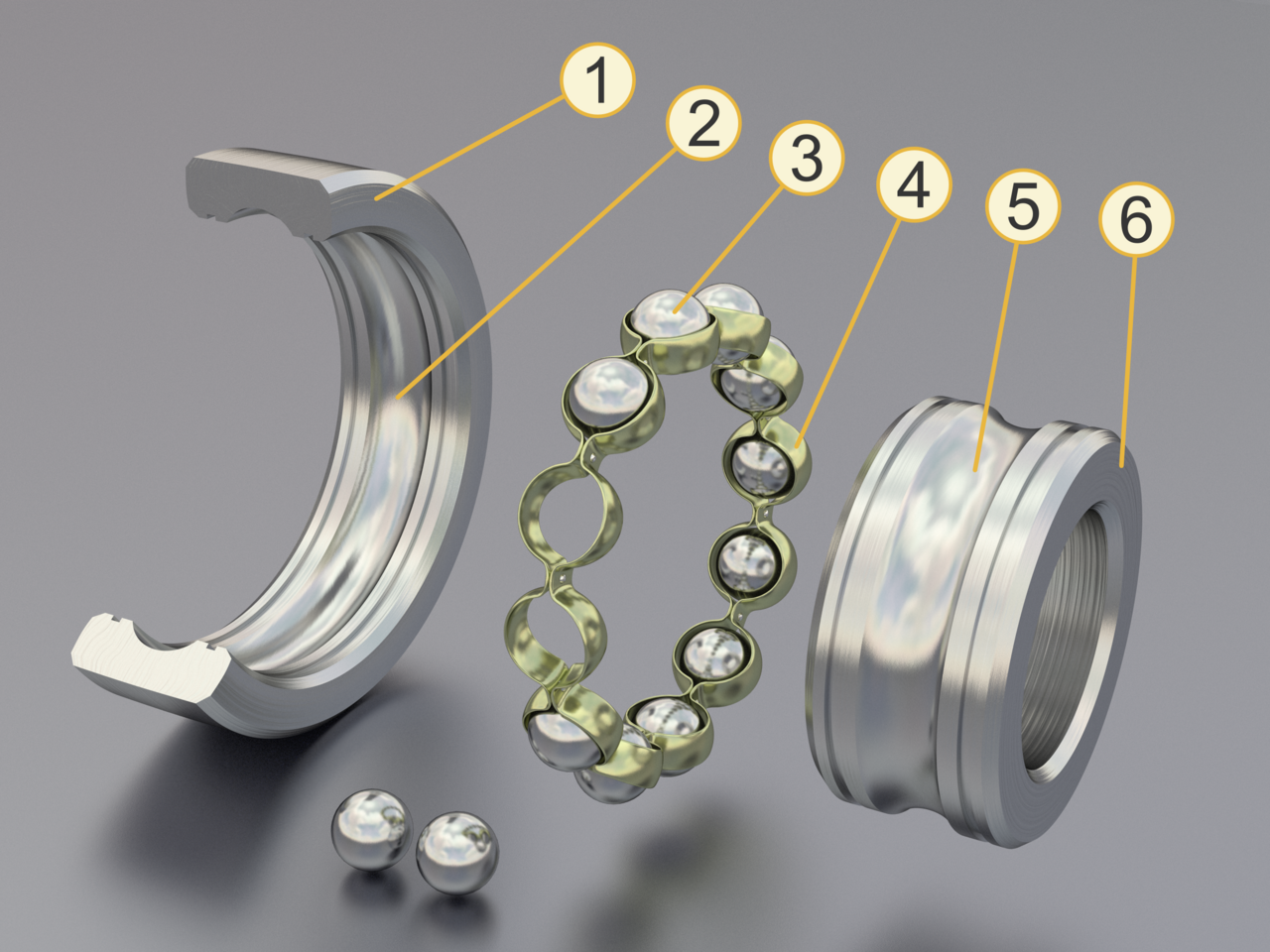
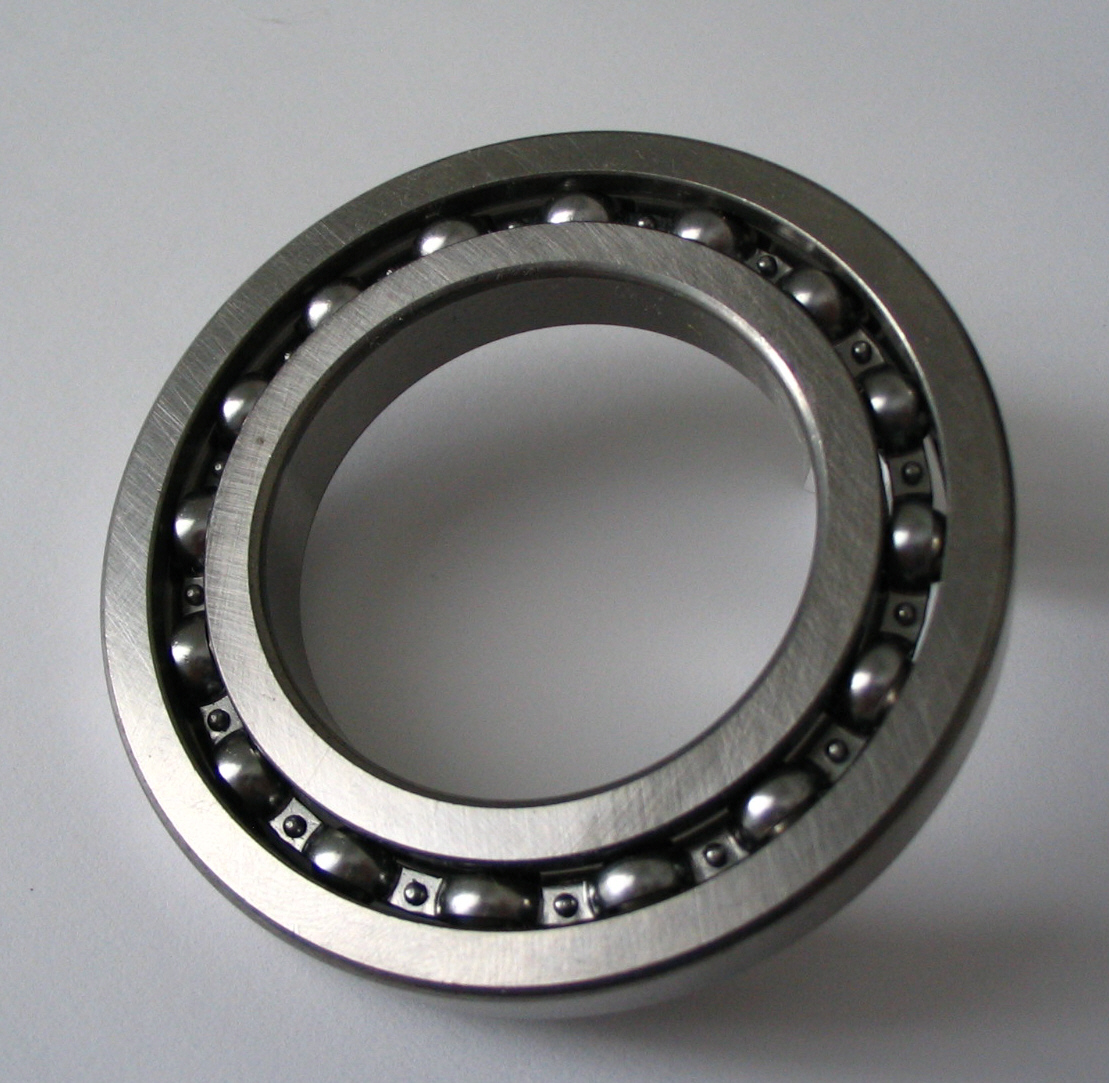
Rotary bearings hold rotating parts like shafts or axles in mechanical systems and transfer axial and radial loads from the source to the supporting structure. The simplest type, the plain bearing, is just a shaft turning inside a hole. Lubrication reduces friction here, and lubricants can be liquids, solids, or gases, chosen based on factors like temperature, load, and speed. In ball and roller bearings, rolling elements with a circular cross-section sit between the races or journals to reduce sliding friction. Many bearing designs exist to meet specific needs for efficiency, reliability, durability, and performance.
It is sometimes thought that rolling bearings—wooden rollers under a moving object—came before the wheel on a plain bearing, leading to speculation that ancient cultures like the Egyptians used tree-trunk rollers under sleds. There is no archaeological proof for this sequence. Egyptian drawings in the tomb of Djehutihotep appear to show massive stone blocks moved not on rollers but on sledges pulled over sand that was wetted to make it stickier and reduce friction. Other Egyptian drawings show plain bearings used to support the far end of hand drills. Wheeled vehicles with plain bearings appeared between about 5000 BC and 3000 BC.
A recovered early rolling-element bearing is a wooden ball bearing supporting a rotating table from the Roman Nemi ships in Lake Nemi, Italy, dated to 40 BC. Around 1500, Leonardo da Vinci included drawings of ball bearings in his helicopter design, the first recorded use of bearings in aerospace. However, Agostino Ramelli was the first to publish sketches of roller and thrust bearings. A problem with ball and roller bearings was that the balls or rollers rubbed against each other, adding friction. This was reduced by enclosing each ball or roller in a cage. Galileo described the caged ball bearing in the 17th century.
The first practical caged-roller bearing was invented in the mid-1740s by clockmaker John Harrison for his H3 marine timekeeper. In that device, the caged bearing only handled a limited oscillating motion, but Harrison later used a similar design for true rotation in a regulator clock. The first patent on ball bearings went to Welsh inventor Philip Vaughan in 1794. His design was the first modern one, with the ball running in a groove in the axle assembly. Bearings were crucial to the Industrial Revolution, helping new industrial machinery run efficiently—for instance, they greatly reduced friction in wheel and axle assemblies compared to earlier designs.
The first patent for a radial-style ball bearing was awarded to Parisian bicycle mechanic Jules Suriray on 3 August 1869. These bearings were fitted to the winning bicycle ridden by James Moore in the world's first bicycle road race, Paris-Rouen, in November 1869. In 1883, Friedrich Fischer, founder of FAG, developed a machine for milling and grinding balls of equal size and exact roundness, which paved the way for an independent bearing industry. His hometown of Schweinfurt later became a world-leading center for ball bearing production. The modern self-aligning ball bearing is credited to Sven Wingquist of SKF, who received Swedish patent No. 25406 in 1907. Henry Timken, a carriage manufacturing innovator, patented the tapered roller bearing in 1898 and formed a company the next year to produce it. Over a century, that company grew to make all types of bearings, including specialty steel bearings and related products. Erich Franke invented and patented the wire race bearing in 1934, focusing on a design with a very small cross-section that could be integrated into the surrounding structure. After World War II, he and Gerhard Heydrich founded Franke & Heydrich KG (now Franke GmbH) to develop and produce wire race bearings.
- field
- Mechanical engineering
- known_for
- Reducing friction between moving parts and enabling desired motion in machinery
- common_types
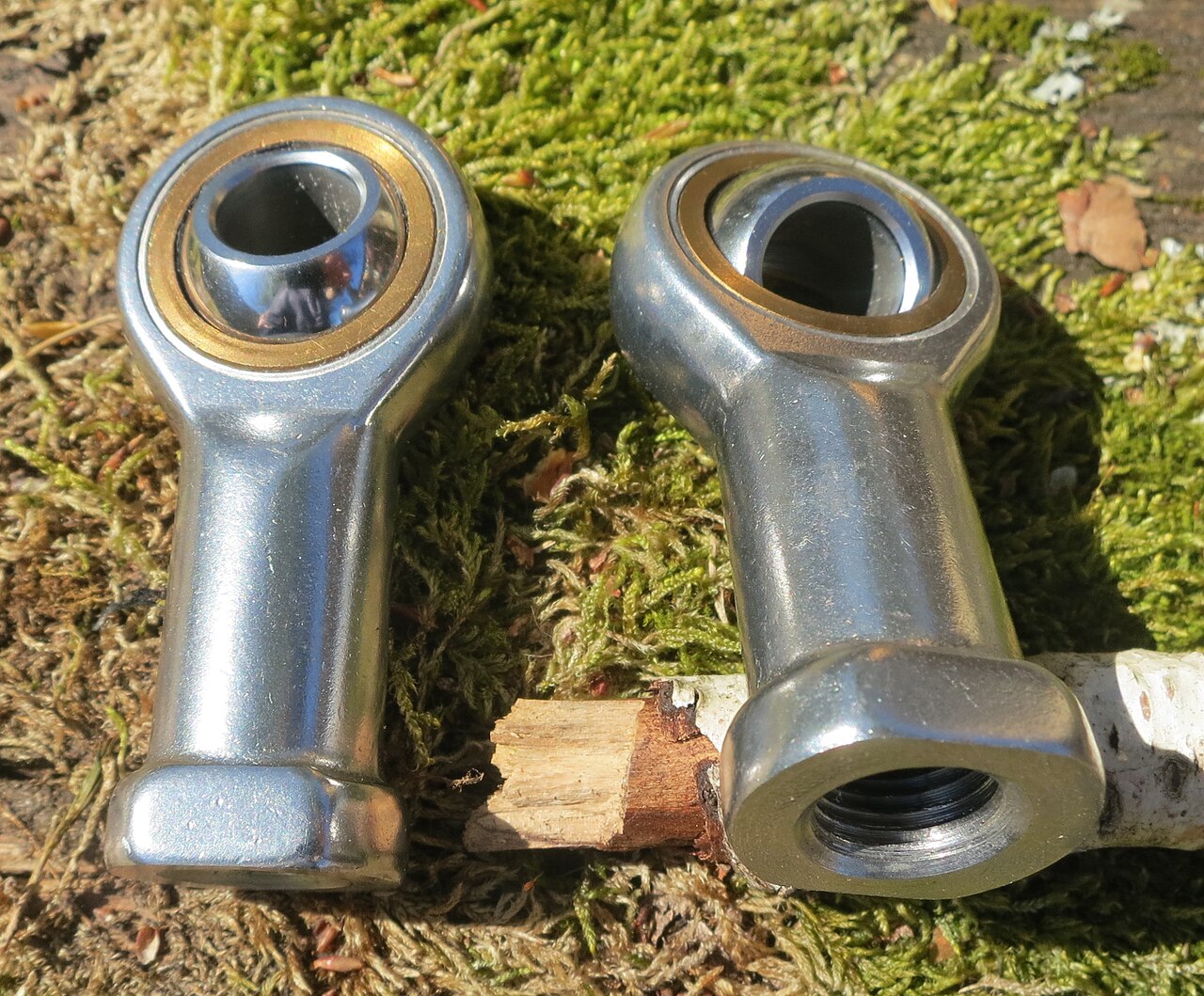
- Plain bearing, ball bearing, roller bearing, tapered roller bearing, wire race bearing, vee groove bearing
Lore & Background
The term 'bearing' is derived from the verb 'to bear,' as a bearing allows one part to support another. The simplest bearings are bearing surfaces cut into a part, while others are separate devices. A recovered example of an early rolling-element bearing is a wooden ball bearing from the Roman Nemi ships, dated to 40 BC. The caged ball bearing was described by Galileo in the 17th century.
Reader's Guide
Bearings have played a pivotal role in the Industrial Revolution, allowing new industrial machinery to operate efficiently by reducing friction in wheel and axle assemblies. Bearings continue to be critical in applications from dental drills to Mars Rover aerospace components. The most common bearing remains the plain bearing, valued for its low cost and acceptable performance with suitable lubrication.
Did You Know?
- The Egyptian drawings in the tomb of Djehutihotep show massive stone blocks moved on sledges pulled over wetted sand, not rollers.
- The first practical caged-roller bearing was invented in the mid-1740s by horologist John Harrison for his H3 marine timekeeper.
- Watchmakers produce 'jeweled' watches using sapphire plain bearings to reduce friction for more precise timekeeping.
Purpose and Design Philosophy
A bearing, at its core, is a machine element whose job is to constrain relative motion between parts to only the movement that is actually desired while simultaneously reducing friction. The word itself comes from the verb "to bear" — one part literally supports another. The simplest implementations are nothing more than bearing surfaces cut or formed directly into a component, with varying degrees of control over form, size, roughness, and location. At the other extreme, the most sophisticated bearings built for the most demanding applications are extraordinarily precise components whose manufacture demands some of the highest standards of current technology. Bearings can be classified broadly by the type of operation they perform, the specific motions they permit (free linear movement, free rotation around a fixed axis), or the directions of the loads they must carry. Some designs even prevent a particular motion entirely by carefully controlling the vectors of normal forces acting on the moving parts. This wide spectrum — from a rough surface to a precision-engineered assembly — reflects the fundamental engineering challenge of managing motion and force in mechanical systems.
Types and Mechanical Principles
Rotary bearings are the workhorses of mechanical systems, holding rotating components like shafts and axles in place while transferring both axial and radial loads from the source to the supporting structure. The plain bearing represents the simplest form: a shaft rotating within a hole, with lubrication — whether liquid, solid, or gas — applied to reduce friction. The choice of lubricant depends on application-specific factors including temperature, load, and speed. A significant leap in efficiency comes with rolling-element bearings, where balls or rollers with circular cross-sections sit between the races or journals of the assembly, replacing sliding friction with rolling contact. This principle underpins both ball bearings and roller bearings. Because no single design serves every need, a wide variety of bearing configurations exists to match the specific demands of each application, targeting maximum efficiency, reliability, durability, and performance. The diversity of available designs reflects the breadth of mechanical challenges engineers must solve across industries.
Historical Evolution
The story of the bearing stretches back millennia, though popular assumptions about its origins are not always supported by evidence. It is sometimes speculated that wooden rollers under sleds predate the wheel, but Egyptian tomb drawings from Djehutihotep actually depict massive stone blocks moved on wetted sand rather than rollers. What is documented is that wheeled vehicles with plain bearings appeared between roughly 5000 BC and 3000 BC, and a recovered wooden ball bearing from the Roman Nemi ships, dated to 40 BC, supports a rotating table. Leonardo da Vinci sketched ball bearings in a helicopter design around 1500, the first recorded aerospace use. Galileo described the caged ball bearing in the 17th century. John Harrison built the first practical caged-roller bearing in the mid-1740s for his H3 marine timekeeper. Philip Vaughan received the first ball-bearing patent in 1794, and Jules Suriray patented the radial-style ball bearing in 1869, which was fitted to the winning bicycle in the Paris-Rouen race that same year.
Industrial Impact and Legacy
Bearings were not merely a convenience during the Industrial Revolution; they were a pivotal enabler. By holding wheel and axle assemblies and dramatically reducing friction compared to earlier non-bearing designs, they allowed the new industrial machinery to operate with the efficiency that mass production demanded. This practical necessity helped spawn an independent bearing industry. Friedrich Fischer, in 1883, developed a method for milling and grinding balls to equal size and exact roundness, laying the groundwork for what became FAG, with his hometown Schweinfurt growing into a world-leading center for ball bearing production. Sven Wingquist's 1907 Swedish patent for the self-aligning ball bearing design, and Henry Timken's 1898 tapered roller bearing patent (followed by the company that grew over a century to produce bearings of all types), further cemented bearings as a specialized industrial sector. Erich Franke's 1934 wire race bearing and Bud Wisecarver's 1972 vee groove linear bearing show the tradition of innovation continuing well into the modern era.
Gallery
Frequently Asked Questions
What is a bearing (mechanical)?
A bearing is a machine component designed to limit relative movement between parts to only the intended direction of motion while cutting down on friction. It is a core element in virtually any rotating or sliding mechanical system.
When did humans first start using bearings?
The earliest known use of plain bearings dates back roughly 5,000–3,000 BC, where they appeared in the wheel axles of early vehicles. This predates any formal engineering discipline by millennia.
What are the most common types of bearings?
The principal categories include plain (sliding) bearings, ball bearings, roller bearings, tapered roller bearings, wire race bearings, and vee groove bearings. Each type suits a different load direction, speed, or motion requirement.
Why are bearings considered fundamental to mechanical engineering?
Without bearings, nearly every rotating or linearly moving machine would suffer excessive wear, energy loss, and premature failure. They make efficient, controlled motion possible across everything from industrial gearboxes to wristwatches.
More in Construction & Materials 1-19
Spotted an error? Know more?
This is a living reference — every entry is fact-audited, and reader corrections feed straight into our audit queue. Suggest an edit · See this site's audit record