
Abrasive
Materials that shape workpieces through controlled friction and wear.

Challiyan · CC BY-SA 4.0
An abrasive is a material, typically a mineral, used to shape or finish a workpiece by rubbing against it, causing friction that wears away part of the workpiece. While finishing often involves polishing to create a smooth, reflective surface, it can also produce rougher finishes like satin, matte, or beaded textures. In essence, ceramics that cut, grind, and polish softer materials are called abrasives.
Abrasives are very common and widely used in many industrial, household, and technological settings. This leads to a broad range of physical and chemical compositions and shapes. Common uses include grinding, polishing, buffing, honing, cutting, drilling, sharpening, lapping, and sanding. (In this context, "mineral" refers loosely to both natural minerals and mineral-like substances, whether natural or man-made.)
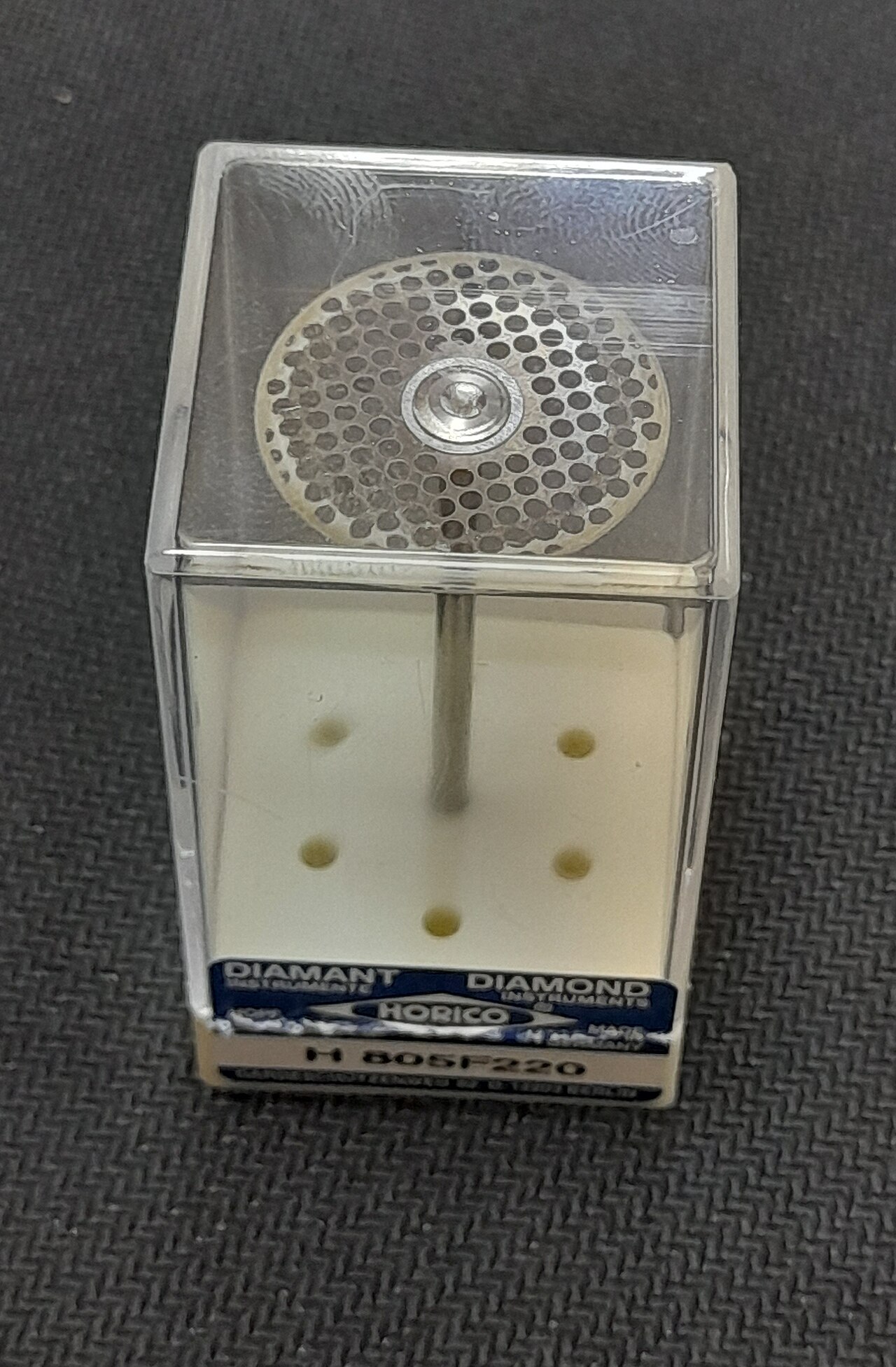
Files are not abrasives; they remove material through the cutting action of sharp teeth cut into their surface, similar to a saw, rather than by scratching or rubbing. However, diamond files are a type of coated abrasive, as they are metal rods coated with diamond powder.
**Mechanics of abrasion**
Abrasives generally work because they are harder than the material being worked on, but this is not strictly necessary. Any two solid materials rubbing together repeatedly will wear each other away over time—for example, softer shoe soles wearing down wooden or stone steps over decades, or glaciers abrading stone valleys.
Typically, abrasive materials are hard minerals (rated 7 or above on the Mohs scale of mineral hardness) or synthetic stones, some of which are chemically and physically identical to natural minerals but are not classified as minerals because they were not naturally formed. (The Mohs scale, while useful for comparison, is an arbitrary, ordinal, and irregular scale of limited value to materials engineers.) Diamond, a common abrasive, occurs both naturally and industrially, as does corundum, which is now more often manufactured from bauxite. However, even softer minerals like calcium carbonate are used as abrasives, for instance as polishing agents in toothpaste.
These minerals are either crushed or already small enough—ranging from macroscopic grains about 2 mm in diameter down to microscopic grains about 0.001 mm—to be used as abrasives. These grains, called grit, have rough edges that often end in points, reducing surface area in contact and increasing localized contact pressure. The abrasive and workpiece are brought into contact while moving relative to each other. Force applied through the grains causes fragments of the workpiece to break away, while simultaneously smoothing the abrasive grain or causing it to loosen from the rest of the abrasive.
Factors affecting how quickly a substance is abraded include: - Difference in hardness: a much harder abrasive cuts faster and deeper. - Grain size (grit size): larger grains cut faster and deeper. - Adhesion between grains, between grains and backing, and between grains and matrix: determines how quickly grains are lost and how soon fresh grains are exposed. - Contact force: more force causes faster abrasion. - Loading: worn abrasive and cast-off workpiece material fill spaces between grains, reducing cutting efficiency and increasing friction. - Use of lubricant, coolant, or metalworking fluid: can carry away swarf (preventing loading), transport heat (affecting physical properties of workpiece or abrasive), decrease friction (with substrate or matrix), suspend worn material for a finer finish, and conduct stress to the workpiece.
**Abrasive minerals**
Abrasives can be classified as natural or synthetic. When it comes to sharpening stones, natural stones have long been considered superior, but advances in material technology are making this distinction less clear. Many synthetic abrasives are effectively identical to natural minerals, differing only in being manufactured rather than mined; impurities in natural minerals can make them less effective.
Some naturally occurring abrasives include: calcite (calcium carbonate), emery (impure corundum), diamond dust (synthetic diamonds are also used extensively), novaculite, pumice, iron(III) oxide, sand, corundum, garnet, sandstone, rotten stone (tripoli), powdered feldspar, and staurolite.
Some abrasive minerals, like zirconia alumina, occur naturally but are rare or costly to obtain, so synthetic versions are used industrially. These and other artificial abrasives include: borazon (cubic boron nitride or CBN), ceramic, ceramic aluminium oxide, ceramic iron oxide, corundum (alumina or aluminium oxide), dry ice, glass powder, steel abrasive, silicon carbide (carborundum), zirconia alumina, boron carbide, and slags.
**Manufactured abrasives**
Abrasives are shaped for various purposes. Natural abrasives are often sold as dressed stones, typically in rectangular blocks. Both natural and synthetic abrasives are commonly available in many shapes, often as bonded or coated abrasives, including blocks, belts, discs, wheels, sheets, rods, and loose grains.
**Bonded abrasives**
A bonded abrasive consists of an abrasive material held within a matrix, though very fine aluminium oxide abrasive may be made of sintered material.
- field
- Materials science, manufacturing
- known_for
- Shaping and finishing workpieces through friction
- common_forms
- Bonded abrasives (blocks, wheels) and coated abrasives (sandpaper, belts)
- key_property
- Hardness difference between abrasive and workpiece
Lore & Background
Abrasives generally rely upon a difference in hardness between the abrasive and the material being worked upon, the abrasive being the harder of the two substances. However, any two solid materials that repeatedly rub against each other will tend to wear each other away, as seen with softer shoe soles wearing away wooden or stone steps over decades or glaciers abrading stone valleys. Materials used as abrasives are typically hard minerals rated at 7 or above on Mohs scale, or synthetic stones, though softer minerals like calcium carbonate are used as polishing agents in toothpaste.
Reader's Guide
Abrasives are fundamental to countless industrial and domestic processes, from grinding and polishing to cutting and sanding. Their significance lies in their ability to efficiently remove material through controlled friction, enabling the shaping and finishing of metals, stone, wood, and other materials. The choice of abrasive depends on factors such as hardness difference, grain size, adhesion, contact force, and the use of lubricants. Bonded abrasives, like grinding wheels, and coated abrasives, like sandpaper, are common forms. The field continues to evolve with synthetic abrasives that are often identical to natural minerals but manufactured for consistency. Understanding abrasion mechanics—including loading, dressing, and truing—is essential for effective use in precision work and large-scale manufacturing.
Did You Know?
- Files are not abrasives; they remove material by cutting action of sharp teeth, not by scratching or rubbing.
- Diamond files are a form of coated abrasive, being metal rods coated with diamond powder.
- Softer minerals like calcium carbonate are used as abrasives in toothpaste as polishing agents.
- Bonded abrasives need to be trued and dressed after use to restore shape and expose fresh grit.
Gallery

Frequently Asked Questions
What is Abrasive?
An abrasive is a hard material, typically a mineral, that removes material from a workpiece by rubbing against it and causing controlled wear through friction. It sits at the intersection of materials science and manufacturing.
What forms does Abrasive come in?
The two most common categories are bonded abrasives, which take the shape of solid blocks or grinding wheels, and coated abrasives, such as sandpaper sheets or sanding belts.
What is Abrasive's defining property?
The critical requirement is that the abrasive must be harder than the material it is working on, so that friction wears away the softer workpiece rather than the abrasive itself.
Where is Abrasive used in practice?
You will find abrasives in nearly every industrial workshop, in household tool kits, and inside advanced manufacturing processes, making them one of the most ubiquitous materials in modern production.
Why is Abrasive important to the field?
Because it is the fundamental mechanism behind cutting, grinding, and polishing operations, and its wide range of ceramic and mineral compositions allows it to handle an enormous variety of softer materials.
More in Construction & Materials 1-19
Spotted an error? Know more?
This is a living reference — every entry is fact-audited, and reader corrections feed straight into our audit queue. Suggest an edit · See this site's audit record