
Lines of Action
Abstract strategy game where players connect all pieces into one group.

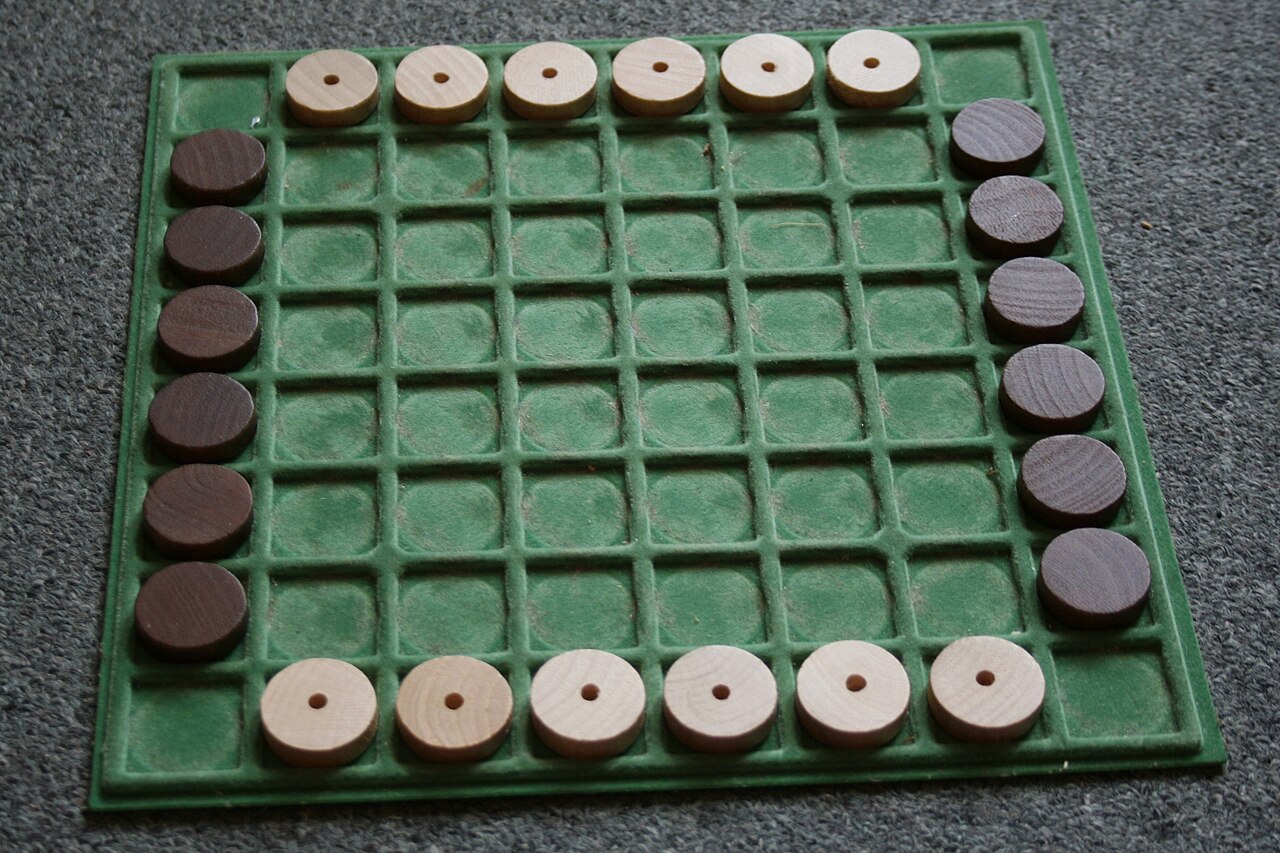
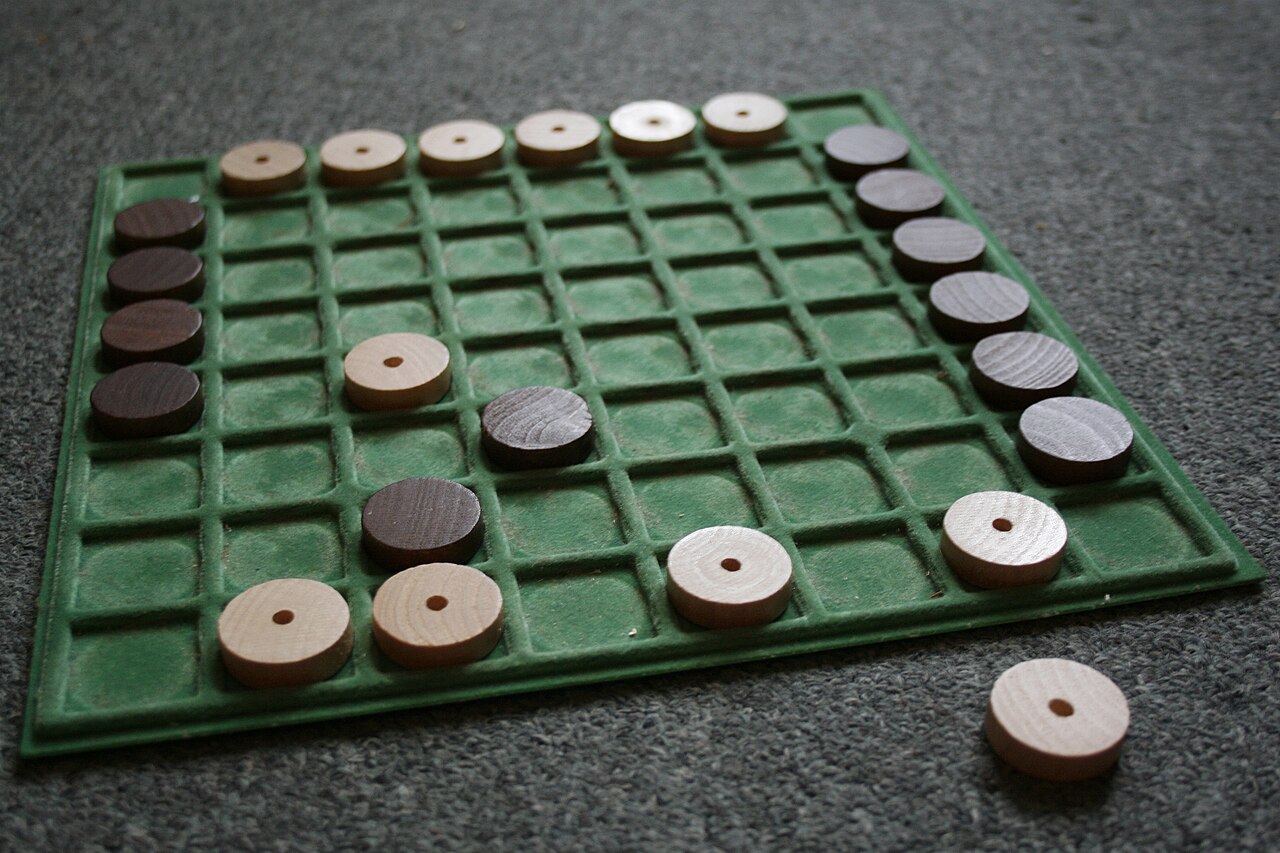
Elembis · Public domain
Lines of Action (often called LOA) is a two-player abstract strategy game created by Claude Soucie. Players win by moving all of their pieces into one connected group, using orthogonal or diagonal adjacency. The game earned a recommendation from the Spiel des Jahres in 1989.
**Rules**
The goal is to unite every one of your pieces into a single contiguous mass, connected either orthogonally or diagonally (eight-direction connectivity).
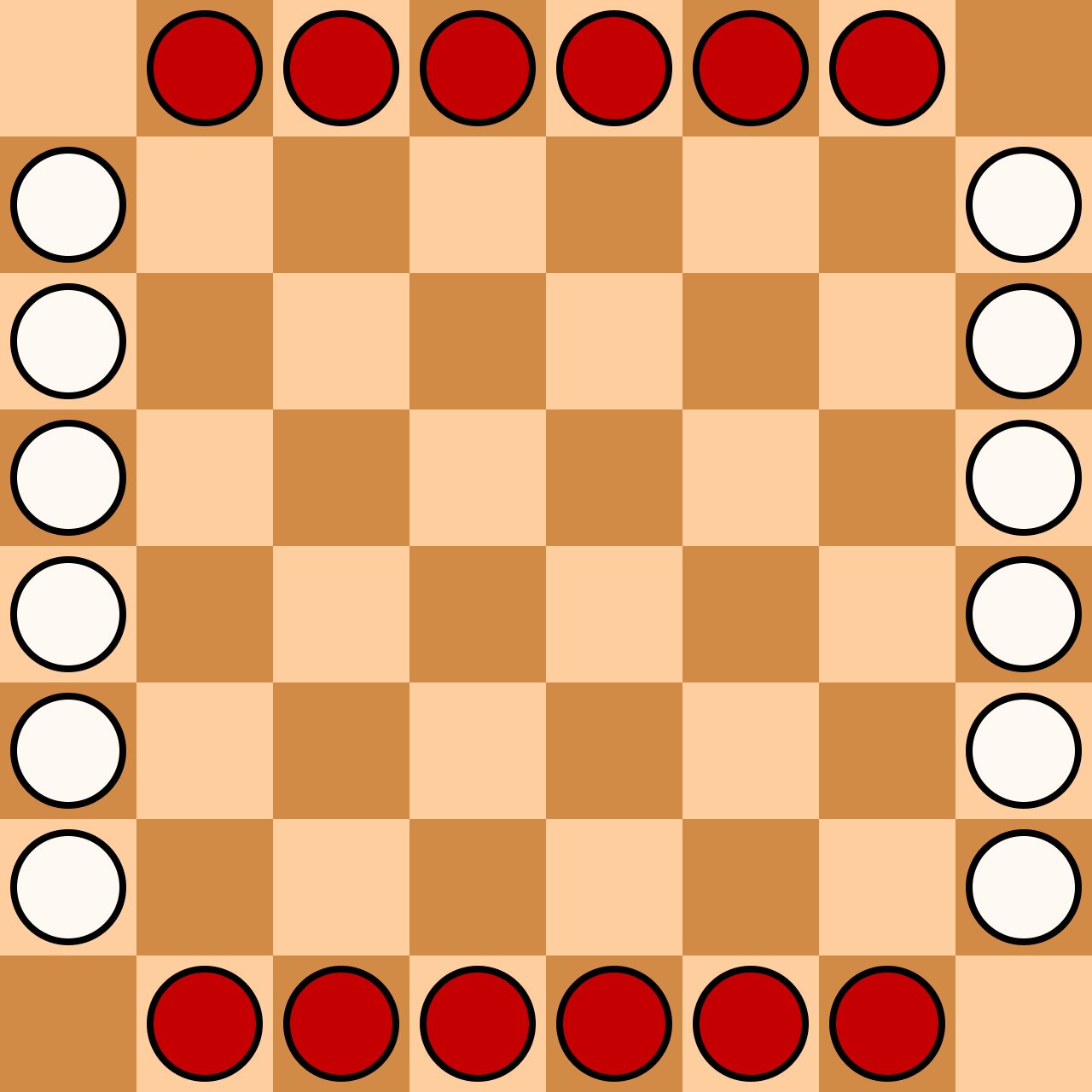
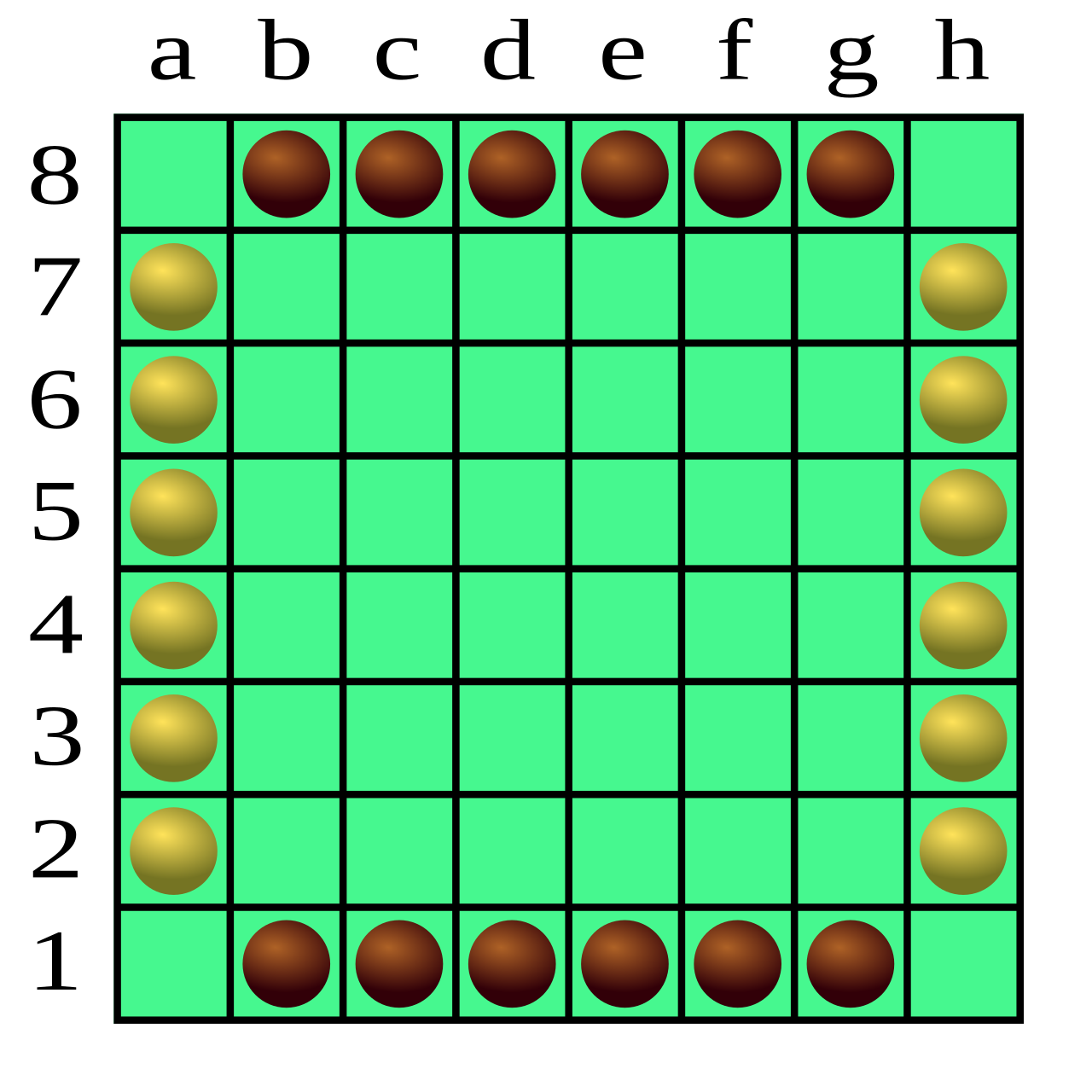
Players take turns, with Black moving first. A piece can move horizontally, vertically, or diagonally. The number of squares it moves equals the total number of pieces—both friendly and enemy—on the line it travels. For instance, Black might open with c8-c6, moving two squares because two pieces lie in that column.
A piece cannot jump over an enemy piece. In one example, White cannot play a6-d6 even though three pieces sit in row 6; instead, White might play a6-c4, moving two squares because two pieces are on that diagonal. A piece may jump over friendly pieces. Black could play e8-b5, jumping over his own piece and moving three squares because three pieces occupy that diagonal.
A piece may land on a square occupied by an enemy piece, capturing and removing it. For example, White could play h3-f1, capturing the black piece on f1. If a player is reduced to a single piece, that player wins immediately, since the piece is trivially united.
If a move causes both players to have all their pieces connected at once, the outcome depends on the tournament rules. In the original 1969 edition of *A Gamut of Games*, this was a draw. The second edition changed it to a win for the player who moved. Sid Sackson noted in the preface: “Claude Soucie and I are all that remains of N.Y.G.A. At his request, I have corrected an error in the rules for LINES OF ACTION, eliminating possible draws.” Despite the inventor’s intent, most modern tournaments—including the World Championships at the Mind Sports Olympiad—score simultaneous connection as a draw.
**Strategy**
In open positions, the game becomes highly tactical as pieces on both sides gain mobility. Strategic depth comes largely from blocking moves that limit the opponent’s options. Pinning enemy pieces against the board edge by moving along the second row or column can be effective. Having more pieces is usually advantageous because they can restrict the opponent’s movement as they clust
- recommended_by
- Spiel des Jahres (1989)
- world_championship_venue
- Mind Sports Olympiad (added in later years)
Quick Facts
- Title
- Lines of Action
- Italic Title
- no
- Designer
- Claude Soucie
- Genre
- Board game / Abstract strategy game
- Players
- 2
- Setup Time
- < 1 minute
- Random Chance
- None
- Skills
- Strategy, tactics
- Aka
- LOA
Facts from the source article.
Lore & Background
Lines of Action was invented by Claude Soucie and first appeared in the 1969 edition of Sid Sackson's book A Gamut of Games. The game's rules were later revised in the second edition to eliminate possible draws, changing simultaneous connection from a draw to a win for the player moving, at Soucie's request. Despite this, most present-day tournaments, including the World Championships at the Mind Sports Olympiad (which added the event in later years, not at its inception in 1997), score simultaneous connection as a draw.
The game features a unique movement rule: a piece moves exactly as many spaces as there are pieces (both friendly and enemy) on the line in which it is moving. Pieces may jump over friendly pieces but not over enemy pieces, and capturing an enemy piece is done by landing on its square. A player reduced to a single piece wins automatically.
Reader's Guide
Lines of Action is significant as a classic abstract strategy game that combines simple rules with deep tactical and strategic complexity. Its movement mechanic, based on counting pieces along a line, creates a dynamic where mobility and blocking are central. The game's strategic depth derives largely from blocking strategies that limit opponent mobility, such as pinning pieces against the board edge. Having more pieces is usually advantageous, but fewer pieces can be easier to unite, creating a nuanced trade-off. The game's inclusion in the Spiel des Jahres recommendations in 1988 helped establish its reputation. The ongoing World Championships at the Mind Sports Olympiad demonstrate its enduring competitive appeal. The dispute over simultaneous connection rules—whether it is a win for the moving player or a draw—reflects the game's evolving tournament culture. LOA remains a respected game in the abstract strategy community, with a dedicated following and regular championship play.
Did You Know?
- The game was invented by Claude Soucie and first published in Sid Sackson's 1969 book A Gamut of Games.
- A piece moves exactly as many spaces as there are pieces (both friendly and enemy) on the line in which it is moving.
- Simultaneous connection is scored as a draw in most present-day tournaments, despite the inventor's preference for a win for the moving player.
- A variant called Scrambled Eggs, with a different starting position, was also proposed by Soucie.
The Mechanics of Movement and Capture
Lines of Action distinguishes itself among abstract strategy games through a movement system that ties a piece's range directly to the board state. Rather than a fixed number of squares, a piece travels exactly as many spaces as there are pieces—belonging to either side—along the line it is moving in. This means the same piece can cover two squares in one position and five in another, making every move a response to the evolving configuration. Black always opens the game, and players alternate turns. Pieces may slide horizontally, vertically, or diagonally, but they cannot leap over an opponent's piece; friendly pieces, however, can be jumped. Landing on an enemy piece captures it and removes it from play. Victory is achieved by uniting all remaining pieces into one contiguous group, connected orthogonally or diagonally. A player reduced to a single piece wins immediately, since that lone piece is trivially united. The one wrinkle is simultaneous connection—when a capture leaves both sides fully connected—which has been treated as either a draw or a win for the mover depending on the ruleset in force.
Strategic Depth and the Art of Blocking
While Lines of Action can produce sharp tactical battles in open positions where both sides' pieces remain mobile, its deeper strategic character emerges from the art of restriction. A core idea is the blockade: by massing pieces in the second row or column, a player can pin an opponent's pieces flush against the board's edge, dramatically curtailing their mobility. Material advantage is a double-edged sword. More pieces on the board generally help, because they crowd the opponent's options and form a central mass. Yet every extra piece also means one more unit that must eventually be incorporated into the connected group, so a player down in material may paradoxically be closer to victory. Expert play, as illustrated in annotated example games, often prioritizes positional pressure over captures. An early capture on the board's periphery is typically modest in value, whereas seizing a piece in the center can reshape the entire position. Even the player moving second can seize the initiative by systematically hemming in the opponent's front-row pieces.
A Competitive Tradition at the Mind Sports Olympiad
Since 1997, the World Championship in Lines of Action has been contested annually at the Mind Sports Olympiad, producing a rich tapestry of champions. The early years saw Fred Kok establish dominance, claiming the title in 1997, 1999, 2002, 2004, and 2006, while Koichi Nicholas added his name in 2001, 2003, and 2005. Tim Hebbes captured three titles across 2007, 2009, and 2011, and a handful of one-time champions—including Hartmut Thordsen, Jochen Drechsler, Peter Horlock, Ankush Khandelwal, and Alain Dekker—punctuated the record. The most recent era has been defined by a remarkable rivalry between James Heppell and Andres Kuusk. Heppell has lifted the trophy in 2008, 2016, 2017, 2019, 2020, 2023, and 2024, while Kuusk has claimed it in 2010, 2015, 2018, 2021, and 2025. Nicholas returned for a final title in 2022, reminding the community that the game's competitive landscape, while concentrated, still holds surprises.
From N.Y.G.A. to the Modern Tournament Floor
Claude Soucie created Lines of Action, and the game first appeared in print in the 1969 edition of A Gamut of Games. In that original version, a position in which a capture left both players' pieces fully connected was scored as a draw. When a second edition was prepared, Soucie asked co-author Sid Sackson to correct what he considered an error in the rules. Sackson's preface note records that he and Soucie were 'all that remains of N.Y.G.A.' and that, at Soucie's request, the simultaneous-connection draw was eliminated in favor of a win for the player who made the capturing move. Yet the broader competitive community largely resisted this change. Today, most tournaments, including the World Championships at the Mind Sports Olympiad, still score simultaneous connection as a draw, preserving the original 1969 interpretation. Beyond the core game, Soucie also proposed a variant called Scrambled Eggs, which uses a different starting arrangement. The game's international recognition was cemented in 1988 when it received a recommendation from the prestigious Spiel des Jahres.
Gallery
Frequently Asked Questions
What is Lines of Action?
Lines of Action is a two-player abstract strategy game in which each side tries to gather all of its pieces into a single connected cluster. It was designed by Claude Soucie and is one of the most well-known titles in the connection-game genre.
How do you win in Lines of Action?
You win the moment every one of your pieces forms a single contiguous group, with pieces counting as linked if they touch orthogonally or diagonally. There is no capturing or blocking element; the entire challenge is pure positioning.
Who created Lines of Action?
The game was invented by French designer Claude Soucie. It has since become a go-to recommendation for anyone looking to get into abstract strategy games.
What awards or recognition has Lines of Action earned?
The Spiel des Jahres jury issued a recommendation for the game in 1989, a major honour in the board-game world. In more recent years it was also added to the Mind Sports Olympiad, where a world championship is now played.
How does piece movement work in Lines of Action?
On your turn you pick one of your pieces and slide it horizontally, vertically, or diagonally across the board. The number of squares it may travel is determined by how many of your opponent's pieces sit adjacent to it, so enemy placement directly shapes your mobility.
More in Connection games 1-24
Spotted an error? Know more?
This is a living reference — every entry is fact-audited, and reader corrections feed straight into our audit queue. Suggest an edit · See this site's audit record