
Connect Four
A solved connection game where the first player can force a win from several starting moves.

Abdurazaaq Mohammed · CC0
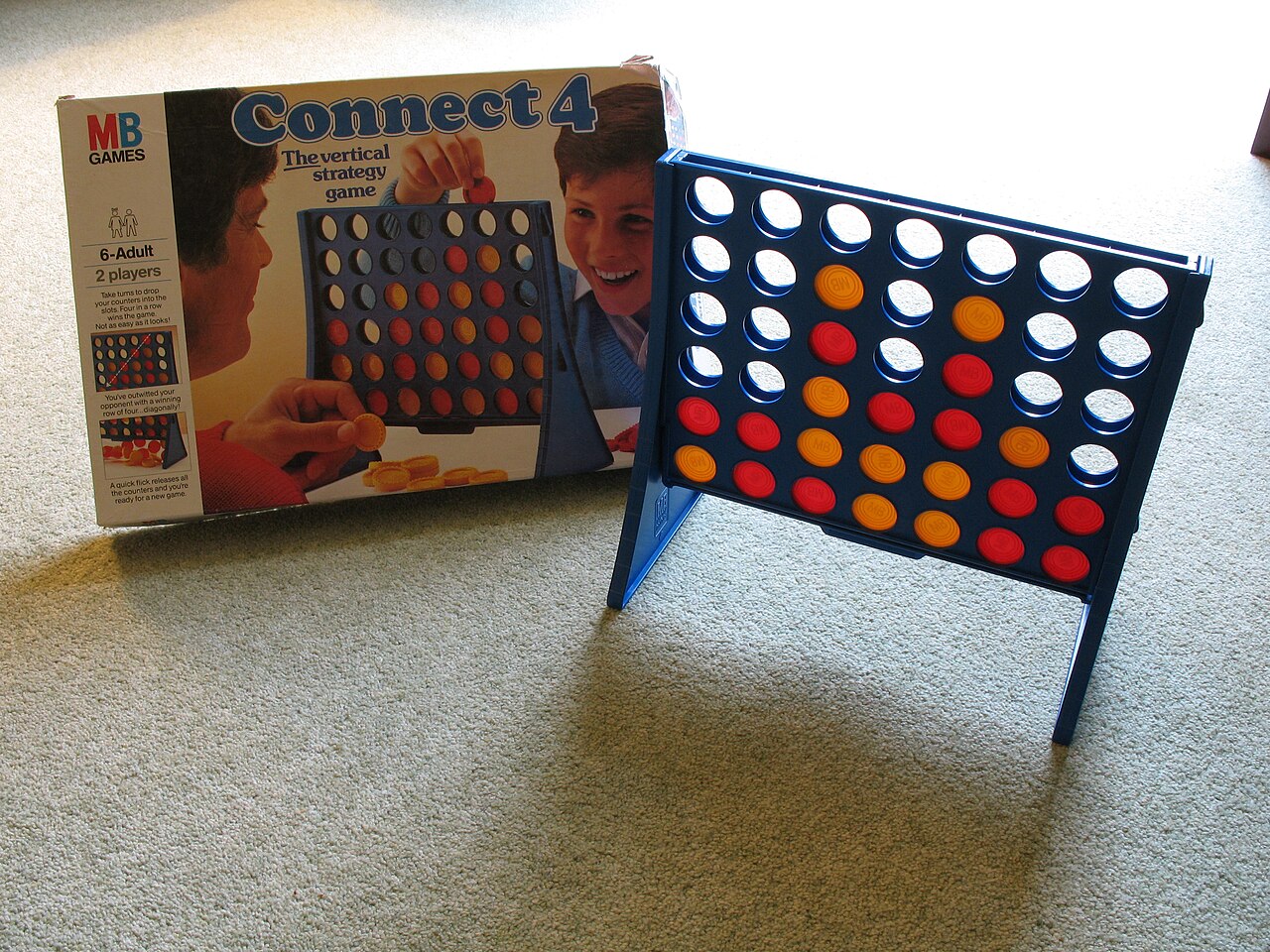
Connect Four is a two-player connection game in which participants take turns dropping colored tokens into a vertically suspended grid. The objective is to be the first to form a horizontal, vertical, or diagonal line of four of one's own tokens. It is a solved game, meaning that with perfect play the first player can always win.
- creator
- Howard Wexler
- year_first_sold
- 1974
- publisher
- Milton Bradley
- board_size
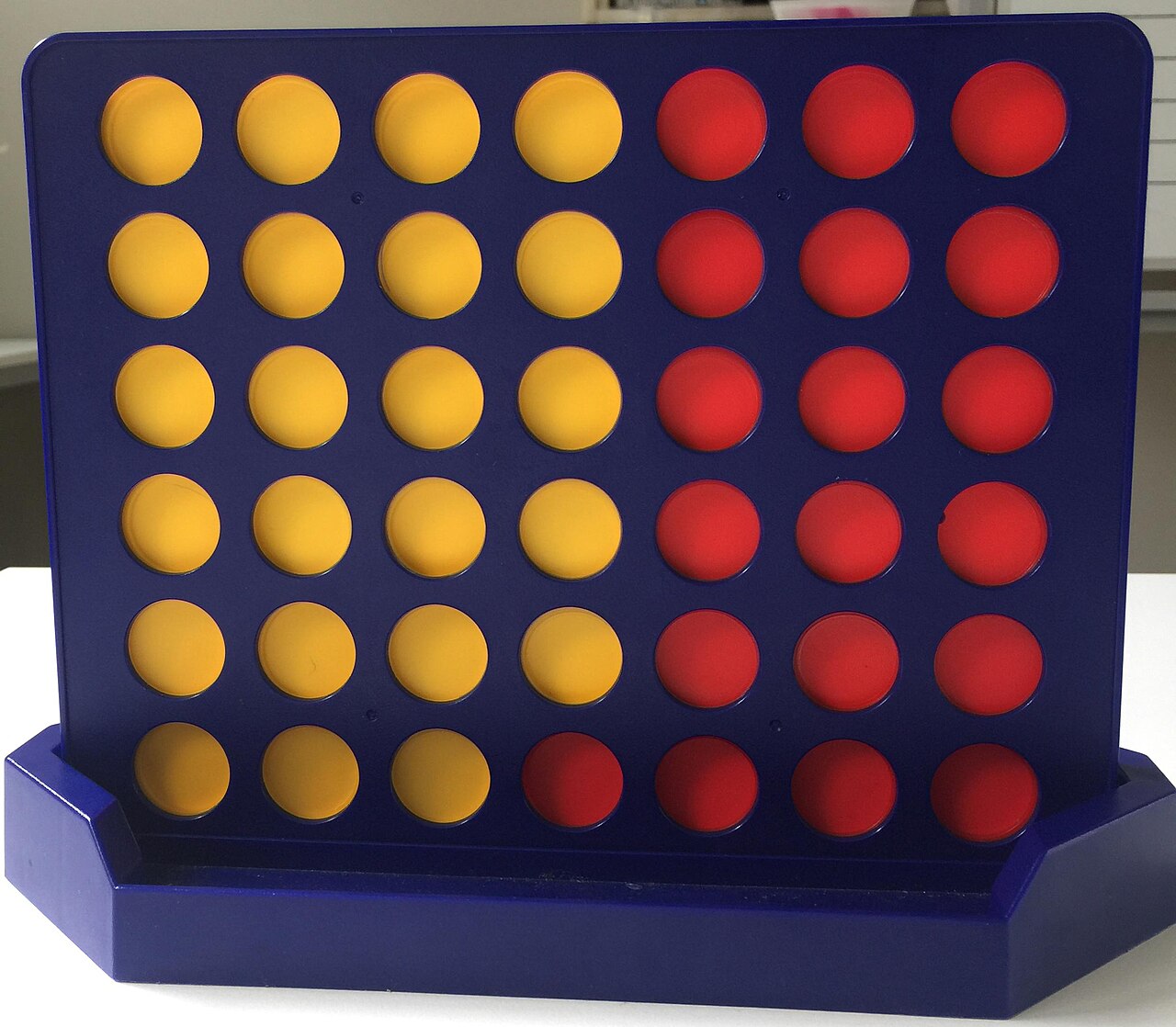
- 7 columns × 6 rows
- game_type
- m,n,k-game (7, 6, 4) with restricted piece placement
- solved_by
- James Dow Allen (1988) and Victor Allis (1988)
Quick Facts
- Label Width
- 160
- Other Names
- 4 in a Row / The Captain's Duel / The Captain's Mistress
- Designer
- Howard Wexler / Ned Strongin
- Publisher
- Milton Bradley / Hasbro
- Years
- 1974–present
- Genre
- Connection game
- Language
- English
- Players
- 2
- Playing Time
- 10 min
- Ages
- 6+
- Materials
- a playing board and tokens
Facts from the source article.
Lore & Background
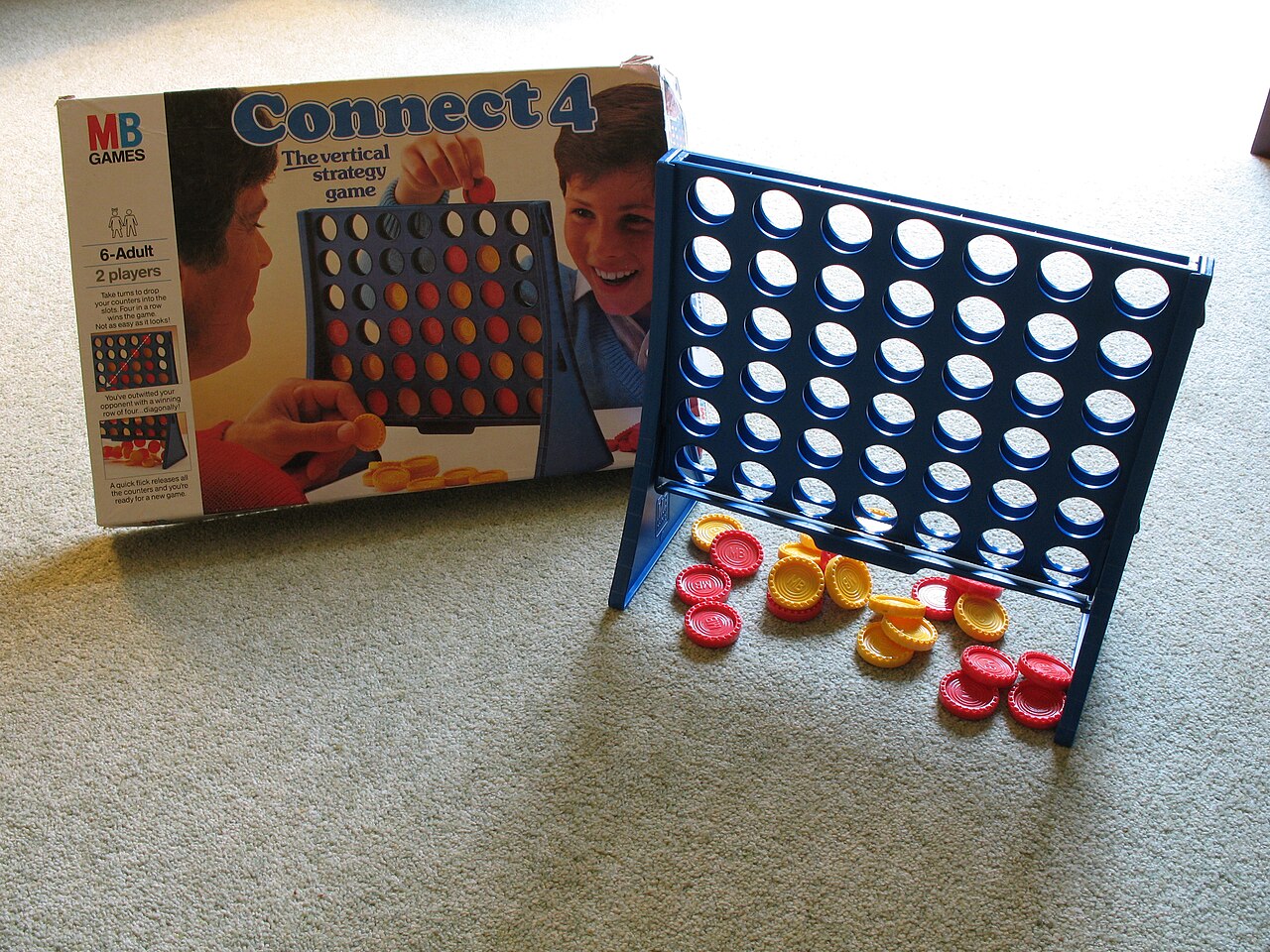
Connect Four was created by Howard Wexler and first sold under the Connect Four trademark by Milton Bradley in February 1974. The game is played on a six-row, seven-column vertically suspended grid. Players choose a color and alternate dropping tokens into unfilled columns; pieces fall straight down to the lowest available space. The first to connect four of their own tokens horizontally, vertically, or diagonally wins. If the board fills without a four-in-a-row, the game is a draw.
The game was first solved by James Dow Allen on October 1, 1988, and independently by Victor Allis on October 16, 1988. Allis described a knowledge-based approach with nine strategies. At the time, brute-force analysis was not deemed feasible given the game's complexity and available computer technology. Later, Connect Four was solved with brute-force methods, beginning with John Tromp's 8-ply database. In 2025, a win-draw-loss look-up table was computed for the classic 7×6 board.
With perfect play, the first player can force a win by starting in the middle column. Starting in columns 3 or 5 also allows the first player to force a win. Starting in column 2 or 6 leads to a draw, while only starting in column 1 or 7 allows the second player to force a win. The game has many rule variations, including PopOut, Pop 10, Five-in-a-Row, and Power Up, as well as different board sizes and electronic versions.
Reader's Guide
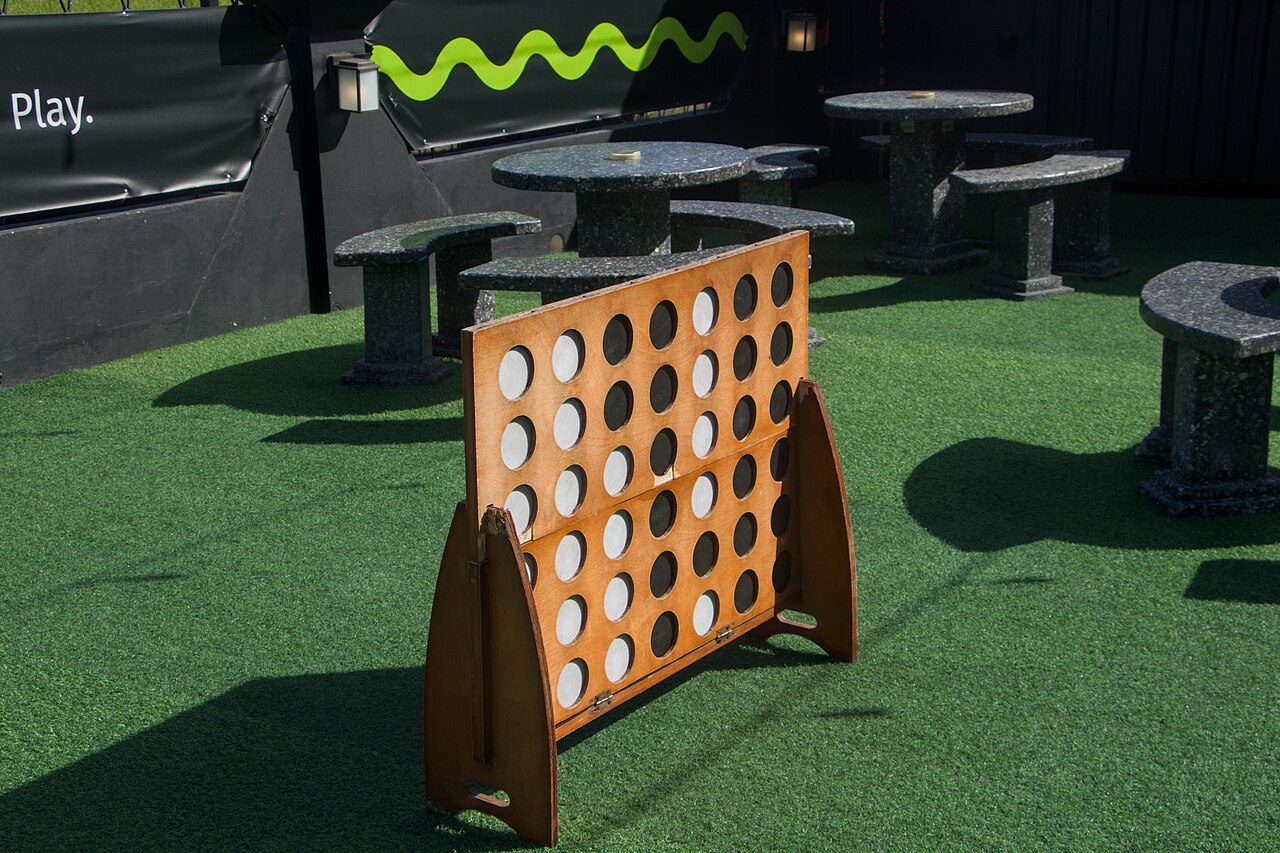
Connect Four is significant as a classic example of a solved perfect-information game. Its solution, achieved independently by James Dow Allen and Victor Allis in 1988, demonstrated that the first player can always force a win with optimal play, specifically by starting in the center column. This made Connect Four one of the first complex board games to be solved, paving the way for advances in game theory and artificial intelligence. The game's straightforward rules and deep strategic possibilities have made it a benchmark for AI algorithms such as minimax and negamax with alpha-beta pruning. The Fhourstones integer performance benchmark is based on solving Connect Four. The game's legacy extends beyond the original board: it has been released for video game consoles, adapted into outdoor giant versions, and spawned numerous rule variations that continue to be studied in AI research. Its status as a solved game does not diminish its popularity; it remains a widely played and studied game.
Did You Know?
- Connect Four is also known as Captain's Mistress and, in the Soviet Union, Gravitrips.
- The game was first solved by James Dow Allen on October 1, 1988, and independently by Victor Allis on October 16, 1988.
- There are 4,531,985,219,092 possible board positions for the classic 7×6 grid.
- With perfect play, the first player can force a win by starting in the middle column, as well as in columns 3 or 5.
Origins and the Many Names of a Classic
Connect Four traces its roots to the mind of Howard Wexler, who designed the game before it reached commercial shelves. Milton Bradley took it up and launched it under the Connect Four trademark in February 1974, giving the world a simple yet deeply strategic tabletop experience. What makes the game's identity particularly fascinating is the sheer number of names it has accumulated across cultures and regions. Beyond the trademarked title, players have called it Connect 4, Four Up, Plot Four, Find Four, Captain's Mistress, Four in a Row, and Drop Four. In the Soviet Union, it went by the distinctly different name Gravitrips, a nod to the gravity-driven mechanic that defines how pieces land on the board. From a game-theory standpoint, Connect Four is classified as an m,n,k-game with parameters (7, 6, 4), where the restriction on piece placement—tokens can only fall into the lowest open slot of a chosen column—distinguishes it from more open grid games. This constraint is what gives the game its unique tactical depth despite its deceptively simple ruleset.
How a Game Unfolds
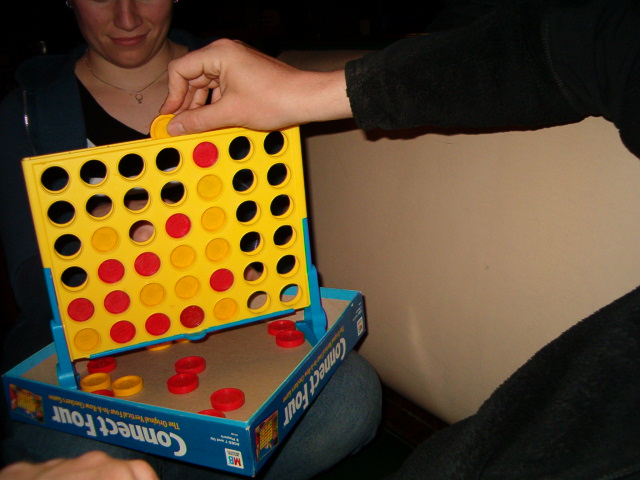
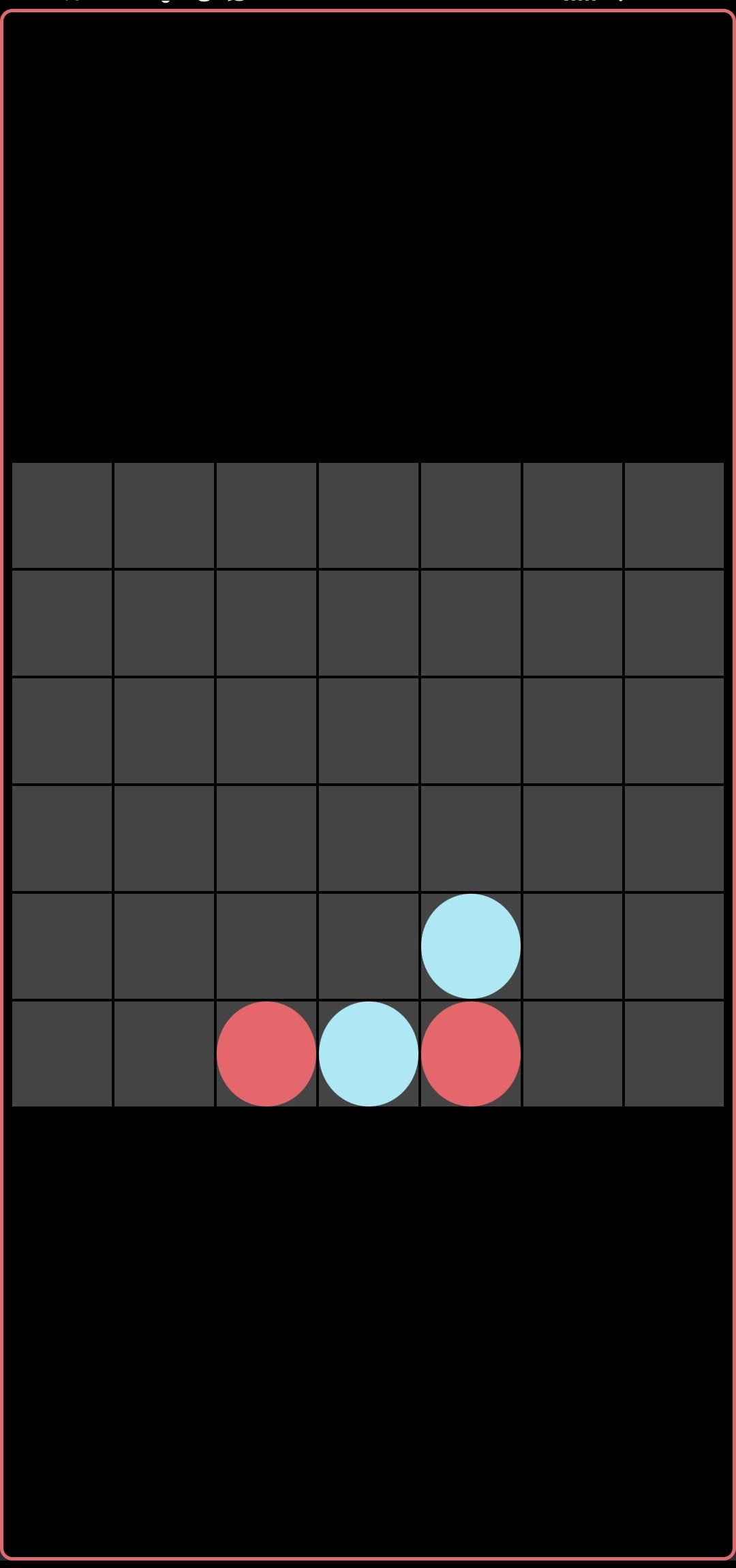
At its core, Connect Four is a turn-based duel played on a vertically suspended grid measuring six rows by seven columns. Each player selects a color—traditionally yellow and red—and takes turns dropping one of their tokens into any unfilled column. The gravity mechanic is essential: a piece always falls straight down and settles in the lowest available slot within that column, meaning players cannot place a token mid-air or skip over an occupied space. The goal is straightforward in description but demanding in execution—be the first to align four of your own tokens in a horizontal, vertical, or diagonal line. A typical opening sees the first player drop a disc into the center column, after which both sides alternate, building upward while watching for both offensive opportunities and defensive threats. The opponent can always sneak up and complete a four-in-a-row on their turn, so vigilance is as important as planning. If every one of the 42 slots fills without either player achieving the required line, the game ends in a draw.
The Solved Game and Its Mathematical Depth
Connect Four occupies a special place in game theory as a two-player, perfect-information, zero-sum game: nothing is hidden, and one player's gain is the other's loss. The sheer scale is staggering—across all possible board states with zero to 42 pieces placed, there are 4,531,985,219,092 distinct positions. In October 1988, James Dow Allen and, independently, Victor Allis each proved the first player holds a winning advantage. Allis described a knowledge-based solution built around nine strategic patterns, while Allen outlined explicit winning strategies. At the time, brute-force computation was considered infeasible given available hardware. Decades later, John Tromp's 8-ply database opened the door to brute-force verification, and modern AI approaches using minimax or negamax with alpha-beta pruning, move ordering, and transposition tables can strongly solve the game. The Fhourstones benchmark even measures integer performance using this solving code. The definitive conclusion: with perfect play, the first player wins on or before the 41st move by opening in the center column. Starting in the adjacent columns yields a theoretical draw, while opening in the outermost columns guarantees a loss for the first player.
Variations and the Research Frontier
Beyond the classic 7-by-6 board, Connect Four has spawned a rich ecosystem of rule variations and board configurations that attract both casual players and serious researchers in game theory and artificial intelligence. Board size alternatives include 5×4, 6×5, 8×7, 9×7, 10×7, and 8×8 grids, as well as the Infinite Connect-Four and Cylinder-Infinite Connect-Four formats. Hasbro's physical gameboards often feature a mechanism for removing discs one at a time from the bottom, enabling house-rule twists. The PopOut variation lets a player, on their turn, either drop a new disc from the top or pop out one of their own discs from the bottom row, shifting all pieces above it downward and reshaping the board. Pop 10 inverts the setup entirely: the board starts completely filled, and players take turns removing their own discs from the bottom, setting them aside if the removed disc was part of a four-in-a-row at the moment of removal. Five-in-a-Row expands the grid to six rows by nine columns, with two extra columns pre-filled in alternating colors, and raises the winning requirement to five consecutive tokens.
Gallery
Frequently Asked Questions
Who invented Connect Four and when did it first go on sale?
Howard Wexler designed the game, and Milton Bradley began retailing it in 1974.
What is the actual objective in Connect Four?
Two players alternately drop their colored discs into a hanging grid, and whoever first lines up four of their own pieces horizontally, vertically, or diagonally takes the round.
How many columns and rows does the Connect Four board have?
The grid is seven columns wide and six rows tall, so each turn offers up to seven legal drop positions.
Is Connect Four a solved game, and who proved it?
Yes—both James Dow Allen and Victor Allis independently demonstrated in 1988 that the opening player can force a win with perfect play, and that several different first moves guarantee the victory.
What makes Connect Four a "restricted" m,n,k-game rather than a free-placement one?
It is classified as a (7, 6, 4) game because the board is 7 wide by 6 tall and four in a row wins, but unlike open-grid variants, a token can only land in the lowest empty cell of the column it is dropped into.
More in Connection games 1-24
Spotted an error? Know more?
This is a living reference — every entry is fact-audited, and reader corrections feed straight into our audit queue. Suggest an edit · See this site's audit record