
Havannah (board game)
A connection game with three winning structures and deep strategy.

Moore, John Hamilton; Robinson, G. G. (George G.) · Public domain
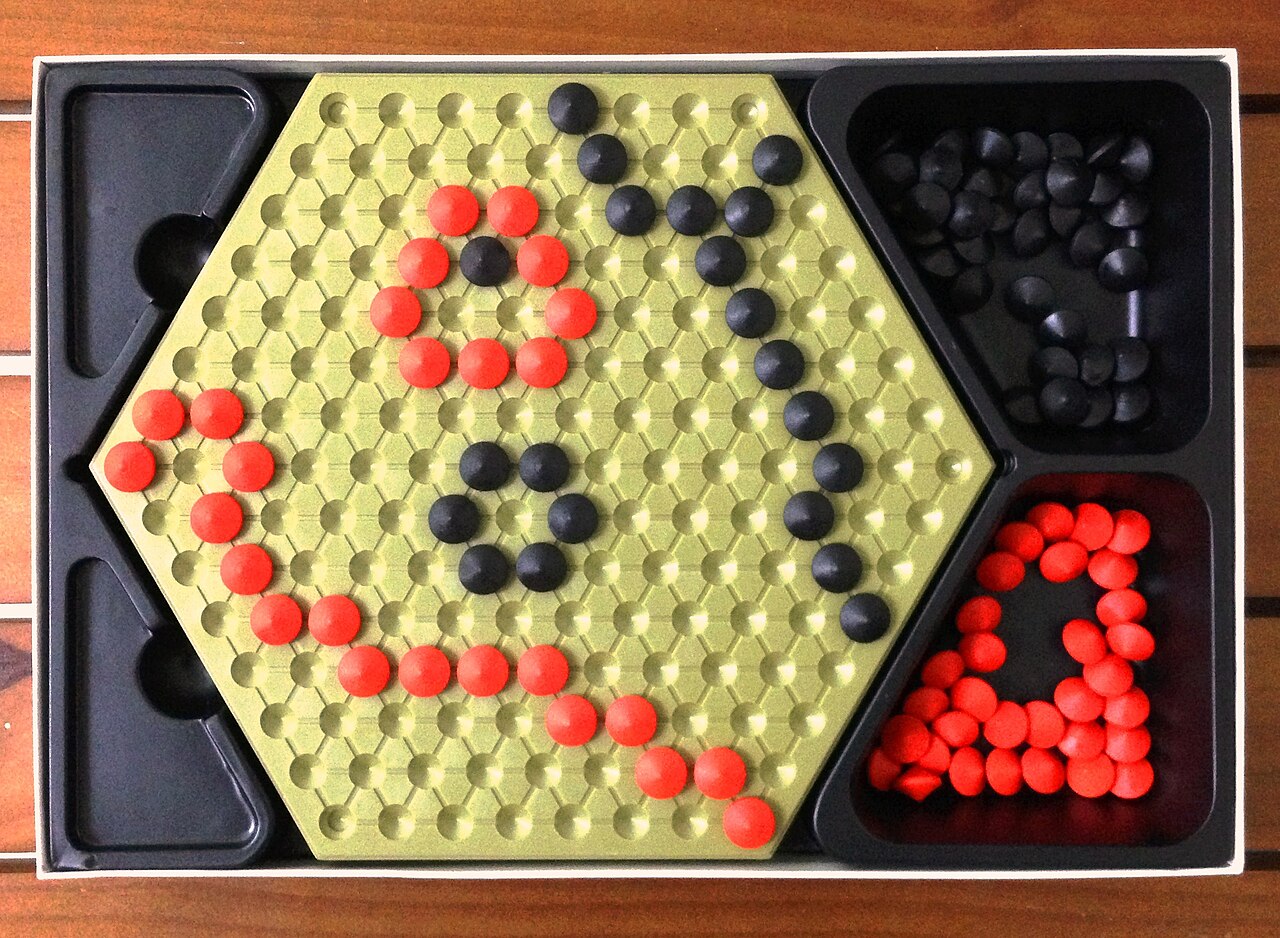
Havannah is a two-player abstract strategy board game invented by Christian Freeling. It is part of the connection games family, alongside Hex and TwixT. The game is known for having "a sophisticated and varied strategy" and is ideally played on a hexagonal board with ten cells per side. Ravensburger once published the game in Germany, offering a smaller eight-cell-per-side version for beginners. Today, Havannah is only produced by Hexboards.
In a standard game, one player uses black stones and the other white. Black makes the first move, and then turns alternate. On each turn, a player places one stone of their color on the board. Stones are never moved, captured, or otherwise altered. A player wins by completing one of three types of unbroken paths made from their own connected stones: a ring, which is a loop surrounding at least one cell (regardless of whether those cells are empty or occupied); a bridge, which connects any two of the board’s six corner cells; or a fork, which connects any three edges of the board (corner points do not count as part of an edge). Because the first player has a clear advantage, the pie rule is commonly used for fairness: after the first move, the second player may choose to switch sides. When players of different skill levels compete, the weaker player (playing white) may be allowed to place two or more stones on their first turn.
Unlike Hex, where a completely filled board always yields exactly one winning connection, a full Havannah board usually contains multiple winning structures—but the game ends as soon as the first one appears. Draws are technically possible in Havannah, but extremely rare; only one draw between human players has been recorded. Tactics are much easier to master than strategy, and skill differences between players can be large.
In 2002, Freeling offered a prize of 1000 euros (available through 2012) to any computer program that could beat him in a single game of a ten-game match. For many years, computer programs lagged far behind human players. Starting around 2010, some Havannah programs began using Monte Carlo tree search, which led to notable improvements. During the "Havannah Challenge 2012" (October 15–19, 2012), Freeling played ten games against three strong programs, playing at least one game as black and one as white against each. He lost the challenge when he had to resign a game as whit
- inventor
- Christian Freeling
- family
- Connection games
- board
- Hexagonal, base-10 (standard) or base-8 (beginner)
- winning structures
- Ring, bridge, fork
- first player
- Black
- handicap rule
- Pie rule
Lore & Background
Havannah was invented by Christian Freeling and belongs to the connection game family, alongside Hex and TwixT. The game is played on a hexagonal board, with the standard size being base-10 (10 hex cells to a side). A smaller base-8 board was published by Ravensburger in Germany for beginners, but the game is now only produced by Hexboards. Black starts, and players alternate placing stones that are never moved or captured. A player wins by completing one of three structures: a ring (a loop around one or more cells), a bridge (connecting any two corner cells), or a fork (connecting any three edges, excluding corners).
Reader's Guide
Havannah is notable for its sophisticated and varied strategy, distinct from its relative Hex. Unlike Hex, where a completely filled board guarantees exactly one winner, Havannah can have multiple winning structures on a filled board, though the game ends with the first. Draws are technically possible but extremely rare, with only one known draw between human players. The pie rule is generally implemented to offset the first-player advantage, allowing the second player to switch positions after the first move. Computer programs lagged behind humans for many years, but Monte Carlo tree search techniques improved play after 2010. In 2012, Christian Freeling lost the Havannah Challenge to the Lajkonik program. By 2019, the program MetaTotoro, based on Polygames, defeated the top human player on LittleGolem on a base-8 board, using a zero-learning algorithm with fully convolutional neural networks. Havannah is a recurring game at the Computer Olympiad, played on base-8 and sometimes base-10 boards with the pie rule. The game's computational complexity is PSPACE-complete, proven by reduction from generalized geography using ring-threat gadgets.
Did You Know?
- Havannah was invented by Christian Freeling and belongs to the connection game family, alongside Hex and TwixT.
- In the 2012 Havannah Challenge, the program Mogo defeated Christian Freeling, not Lajkonik.
Gallery



Frequently Asked Questions
Who created Havannah and what family of games does it belong to?
Christian Freeling designed Havannah as a two-player abstract strategy game. It sits in the connection games family right alongside Hex and TwixT.
What are the three ways to win in Havannah?
A player claims victory by forming a ring, a bridge, or a fork with their stones. Having three distinct winning structures is what gives the game its reputation for deep, varied strategy.
What does a standard Havannah board look like?
The board is hexagonal with ten cells along each side, which is the base-10 format. A smaller base-8 board with eight cells per side was offered as a beginner-friendly option by Ravensburger in Germany.
Where can I buy Havannah today?
Hexboards is currently the only company producing the game. Earlier German editions came from Ravensburger, but that publisher no longer carries it.
How does the pie rule work in Havannah?
The pie rule serves as a fairness mechanism: after one player places an initial stone, the other player picks which color (black or white) to play. This neutralizes the first-move advantage that black would otherwise hold.
More in Connection games 1-24
Spotted an error? Know more?
This is a living reference — every entry is fact-audited, and reader corrections feed straight into our audit queue. Suggest an edit · See this site's audit record