
Crosstrack
Tile-based path connection game on an octagon board.

Mliu92 · CC BY-SA 4.0
Crosstrack is an abstract strategy board game designed by Philip Shoptaugh and first published in 1994. It is a tile-based edge-matching path connection game played on an irregular octagon board, where players compete to create an unbroken path between two opposite sides.
- designer
- Philip Shoptaugh
- first_published
- 1994
- field
- Board game design
- known_for
- Crosstrack, a tile-based path connection game
- board_shape
- Irregular octagon
- tile_types
- Octagonal and square interstitial tiles
Quick Facts
- Subject Name
- Crosstrack
- Players
- 2-4
- Ages
- 8+
- Setup Time
- 30 seconds
- Playing Time
- 10-30 minutes
- Random Chance
- None
- Skills
- Tactics, Strategy
Facts from the source article.
Lore & Background
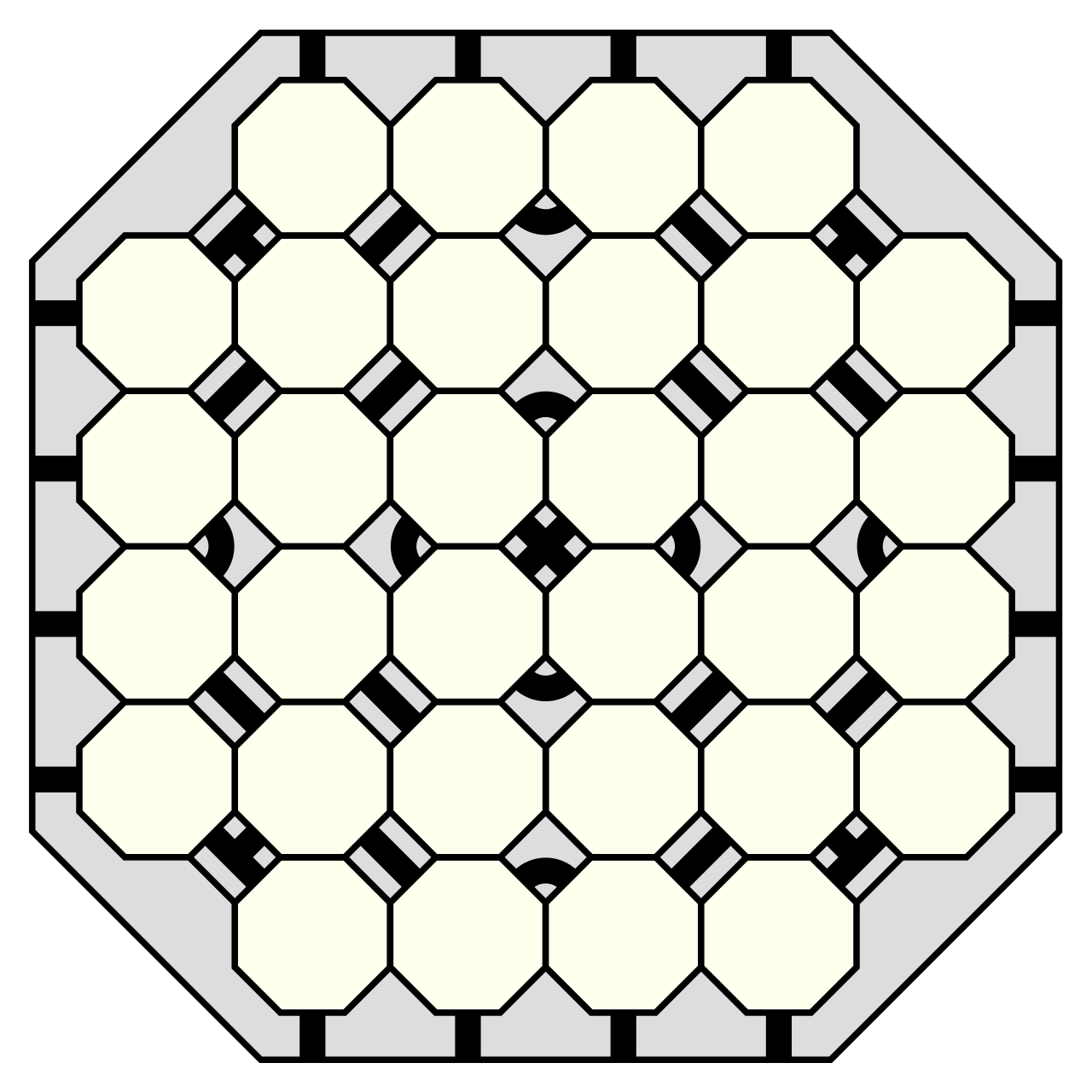
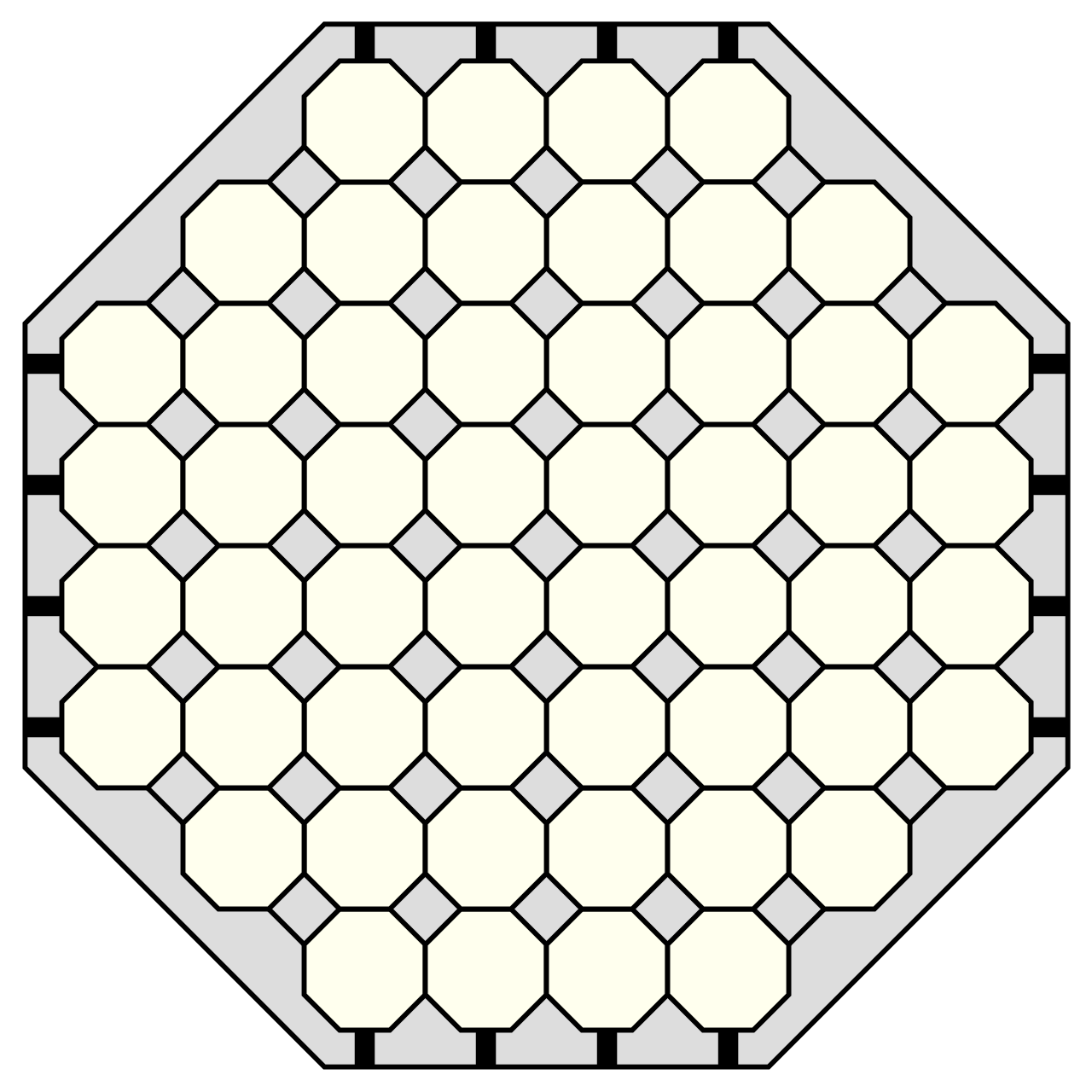
Crosstrack was designed by Philip Shoptaugh and first published in 1994 by Discovery Toys. The game is played on an octagonal board with 49 octagonal cells and 42 square interstitial spaces. Players place octagonal pathway pieces and square intersection pieces to create paths. A travel variant named Crosstrack Challenge was released in 1996 with a smaller 4×4 octagonal board and prepopulated connectors. In 1999, the license reverted to Shoptaugh, who re-released both versions, renaming the Challenge version to Crosstrack (standard size) and the original to Crosstrack (tournament size) or Large Crosstrack.
Reader's Guide
Crosstrack is significant as an example of a tile-based edge-matching path connection game, similar to Trax, Tsuro, Tantrix, and Octiles. Its unique octagonal board and combination of octagonal and square tiles distinguish it from games using only square or hexagonal tiles. The game supports two, three, or four players, as well as a team variant. Strategy involves controlling the ports at the edges of the board and understanding the strengths and weaknesses of different pieces. The game's legacy includes two published versions and a travel variant, with varying colors and board sizes depending on the publisher.
Did You Know?
- Crosstrack was first published in 1994 by Discovery Toys.
- The game board has 49 octagonal cells and 42 square interstitial spaces.
- A travel variant named Crosstrack Challenge was released in 1996 with a smaller 4×4 octagonal board.
- In 1999, the license reverted to Philip Shoptaugh, who re-released both versions with new names.
The Octagonal Board and Tile System
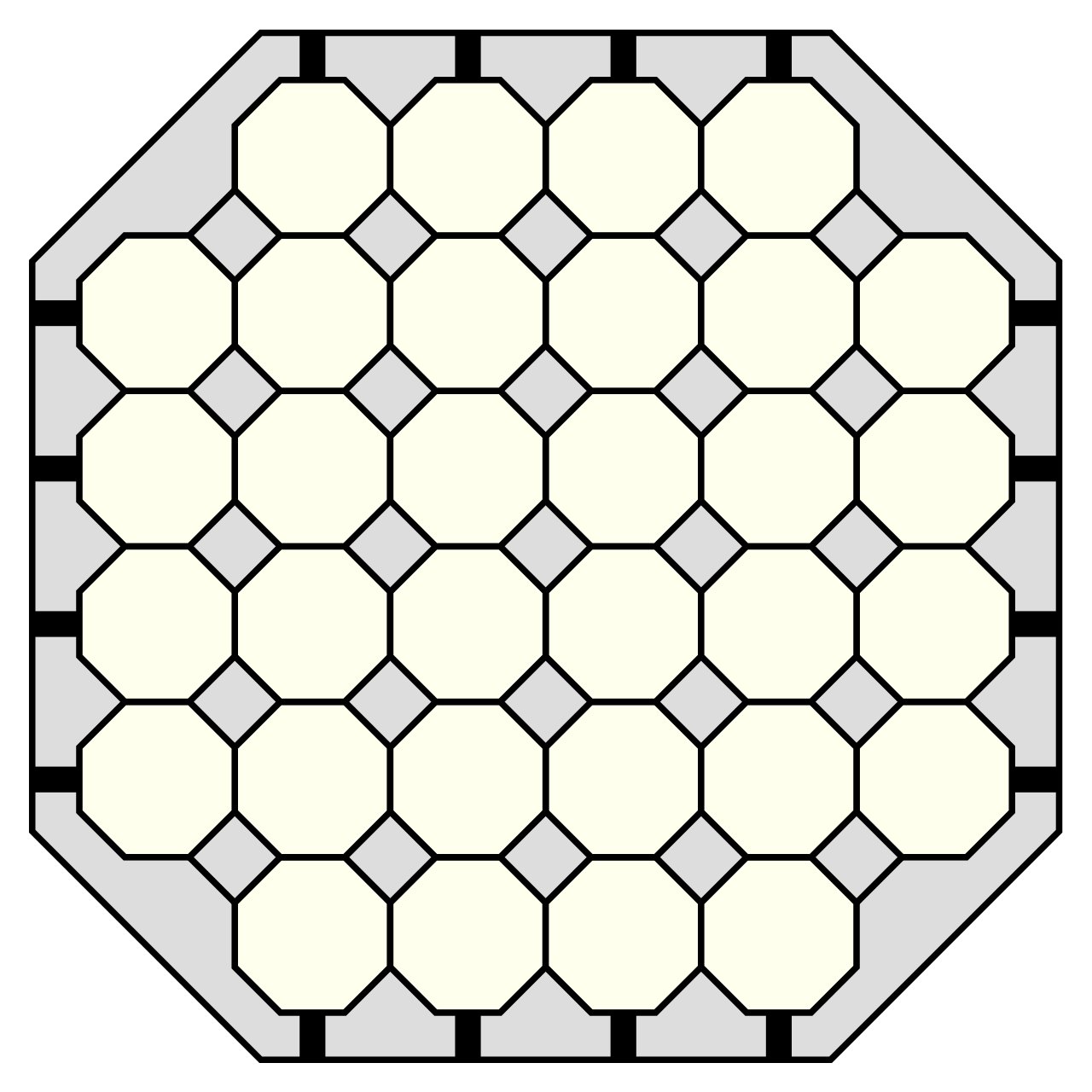
Crosstrack's most visually distinctive feature is its playing surface: an irregular octagonal board composed of 52 octagonal cells arranged in a 4×3 grid, punctuated by 45 square interstitial spaces. Four paths lead inward along each of the board's four 4-cell sides, giving the layout a radial symmetry that sets it apart from rectangular or hexagonal alternatives. The playing pieces come in two shapes. There are 32 octagonal pathway tiles, split into four color sets of eight, where each set contains eight unique track patterns—four tiles connecting three or four sides with two paths, and four connecting five or six sides with three paths. The remaining 16 pieces are square intersection tiles in a single black color, divided into four each of straight, crossed, tee, and elbow configurations. Philip L. Shoptaugh holds a patent covering this system of octagonal and square interstitial tiles bearing angular paths, and the specific combination of shapes and cell counts gives Crosstrack a spatial character unlike any other game in its family.
Turn Structure and Strategic Constraints
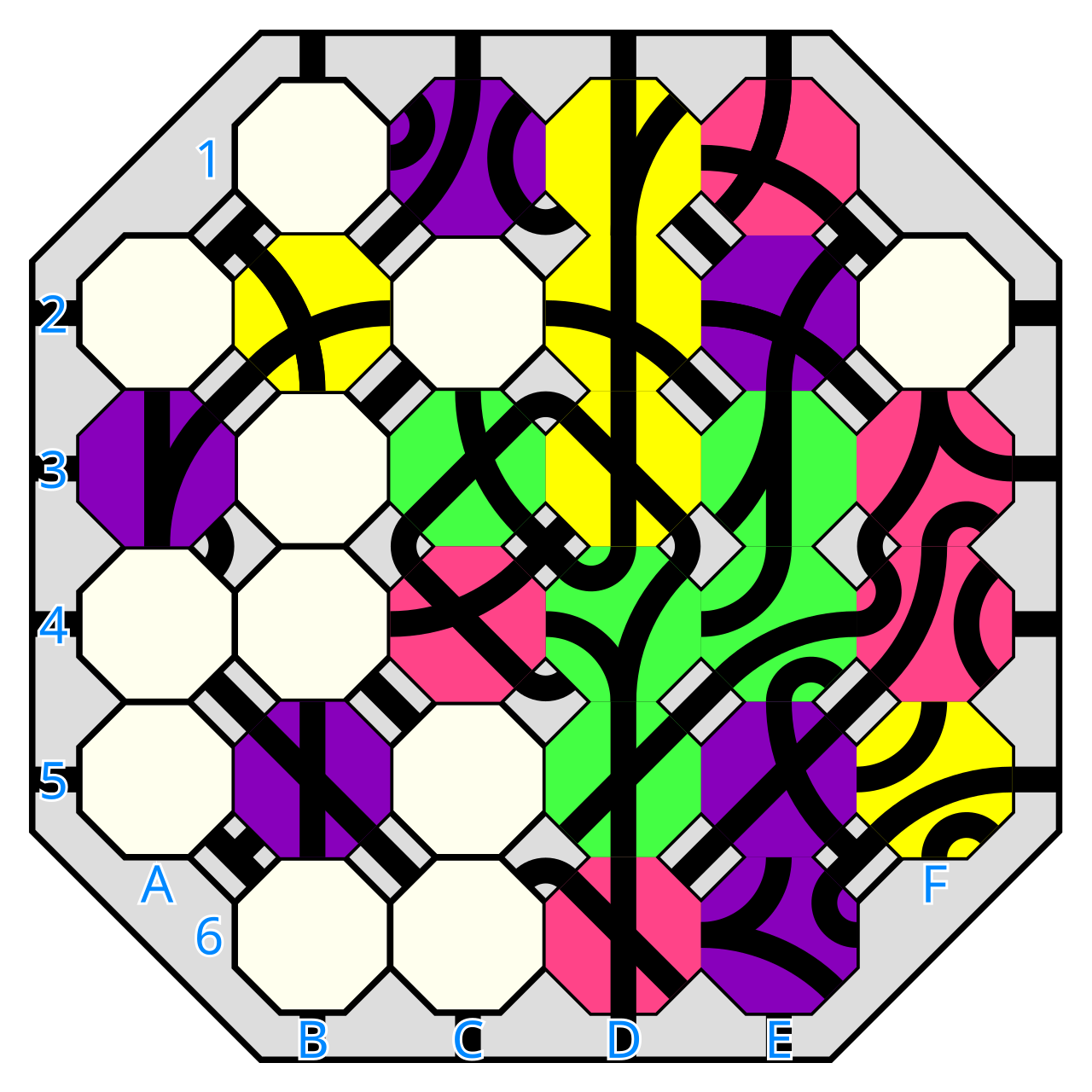
Each turn in Crosstrack offers a player exactly three options: place a new octagonal pathway tile from their personal stock onto any open cell, rotate one of their already-placed tiles to a different orientation, or relocate one of their tiles to a different unoccupied space. Crucially, rotation and relocation are mutually exclusive within a single turn—doing one precludes the other. A tile, once set down, can never be removed or swapped for a fresh one from the stock, and no player may ever rotate or shift an opponent's piece. In the 1994 and tournament editions, square intersection tiles drawn from a shared pool can be dropped in after the opening round, but once placed they are locked permanently. The three-player variant adds a particularly elegant layer: a fourth color serves as a common stock, and any player who acts on a common tile locks it for the next two turns, preventing immediate counter-manipulation. In the four-player team mode, partners sit opposite one another and may adjust each other's placed tiles, yet neither can draw from the other's stock, and discussion is permitted before a move is committed.
Publication Timeline and the Two Board Sizes
Philip Shoptaugh designed Crosstrack and it first hit shelves in 1994 under the Discovery Toys label, marketed with the tagline "unique track switching game." The original edition featured the larger 4×3 octagonal board measuring roughly 14 inches (360 mm) between opposite sides. In 1996 a compact travel version called Crosstrack Challenge appeared, shrinking the board to a 4×2 layout with just 32 octagonal cells and 25 pre-attached interstitial squares, eliminating the separate intersection pieces entirely and reducing the pathway tile count to 24 in sets of six. When the publishing license reverted to Shoptaugh in 1999, he reissued both formats under simplified names: the smaller board became simply "Crosstrack" at standard size, while the 1994 original was rebranded as "Crosstrack (tournament size)" or "Large Crosstrack." The smaller board measures about 9 inches (230 mm) across. Piece colors and board finishes have varied across publishers over the years, but the core tile patterns within each color set remain consistent between the two sizes, with the Challenge edition dropping three of the eight patterns from the larger game and adding one new crossed-path tile.
A Place in the Edge-Matching Path Game Family
Crosstrack belongs to a well-defined family of abstract strategy games built around tile-based edge-matching and path connection. The shared objective across this genre is to be the first player to forge an unbroken track linking two opposite sides of the board, regardless of which player's colored tiles happen to form the winning chain. Within the family, games are often distinguished by the geometry of their tiles. Trax, Tsuro, and the Black Path Game all use four-sided square tiles, while Tantrix and Kaliko employ hexagonal pieces. Octiles shares the octagonal tile shape with Crosstrack, making it the closest geometric cousin. What sets Crosstrack apart from even Octiles is the addition of square interstitial connector pieces that sit between the octagonal cells, creating a two-layer spatial puzzle where angular paths on octagons must negotiate with the fixed or placeable squares. The result is a game whose tactical texture shifts with every rotation or relocation, and whose board geometry—eight-sided outer perimeter with four inward-leading paths—offers a playing space that feels neither grid-like nor fully radial, but something in between.
Gallery
Frequently Asked Questions
Who designed Crosstrack?
Philip Shoptaugh is the designer behind this abstract strategy title. He developed the game as a tile-based path-connection experience for the board game market.
What is the main goal in a game of Crosstrack?
Players take turns placing tiles to build an unbroken, edge-matching path that links two opposite sides of the board. Whoever completes that connection first wins the round.
What shape is the Crosstrack board?
The playing surface is an irregular octagon, which gives the layout a distinctive non-square geometry. This shape influences how paths curve and how players plan their routes.
What types of tiles are used in Crosstrack?
The set includes octagonal tiles as well as square interstitial tiles that slot in between them. Together these two tile categories let players extend and branch their paths across the board.
When was Crosstrack first published?
The game hit the market in 1994, placing it squarely in the mid-nineties wave of abstract strategy board games. It has been a staple of the connection-game niche ever since.
More in Connection games 1-24
Spotted an error? Know more?
This is a living reference — every entry is fact-audited, and reader corrections feed straight into our audit queue. Suggest an edit · See this site's audit record