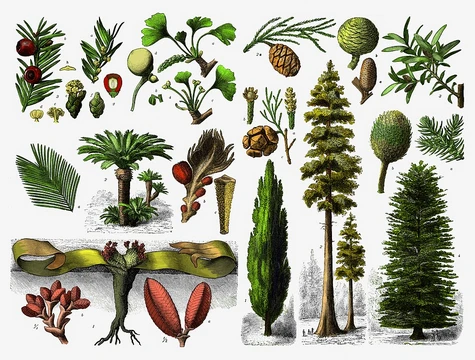
Taxaceae
Conifer family with fleshy arils and poisonous seeds.
Taxaceae, the yew family, comprises coniferous trees and shrubs with six living and two extinct genera, encompassing roughly thirty species. These plants are typically small, many-branched trees or shrubs with evergreen leaves arranged in a spiral, though the leaf bases are often twisted so that the foliage appears to be arranged in two rows. The leaves are linear to lanceolate in shape and feature pale green or white stomatal bands on their undersides. Members of this family are usually dioecious, with male and female reproductive structures on separate plants, though monoecious individuals occur rarely. The male cones are catkin-like, measuring two to five millimeters long, and release pollen in early spring; they can sometimes be difficult to distinguish from the branches. The female “cones” are highly reduced, with only the uppermost bracts bearing one or occasionally two seeds, which may grow singly or in clusters at branch ends. As the seed matures, a fleshy aril develops, either partly enclosing the seed, as seen in *Amentotaxus*, *Austrotaxus*, *Pseudotaxus*, and *Taxus*, or fully enclosing it, as in *Cephalotaxus* and *Torreya*. The aril’s developmental origin remains unclear but may represent fused, swollen leaves. While the seeds of some genera contain the potent poisons taxine and taxol, the mature aril is soft, juicy, often brightly colored, and sweet or resinous in flavor; birds eat the aril and disperse the hard, undamaged seed in their droppings. However, damaged seeds can release their toxins, posing a danger to humans. Taxaceae is now classified within the order Pinales based on DNA analysis and micromorphology, which show yews are phylogenetically nested among other conifers. The family is thought to be the sister group to Cupressaceae, diverging during the early to mid-Triassic, with the clade containing both being sister to Sciadopityaceae. The oldest confirmed fossil, *Palaeotaxus rediviva*, dates to the earliest Jurassic of Sweden, while Middle Jurassic fossils of *Amentotaxus* from China indicate substantial diversification had already occurred by that period. Debate persists over whether *Cephalotaxus* belongs in its own family, Cephalotaxaceae, but phylogenetic evidence strongly supports its inclusion within Taxaceae, as morphological differences—such as seed size and maturation time—are relatively minor compared to clear connection
- classification
- Family of conifers in order Pinales
- extant_genera
- 6
- extinct_genera
- 2
- species_count
- About 30
- key_characteristic
- Fleshy aril enclosing seeds; some seeds contain taxine and taxol
- distribution
- Mostly northern temperate regions; few species in tropics and Southern Hemisphere
Lore & Background
Taxaceae includes six extant genera: Amentotaxus, Austrotaxus, Pseudotaxus, Taxus, Cephalotaxus, and Torreya. (Note: In widely accepted botanical classification, Cephalotaxus is often placed in its own family, Cephalotaxaceae.) The plants are dioecious or rarely monoecious, with male cones 2–5 mm long that shed pollen in early spring. Female cones are highly reduced, with only the upper bracts fertile, bearing one or rarely two seeds. As the seed matures, a fleshy aril partly encloses it in Amentotaxus, Austrotaxus, Pseudotaxus, and Taxus, while in Cephalotaxus the seed is enclosed in a fleshy aril that is not fully fused to the seed coat (drupe-like but not a complete, separate aril), and in Torreya the aril is fleshy and partially encloses the seed. The aril is soft, juicy, often brightly colored and sweet, but resinous-flavored in others; birds eat the aril and disperse the hard seed undamaged, though damaged seeds can release poisons dangerous to humans.
Reader's Guide
Taxaceae is significant as a family of conifers that has been reclassified based on DNA analysis, now generally included in the order Pinales, whereas formerly it was often placed in a separate order Taxales. Phylogenetic evidence strongly supports a very close relationship between Cephalotaxus and other members of Taxaceae, leading most botanists to include Cephalotaxus within Taxaceae rather than recognizing a separate family Cephalotaxaceae. The family is thought to be the sister group to Cupressaceae, diverging during the early-mid Triassic, and the clade comprising both is sister to Sciadopityaceae. The oldest confirmed member is Palaeotaxus rediviva from the earliest Jurassic of Sweden, and fossils of Amentotaxus from the Middle Jurassic of China indicate substantial diversification by that time. The family's seeds contain the poisons taxine and taxol, making them highly poisonous to humans if damaged, yet the mature aril is safely eaten by birds, which disperse the seeds.
Did You Know?
- Taxaceae includes six extant genera and about 30 species.
- The seeds of some genera contain the poisons taxine and taxol.
- The oldest widely accepted Taxaceae fossils are from the Early Jurassic, providing strong evidence for the family's origin in that period.
- Taxus seeds take about 18 months to mature, while Cephalotaxus seeds take about 18–24 months to mature.
Frequently Asked Questions
Who is Taxaceae?
Taxaceae is a conifer family within the order Pinales, consisting of six living genera plus two that are now extinct, for a total of roughly thirty species. Rather than towering giants, its members are compact, many-branched evergreen trees and shrubs.
What are Taxaceae's signature traits?
The family stands out for its fleshy arils, soft berry-like coverings that partially or fully wrap the seeds—a feature unusual among conifers. Their foliage is also distinctive, with leaves frequently twisted at the base so they align into two neat, parallel rows.
Why is Taxaceae considered dangerous?
Seeds in several of its genera carry powerful toxins, notably taxine and taxol, which make them extremely hazardous if ingested. This toxic chemistry is one of the family's most widely recognized and talked-about characteristics.
Where does Taxaceae appear across the globe?
The bulk of its species occupy temperate zones throughout the Northern Hemisphere, with only a small number reaching into tropical regions or the Southern Hemisphere. It is therefore a predominantly northern-temperate family with a few scattered outliers.
How large is Taxaceae's roster of members?
The family counts six extant genera and two extinct ones, adding up to about thirty species in total. That modest number makes it one of the smaller conifer families, yet its aril-based seed strategy sets it apart from most of its relatives.
More in Conifers And Gymnosperms 1-24
Spotted an error? Know more?
This is a living reference — every entry is fact-audited, and reader corrections feed straight into our audit queue. Suggest an edit · See this site's audit record