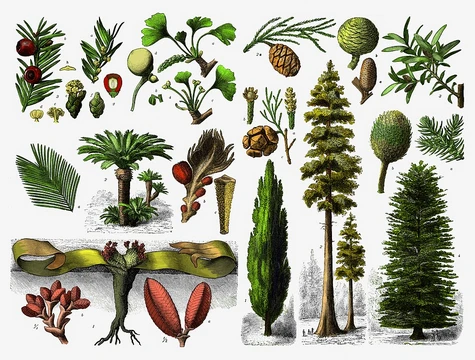
Pinales
Monotypic order of conifers, comprising only the pine family.

Pinales is a monotypic order within the subclass Pinidae, class Pinopsida, comprising only the family Pinaceae. Historically, the name Pinales was used interchangeably with Coniferales to refer to all conifers, but subsequent analyses have restricted its scope. The taxonomic history of this order is deeply intertwined with the broader classification of gymnosperms. In 1825, Brown identified two groups of seed plants based on whether ovules were exposed or enclosed, a distinction formalized by Lindley in 1830, who divided Dicotyledons into Gymnosperms and Angiosperms, placing conifers in the order Coniferae. Lindley’s later work (1853) placed conifers within the class Gymnogens as the order Pinaceae. Bentham and Hooker (1880) included conifers within Coniferae, alongside taxads. The Engler system (1903) listed Coniferae as a class. Gorozhankin (1895), who holds botanical authority for Pinales, classified gymnosperms into subclasses including Peucideae (Coniferae). Pilger’s revision (1926) grouped twelve gymnosperm families into two classes, including Coniferales. Benson (1957) introduced the term Pinales within the class Conopsida. Cronquist (1960) placed conifers in division Coniferophyta, class Coniferae. Later, Cronquist and collaborators (1966) merged all gymnosperms into division Pinophyta, with subdivision Pinicae. In molecular phylogenetics, De-Zhi and colleagues (2004) proposed a division with Coniferopsida including subclass Taxidae, order Pinales. The Angiosperm Phylogeny Group’s system (Chase and Reveal, 2009) placed conifers in subclass Pinidae, with one order. Since at least 2022, three orders of conifers are widely accepted: Pinales, Cupressales, and Araucariales. The extant conifers, numbering about 600 species in 70 genera, most likely form a monophyletic group.
- taxonomic_authority
- Gorozhankin (Gorozh.)
- classification
- Order Pinales, subclass Pinidae, class Pinopsida, division Pinophyta
- families_included
- 1 (Pinaceae)
- historical_usage
- Formerly synonymous with all conifers (Coniferales)
Lore & Background
The order Pinales, as currently recognized, is a monotypic order within the subclass Pinidae and class Pinopsida, containing only the family Pinaceae. Historically, the name Pinales was used interchangeably with Coniferales to refer to all conifers, a broad grouping accepted until at least 2011. However, subsequent analyses have divided the conifers into three distinct orders: Pinales, Cupressales, and Araucariales, a framework widely accepted since at least 2022. The taxonomic history of Pinales is intertwined with the broader classification of gymnosperms, which are seed plants with exposed ovules that receive pollen directly, a distinction first recognized by Brown in 1825 and formalized by Lindley in 1830. Lindley originally placed conifers in the order Coniferae within the tribe Gymnosperms. Later systems varied widely: Bentham and Hooker (1880) included taxads within Coniferae, while the Engler system (1903) listed Coniferae as a class. Gorozhankin (1895) bears the botanical authority for the name Pinales, placing it within his class Gymnospermae. In the twentieth century, Pilger (1926) grouped conifer families into the order Coniferales. Benson (1957) introduced the term Pinales, placing it within the class Conopsida. The modern era of molecular phylogenetics has seen further revisions, with the Angiosperm Phylogeny Group’s system (Chase and Reveal, 2009) placing conifers as the sole order within the subclass Pinidae. The extant conifers, numbering about 600 species across roughly 70 genera, most likely form a monophyletic group, though their relationships with other gymnosperm lineages, particularly Gnetophyta, remain subjects of ongoing research and debate.
Reader's Guide
Pinales holds significance as the sole order within the pine family Pinaceae, representing a key lineage of conifers. Its taxonomic history reflects broader shifts in gymnosperm classification, from early systems that grouped all conifers under a single order to modern molecular phylogenetics that recognizes three distinct orders. This change underscores ongoing controversies in gymnosperm taxonomy, particularly regarding the placement of Gnetophyta and the relationships among conifer families. The order's current monotypic status contrasts with historical treatments that included six to seven families, such as Araucariaceae, Cupressaceae, and Taxaceae. The phylogeny of conifers remains debated, with the 'gnepine' hypothesis placing Gnetidae within conifers, while other analyses support a five-clade model. Pinales thus serves as a focal point for understanding the evolution and classification of seed plants.
Did You Know?
- Pinales is a monotypic order comprising only the family Pinaceae.
- The name Pinales was historically used interchangeably with Coniferales to refer to all conifers.
Frequently Asked Questions
Who is Pinales?
Pinales is a monotypic taxonomic order of conifers named under the authority of Gorozhankin, sitting within the subclass Pinidae and class Pinopsida. It contains exactly one family, Pinaceae, making it the smallest and most narrowly defined of the three recognized conifer orders.
What is Pinales's role in the conifer classification?
Pinales occupies one of three top-level orders alongside Cupressales and Araucariales, and it is the order that houses the entire pine family (pines, spruces, firs, larches, and their close relatives). Its position in the subclass Pinidae places it firmly within the broader class Pinopsida of the division Pinophyta.
Why is Pinales important to the conifer world?
Because Pinaceae is by far the largest and most economically significant conifer family, Pinales is the order that encompasses the trees behind most timber, Christmas-tree, and reforestation industries. Losing the order would mean losing the formal taxonomic home for every pine, spruce, fir, and larch on Earth.
What happened to Pinales's old identity as 'all conifers'?
For much of botanical history the name Pinales was used interchangeably with Coniferales to lump every coniferous plant into a single order. Molecular and morphological analyses later showed that grouping all conifers together was too broad, so the name was restricted to just the pine family while Cupressales and Araucariales were carved out as separate orders.
More in Conifers And Gymnosperms 1-24
Spotted an error? Know more?
This is a living reference — every entry is fact-audited, and reader corrections feed straight into our audit queue. Suggest an edit · See this site's audit record