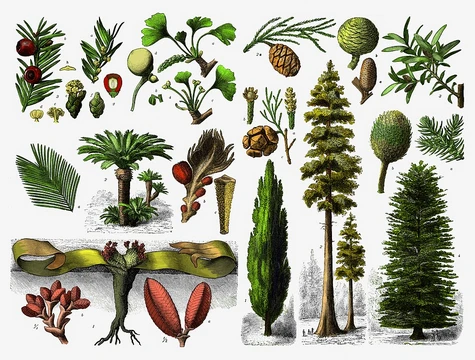
Picea engelmannii
A high-elevation spruce prized for tone wood and timber.

Picea engelmannii goes by several common names: Engelmann spruce, mountain spruce, and silver spruce. This conifer is native to western North America and is especially valued for the tone wood it provides for acoustic guitars and other musical instruments. It grows mostly at high elevations in mountain ranges, but also appears in cool, watered canyons.
The tree reaches a medium to large size, typically 25 to 40 meters tall, though exceptional individuals can grow to 65 meters, with trunks up to 1.5 meters in diameter. Its bark is reddish, thin, and scaly, flaking off in small circular plates. Young trees have a narrow, conical crown that becomes more cylindrical with age. The shoots are buff-brown to orange-brown, usually densely hairy, with prominent pulvini. The needle-like leaves are 15 to 30 millimeters long, flexible, and rhombic in cross-section. They are glaucous blue-green above with thin lines of stomata, and blue-white below with two broad bands of stomata. Crushing the needles releases a pungent odor.
In spring, the tree produces purple cones about 1 centimeter long that release yellow pollen when windy. The mature cones are pendulous, slender, and cylindrical, 2.5 to 8 centimeters long and about 1.5 centimeters wide when closed, opening to 3 centimeters wide. Their thin, flexible scales are 1.5 to 2 centimeters long with wavy margins. The cones start reddish to dark purple and mature to light brown four to seven months after pollination. The seeds are black, 2 to 3 millimeters long, with a slender, light brown wing 5 to 8 millimeters long. At the fringe of alpine tundra, the tree grows in a stunted, krummholz form.
Engelmann spruce is found from 520 to 3,650 meters above sea level, though rarely lower toward the northwest. Its range extends from central British Columbia south through the Rocky Mountains and the eastern slopes of the Cascade Range to southern Oregon, and east into Montana, Idaho, and Colorado. It appears more sparsely in Arizona and New Mexico’s sky islands, with two isolated populations in northern Mexico. In the Idaho Panhandle canyons and, more limitedly, the northeastern Olympic Mountains, some exceptionally large specimens occur—including one 2.1 meters in diameter and 55 meters tall. In the Cascade Range, it grows mostly on eastern slopes from 900 to 1,800 meters, and it is abundant in the Rocky Mountains. It also occurs in the Monashee and Selkirk Mountains and the highlands around the Interior Plateau.
Ecologically, Engelmann spruce saplings face challenges from reduced snowpack. When snow cover is lost, increased transpiration, low sapwood water reserves, and extended soil frost in windswept areas can prevent regeneration both above and below the tree line. Water uptake and root-stored water are critical for saplings exposed above snowpack in late winter to early spring. For exposed trees, soil water availability may be crucial in late winter when transpirational demands rise. Cuticular damage from windblown ice is more important at the tree line, while desiccation damage is more significant at lower elevations. Despite wind damage, this species tends to grow taller than other trees at the tree line. It is shade tolerant but less so than subalpine fir, so it depends somewhat on fires to outgrow competitors. However, its thin bark and shallow roots make it vulnerable to fire. Spruce bark beetles attack the tree, especially deadly to centuries-old stands, and avalanches also pose a threat. Older spruce forests offer little forage for animals, but after fires—which often burn completely—many other plants, especially deciduous ones, can thrive. Streams shaded by Engelmann spruce are used by trout, and aphids produce galls that hang from the tree and resemble dried cones.
Two geographical subspecies are accepted: *Picea engelmannii* subsp. *engelmannii* covers most of the range, while subsp. *mexicana* is found in two isolated populations on high mountains in northern Mexico—the Sierra del Carmen in Coahuila and Cerro Mohinora in Chihuahua. Engelmann spruces in the Madrean sky islands of extreme southeastern Arizona and southwestern New Mexico may also belong to this subspecies, though this is disputed. The species hybridizes extensively with white spruce in interior Canada, forming a complex known as *Picea × albertiana* (Alberta spruce or interior spruce), and to a lesser extent with Sitka spruce where they meet on the western fringes of the Cascades.
Native Americans used the resin and foliage for various medicines. Economically, the wood is light and fairly strong, harvested for paper-making and general construction. Wood from slow-grown, high-elevation trees is especially prized for soundboards in acoustic guitars, harps, violins, and pianos. Because it is odorless and low in resin, it has also been used for food containers like barrels. It is occasionally used as a Christmas tree.
- common_names
- Engelmann spruce, mountain spruce, silver spruce
- trunk_diameter
- up to 1.5 m (4 ft 11 in)
- native_range
- western North America, from central British Columbia to southern Oregon, and south to Arizona, New Mexico, and northern Mexico
- conservation_status
- not specified in source
Quick Facts
- Genus
- Picea
- Species
- engelmannii
Facts from the source article.
Lore & Background
Engelmann spruce is a medium-sized to large evergreen tree with reddish, thin, scaly bark and a narrow conic crown that becomes cylindric with age. Its needles are glaucous blue-green above and blue-white below, with a pungent odor when crushed. The tree produces yellow to reddish male cones that release yellow pollen, while the female cones are purple and do not release pollen. Its pendulous, slender cylindrical cones mature from reddish to dark purple to light brown. The seeds are black with a light brown wing. The species grows in a krummholz form along the fringe of alpine tundras and is found in the Rocky Mountains, the eastern slopes of the Cascade Range, and isolated populations in northern Mexico. It hybridizes with white spruce, but the hybrid is not known as Picea × albertiana; that name refers to the hybrid between white spruce and Sitka spruce. Hybridization with Sitka spruce is well-documented and the hybrid is known as Picea × lutzii. Two subspecies are recognized: Picea engelmannii subsp. engelmannii and Picea engelmannii subsp. mexicana, though the status of some populations in the Madrean sky islands is disputed. Ecologically, Engelmann spruce is shade tolerant but depends on fires to outcompete other species, though its thin bark and shallow roots make it vulnerable to fire. Spruce bark beetles attack the tree, and it is susceptible to avalanches. Saplings rely on snowpack for survival, and loss of snowpack can prevent regeneration. The tree's wood is light and fairly strong, used for paper-making, construction, and musical instrument soundboards.
Reader's Guide
Engelmann spruce holds significance as a source of high-quality tone wood for acoustic guitars, harps, violins, and pianos, particularly from slow-grown trees at high elevations. Its wood is also valued for being odorless and low in resin, making it suitable for food containers such as barrels. The species plays a role in forest ecology, providing shade for trout streams and supporting aphid galls that resemble dried cones. Its ability to grow at tree line and in krummholz form makes it a key component of alpine ecosystems. The tree's hybridization with white spruce and Sitka spruce contributes to a complex species group, and its isolated Mexican populations are of botanical interest. Native Americans used the resin and foliage for medicines. Despite its economic and ecological importance, the species faces threats from fire, bark beetles, and changing snowpack conditions, which may affect its regeneration in a warming climate.
Did You Know?
- Engelmann spruce needles have a pungent odor when crushed.
- The tree grows in a krummholz form along the fringe of alpine tundras.
- Its wood has a mild resinous odor and is not typically used for food containers due to its resin content.
- The species hybridizes with white spruce, but the hybrid is not named Picea × albertiana—that name belongs to the white spruce × Sitka spruce hybrid. Engelmann spruce does hybridize with Sitka spruce to form Picea × lutz
Frequently Asked Questions
What is Picea engelmannii?
Engelmann spruce is a high-elevation conifer in the spruce genus (Picea), native to the mountain ranges of western North America. It is one of the few conifers that thrives at extreme altitudes and is also found in watered canyon bottoms.
How large does Picea engelmannii get?
Mature specimens usually stand 25 to 40 meters tall with trunks reaching up to about 1.5 meters in diameter. In rare cases, individuals have been recorded at approximately 65 meters, making them among the tallest spruces in their range.
Why do luthiers and instrument makers seek out Picea engelmannii?
The wood is prized for its combination of light weight and stiffness, which produces a bright, resonant tone ideal for soundboards. It has become a go-to species for acoustic guitar tops and other stringed instruments because of that distinctive acoustic character.
What common names does Picea engelmannii go by?
Beyond its scientific name, you will most often see it listed as Engelmann spruce, mountain spruce, or silver spruce. The 'silver' nickname likely refers to the pale, blue-green hue of its needles.
More in Conifers And Gymnosperms 1-24
Spotted an error? Know more?
This is a living reference — every entry is fact-audited, and reader corrections feed straight into our audit queue. Suggest an edit · See this site's audit record