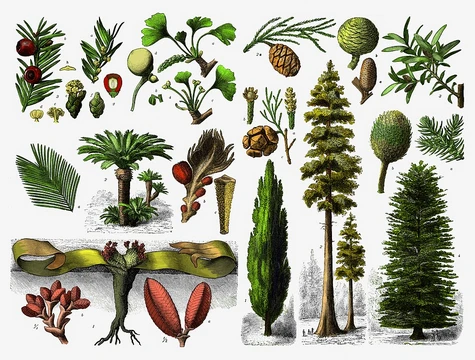
Spruce
A genus of coniferous trees, source of timber and pulp.
Spruce is a tree of the genus Picea, comprising some 37 species of coniferous evergreen trees in the family Pinaceae, found in the northern temperate and boreal (taiga) regions of the Northern Hemisphere. Spruces are distinguished from other Pinaceae by their four-sided needles attached singly to small persistent peg-like structures (pulvini) on the twigs, and by their resinous, monoecious nature with separate male and female cones on the same tree. They are a major producer of timber for construction and pulp for paper, and the Norway spruce is widely used for Christmas trees.
The genus name Picea derives from the Latin word for pitch, a substance historically obtained from the resin of the Norway spruce. The common name "spruce" entered Middle English from Old French, originally referring to goods imported from Prussia. Spruces typically have a straight trunk, though wind exposure or damage from browsing or insects can cause a bushy or irregular form. Young trees display a conical crown, which in older specimens becomes roughly cylindrical. Mature heights vary considerably, from 10 to 20 meters in smaller species like black spruce up to a maximum of 100 meters in Sitka spruce. Branches grow in regular whorls, with lower branches often lost unless the tree grows in full sun. Needles, which are square in cross-section and attached via pulvini, persist for four to ten years before shedding, leaving the twigs rough. Cone scale structure—including length, width, immature color, and apex shape—is the most reliable feature for identifying species. Spruces are generally moderate in lifespan, ranging from 100 to 600 years, with the oldest recorded single tree reaching 852 years. Clonal reproduction can extend this dramatically; a Norway spruce clone in Sweden, known as Old Tjikko, has achieved an estimated age of 9,550 years through layering. The fossil record of the genus extends back roughly 136 million years to the Early Cretaceous, though the surviving branch of the lineage diverged only about 30 million years ago. Pests affecting spruce forestry include the green spruce aphid, eastern spruce budworm, and two species of bark beetle. Beyond timber and paper, spruce is the standard material for soundboards of stringed instruments such as acoustic guitars, and Native Americans have used the roots of certain species for basket weaving. Artists from the 16th centur
- oldest_known_fossil
- ~100–90 million years old (Late Cretaceous)
- oldest_reported_tree_age
- over 600 years (Picea abies, Norway spruce in Sweden)
Quick Facts
- Taxon
- Picea
- Type Species
- Picea abies
- Type Species Authority
- (L.) H. Karst.
- Subdivision
- About 37; see text.
Facts from the source article.
Lore & Background
The scientific name Picea derives from Latin 'pix', meaning pitch, obtained from the resin of Picea abies. The English word 'spruce' comes from Middle English 'spruse' or 'Sprws', originally denoting goods imported from Prussia, and ultimately from Old French 'Pruce' (Prussia). The genus was first validly published by A. Spruces have a straight trunk, though can become bushy if damaged by wind or biotic factors. Young trees have a conical crown; older trees tend toward a cylindrical column. Branches grow in regular whorls, with lower branches soon lost except in open-grown trees. Needles range from 0.6–0.8 cm (Picea orientalis) to 3.5–5 cm (Picea smithiana). Cones range from 2–3.5 cm (Picea mariana) to 10–20 cm (Picea abies). The structure of cone scales is the most useful feature for identifying species. Pests of spruce forestry include green spruce aphid, eastern spruce budworm, European spruce bark beetle, and great spruce bark beetle. Spruce is the standard material for soundboards of stringed instruments like acoustic guitars. Native Americans use the roots of some species for weaving baskets.
Reader's Guide
Spruce trees, members of the genus *Picea*, are coniferous evergreens native to the northern temperate and boreal regions. They are distinguished from other pines by their four-sided needles, which are attached singly to small, peg-like structures on the twigs; these pegs remain after the needles are shed, leaving the branches rough. The trees are resinous and monoecious, bearing separate male and female cones on the same individual. Young spruces typically have a conical crown that becomes more cylindrical with age, with heights ranging from ten to one hundred meters depending on the species. Branches grow in regular whorls, with lower branches often lost unless the tree is in full sun. Needle length varies by species, from less than a centimeter to around five centimeters. Cones also vary widely in size, from two to twenty centimeters, and their scale structure is the primary feature for identifying species. Spruces have a moderate lifespan, generally one hundred to six hundred years, though one Engelmann spruce specimen reached 852 years. Clonal reproduction can extend this dramatically; a Norway spruce clone in Sweden, known as Old Tjikko, has achieved an estimated age of 9,550 years through layering. The genus is a major source of timber for construction and wood pulp for paper, and its wood is the standard material for the soundboards of acoustic guitars and other stringed instruments. Norway spruce is widely cultivated as a Christmas tree. Indigenous peoples have used the roots of certain species for basket weaving. Spruces face pests including the green spruce aphid, eastern spruce budworm, and European and great spruce bark beetles. The genus has a complex evolutionary history, with DNA studies revealing frequent conflict with traditional morphology-based classifications and strong evidence of reticulate evolution through hybrid introgression, as seen between *Picea abies* and *Picea obovata*, and between *Picea glauca* and *Picea engelmannii*.
Did You Know?
- The scientific name Picea derives from Latin 'pix', meaning pitch, obtained from the resin of Picea abies.
- The oldest reliably identified spruce fossils are from the Late Cretaceous, around 100–90 million years ago.
- Spruce is the standard material for the soundboards of stringed instruments like acoustic guitars.
Frequently Asked Questions
What exactly is Spruce in the conifer world?
Spruce is the genus Picea, a group of roughly 37 evergreen conifer species within the Pinaceae family. They are native to the cool northern temperate and boreal (taiga) zones of the Northern Hemisphere.
How do I tell a spruce apart from a fir or a pine?
Spruce needles are four-sided and attach one at a time to small, persistent peg-like bumps called pulvini on the twig, whereas firs have flat needles and pines have needles in bundles. Spruces are also resinous and monoecious, carrying both male and female cones on the same tree.
How old can a spruce tree actually get?
The oldest reported Norway spruce (Picea abies) in Sweden has surpassed 600 years of growth. Fossil records push the genus back an estimated 100 to 90 million years, to the Late Cretaceous period.
What are spruces actually used for by people?
They are a major source of construction timber and wood pulp for the paper industry. The Norway spruce, in particular, is the most popular species chosen for Christmas trees.
Where in the world do spruces grow?
Their range is confined to the Northern Hemisphere, where cool northern temperate and boreal climates dominate. You will not find them in the Southern Hemisphere or in tropical lowlands.
More in Conifers And Gymnosperms 1-24
Spotted an error? Know more?
This is a living reference — every entry is fact-audited, and reader corrections feed straight into our audit queue. Suggest an edit · See this site's audit record