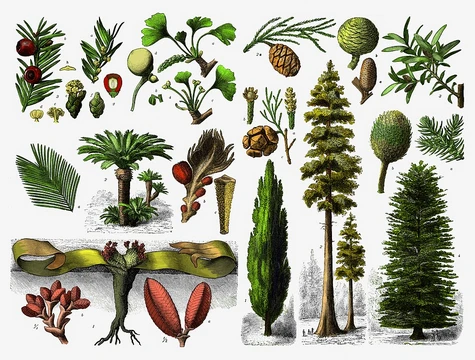
Pinus taeda

Pinus taeda, called loblolly pine, is a pine species native to the Southeastern United States, ranging from East Texas to Florida and north to southern New Jersey. In the wood industry, it is classified as a southern yellow pine. According to U.S. Forest Service surveys, it is the second most common tree species in the country, behind red maple, and it is considered the most commercially important tree in the Southeast for its timber. The name "loblolly" comes from the fact that this pine is typically found in lowlands and swampy areas.
Loblolly pine was the first among over 100 species of Pinus to have its complete genome sequenced. In March 2014, it held the record for the largest sequenced genome, with 22 billion base pairs—seven times larger than the human genome. By 2018, the axolotl genome (32 billion base pairs) surpassed it as the largest assembled genome. In 1939, the loblolly pine was designated the official state tree of Arkansas.
The tree typically reaches 30–35 meters (98–115 feet) in height, with a trunk diameter of 0.4–1.5 meters (1.3–4.9 feet). Exceptional specimens can grow to 50 meters (160 feet), making it the tallest of the southern pines. Its needles grow in bundles of three, sometimes twisted, and are 12–22 centimeters (4¾–8¾ inches) long—an intermediate length among southern pines, shorter than those of longleaf or slash pine but longer than those of shortleaf and spruce pine. The needles are yellowish-green to grayish-green and usually last up to two years before falling, giving the tree its evergreen appearance. While some needles drop year-round due to weather, insects, or drought, most fall in autumn and winter of their second year. The seed cones are green, ripening to pale buff-brown, 7–13 centimeters (2¾–5 inches) long and 2–3 centimeters (¾–1¼ inches) wide when closed, opening to 4–6 centimeters (1½–2¼ inches) wide, with each scale bearing a sharp spine 3–6 millimeters (⅛–¼ inch) long. The bark is reddish-brown and deeply fissured into irregular, broad, scaly plates on older trees. Branches are reddish-brown to dark yellowish-brown.
Loblolly pines are among the fastest-growing pines, making them valuable in the lumber industry. Their wood is marketed as yellow pine and used similarly to other southern pines, such as the stronger longleaf and shortleaf pines, as well as for pulpwood. They grow an average of 2 feet per year. The tallest known loblolly pine, at 51.4 meters (169 feet), and the largest, with a volume of 42 cubic meters (1,500 cubic feet), are both in Congaree National Park.
The word "loblolly" combines "lob," referring to thick, heavy bubbling of cooking porridge, and "lolly," an old British dialect word for broth, soup, or boiled food. In the southern United States, it means "a mudhole; a mire," referencing the consistency of porridge, and the pine is generally found in lowlands and swampy areas. Loblolly pines thrive in acidic clay soil, common throughout the South, making them prevalent in rural areas. Other old, rarely used names include oldfield pine (for its early colonization of abandoned fields), bull pine (for its size), rosemary pine (for its distinctive fragrance), and North Carolina pine. The scientific name *Pinus* is Latin for pines, and *taeda* refers to the resinous wood.
With wildfire suppression, loblolly pine has become common in parts of the Deep South once dominated by longleaf pine and, in northern Florida, slash pine. Its growth rate is rapid even among fast-growing southern pines. Several moths and beetles prey on young shoots, notably the Nantucket Pine Tip moth, which bores into shoots and consumes inner tissue. The yellowish, resinous wood is prized for lumber and wood pulp, and the tree is commercially grown in extensive plantations. Loblolly pine is the pine of the Lost Pines Forest near Bastrop, Texas, and in McKinney Roughs Nature Park along the Texas Colorado River—isolated populations on acidic sandy soil surrounded by alkaline clays poor for pine growth. A study using loblolly pines indicated that higher atmospheric carbon dioxide levels may help the trees better endure ice storms.
Notable trees include the "Eisenhower Tree" on the 17th hole of Augusta National Golf Club. President Dwight D. Eisenhower, a club member, hit the tree so often that at a 1956 meeting he proposed cutting it down; club chairman Clifford Roberts adjourned the meeting to avoid rejecting the request. In February 2014, an ice storm severely damaged the tree, and arborists deemed it unsalvageable, leading to its removal. The "Morris Pine" in southeastern Arkansas is over 300 years old, with a diameter of 142 centimeters (56 inches) and a height of 35.7 meters (117 feet). Loblolly pine seeds were carried aboard Apollo 14; after return, they were planted in several U.S. locations, including the White House grounds, and as of 2016, some of these "moon trees" remain alive.
Pines are the most common conifers, with over 100 species in the genus *Pinus*. Sequencing their genomes was a major challenge due to their size and complexity. Loblolly pine was the first species to have its genome sequenced.
- field
- Botany, Forestry
- native_range
- Southeastern United States (East Texas to Florida, up to southern New Jersey)
- known_for
- Most commercially important tree in the Southeastern U.S.; first Pinus species with complete genome sequenced; second-most common tree in the U.S.
- genome_size
- 22 billion base pairs (seven times larger than human genome)
Lore & Background
Loblolly pine can reach a height of 30–35 meters, with exceptional specimens up to 50 meters, making it the largest of the southern pines. Its needles are in bundles of three, 12–22 centimeters long, and yellowish-green to grayish green. The bark is reddish brown and deeply fissured into irregular, broad, scaly plates on older trees. The species is one of the fastest growing pines, averaging 2 feet per year, and its lumber is marketed as yellow pine, used similarly to other southern pines. The tallest known loblolly pine, 51.4 meters tall, and the largest, measuring 42 cubic meters in volume, are both in Congaree National Park. The common name 'loblolly' derives from an old British dialect word for thick porridge, used in the southern United States to mean 'a mudhole; a mire,' referencing the pine's prevalence in lowlands and swampy areas. Other historical names include oldfield pine, bull pine, rosemary pine, and North Carolina pine. The scientific name Pinus taeda refers to the resinous wood. With wildfire suppression, loblolly pine has become prevalent in parts of the Deep South once dominated by longleaf pine and slash pine.
Reader's Guide
Pinus taeda holds significant ecological and economic importance in the Southeastern United States. As the second-most common tree species in the country and the most commercially important in the region, it is extensively grown in plantations for lumber and wood pulp. Its rapid growth rate—among the fastest of southern pines—makes it a valuable resource for the timber industry, where its wood is classified as southern yellow pine. The species also plays a key role in forest ecology, particularly in areas where wildfire suppression has allowed it to replace longleaf and slash pines. Scientifically, loblolly pine is notable for being the first of over 100 Pinus species to have its complete genome sequenced. This genomic work has provided insights into conifer biology and the challenges of sequencing large, complex genomes. Its seeds traveled to the moon on Apollo 14, and the resulting 'moon trees' remain as living symbols of space exploration. The species also features in golf history through the Eisenhower Tree at Augusta National. Its ability to grow in acidic clay soils and its prevalence in lowlands have made it a familiar part of the Southern landscape.
Did You Know?
- Loblolly pine is the second-most common species of tree in the United States, after red maple.
- Loblolly pine seeds were carried aboard the Apollo 14 flight and planted in several locations in the US, including the White House grounds.
- The tallest known loblolly pine, 51.4 meters tall, and the largest, measuring 42 cubic meters in volume, are both in Congaree National Park.
More in Conifers And Gymnosperms 1-24
Spotted an error? Know more?
This is a living reference — every entry is fact-audited, and reader corrections feed straight into our audit queue. Suggest an edit · See this site's audit record