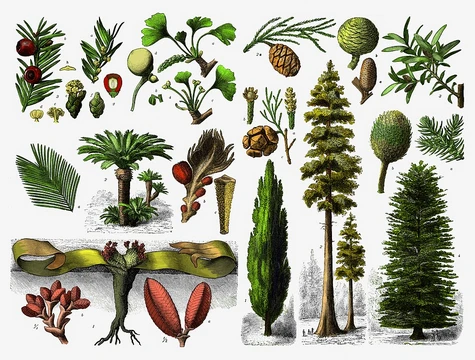
Pinus sylvestris
Ancient evergreen conifer native to Eurasia, valued for timber and ecology.

Pinus sylvestris is a species of tree in the pine family Pinaceae, native to Eurasia. Commonly known as Scots pine in English and Scotch pine in the United States, it is an ancient evergreen coniferous tree that has been a key component of northern European forests for millions of years. Its timber, called red deal or yellow deal, has been historically important for forestry and construction. The species can be readily identified by its combination of fairly short, blue-green leaves and orange-red bark. Before the 18th century, it was more often called Scots fir or Scotch fir, and it is occasionally referred to as Baltic pine, European red pine, or European redwood. A fossil seed cone of a related variety, dated to the late Pliocene epoch around 2.6 million years ago, underscores its ancient lineage. Modern trees typically reach up to a certain height and trunk diameter, though exceptional specimens on productive sites can grow taller and thicker; the tallest recorded, over 210 years old, stands in Estonia. Lifespan normally ranges from 150 to 300 years, with the oldest known specimens in Lapland, northern Finland, exceeding 760 years. The bark is thick, flaky, and orange-red on young trees, becoming scaly and gray-brown with age, though the upper trunk often retains the orange-red hue. Mature trees have a distinctive habit: a long, bare, straight trunk topped by a rounded or flat-topped crown. The blue-green needles are produced in pairs and persist for two to four years in warmer climates, up to nine years in subarctic regions. Seed cones are red at pollination, maturing over two years into pointed, ovoid-conic structures that release blackish seeds in spring. The species is the only pine native to northern Europe, ranging from Western Europe to eastern Siberia, and from the Arctic Circle south to the Caucasus and Anatolia. It thrives on poorer, sandy soils, rocky outcrops, and peat bogs, where it faces less competition from spruce or broad-leaved trees. In Britain and Ireland, pollen records show it spread after the Last Glacial Maximum, arriving in southern England from northeast France around 9,000 years ago and reaching Scotland between 8,000 and 8,500 years ago. It later became extinct across most of Britain and Ireland around 5,500 years ago, except in Scotland, Kielder in England, and The Burren in Ireland, with Irish and western Scottish population
- Scientific name
- Pinus sylvestris
- Common names
- Scots pine, Scotch pine, Baltic pine, European red pine
- Maximum trunk diameter
- 1 m (3 ft 3 in), exceptionally 1.7 m (5+1⁄2 ft)
- Native range
- Eurasia, from Western Europe to Eastern Siberia
- Conservation status
- Not specified in article
Lore & Background
Pinus sylvestris can be identified by its combination of fairly short, blue-green leaves and orange-red bark. The bark is thick, flaky, and orange-red when young, becoming scaly and gray-brown in maturity, though the upper portion of the trunk sometimes retains the orange-red color. Mature trees have a distinctive habit: a long, bare, straight trunk topped with a rounded or flat-topped mass of foliage. The needles are glaucous blue-green, 2.5–5 cm long, and produced in fascicles of two with a persistent gray basal sheath. On vigorous young trees, needles can be twice as long and occasionally occur in fascicles of three or four. Seed cones are red at pollination, then pale brown and globose in their first year, expanding to full size in their second year, maturing to gray-green or yellow-brown, 3–7.5 cm long. The cone scales have a flat to pyramidal apophysis with a small prickle on the umbo. Seeds are blackish, 3–5 mm long, with a pale brown wing, released when cones open in spring 22–24 months after pollination. The species is native to Eurasia, ranging from Western Europe to Eastern Siberia, south to the Caucasus and Anatolia, and north into the Arctic Circle. It is mainly found on poorer, sandy soils, rocky outcrops, peat bogs, or near the forest limit, as it is out-competed on fertile sites by spruce or broad-leaved trees.
Reader's Guide
Pinus sylvestris is the only pine native to northern Europe and has been a cornerstone of boreal and montane forests. It forms pure stands or mixes with species such as Norway spruce, silver birch, and Eurasian aspen. The species has significant ecological and historical importance, particularly in Scotland where it formed the Caledonian Forest. Overcutting, fire, overgrazing, and deliberate clearance have reduced this forest to about 1% of its original extent, but restoration efforts are underway. The tree's longevity may be linked to genetic factors, including strong negative selection during the haploid stage. A fossil seed cone dated to the late Pliocene (~2.6 million years ago) attests to its ancient lineage.
Did You Know?
- A fossil seed cone of Pinus montana fossilis, sent to the Swedish Museum of Natural History, was dated to the late Pliocene epoch (~2.6 million years ago).
- In the preindustrial age, Scandinavian countries used the pine for making tar.
More in Conifers And Gymnosperms 1-24
Spotted an error? Know more?
This is a living reference — every entry is fact-audited, and reader corrections feed straight into our audit queue. Suggest an edit · See this site's audit record