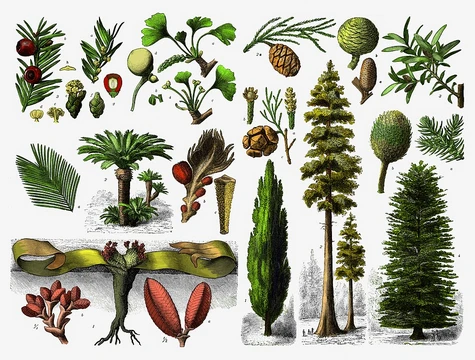
Pinus pinaster
A fast-growing pine native to Europe, invasive in South Africa.

**Pinus pinaster**, commonly called the maritime pine, is a fast-growing, hard pine native to the southern Atlantic coast of Europe and parts of the western Mediterranean. It features notably long needles and large cones, and produces medium-sized seeds equipped with large wings.
**Description**
This tree reaches a medium height of 20 to 35 meters, with exceptional individuals growing up to 41 meters, and a trunk diameter of up to 1.2 meters (rarely 1.9 meters). Its bark is thick, orange-red, and deeply cracked near the base, becoming thinner higher up. The needles grow in pairs, are 10 to 25 centimeters long, very stout (about 2 millimeters wide), and range from bluish-green to a distinct yellowish-green. Among all European pines, the maritime pine has the longest and most robust needles. The cones are conical, 8 to 22 centimeters long and 4 to 6 centimeters wide at the base when closed. They start green and turn glossy red-brown after two years. These cones open slowly over several years or after being heated by a forest fire, releasing seeds when they spread to 8 to 12 centimeters wide. The seeds are 8 to 10 millimeters long, shiny black on top and dull gray-brown underneath, with a 20 to 25 millimeter wing that aids wind dispersal.
**Taxonomy**
Maritime pine is closely related to Turkish pine, Canary Island pine, and Aleppo pine, sharing many features with them. It is a relatively uniform species with consistent form across its range, though three subspecies are recognized by the Plants of the World Online database (not all authorities agree): *Pinus pinaster* subsp. *pinaster* (Atlantic Europe), subsp. *escarena* (Mediterranean Europe), and subsp. *renoui* (northwest Africa’s Atlas Mountains).
**Distribution and Habitat**
Its native range spans the western Mediterranean Basin and the southern Atlantic coast of Europe, from central Portugal and northern Spain (especially Galicia) through southern and western France, east to western Italy and Croatia, and south to northern Tunisia, Algeria, and Morocco. It prefers a Mediterranean climate with cool, rainy winters and hot, dry summers. Outside its native range, it has become naturalized (and locally invasive) in southern England. It typically grows at low to moderate elevations, from sea level up to 600 meters, but reaches 2,000 meters in southern Morocco. Its current fragmented distribution results from mountain ranges isolating populations and from human activity.
**Ecology**
Factors like dispersal, habitat loss, and seed production influence how quickly this pine spreads. It favors acidic soils with medium to dense vegetation but can also grow in basic, sandy, or poor soils where few commercial species thrive. *Pinus pinaster* is a diagnostic species of the vegetation class *Pinetea halepensis*.
**Pests**
The larvae of the moth *Dioryctria sylvestrella* feed on this pine, and their boring causes heavy resin flow from wounds, weakening the tree and letting fungi and other pathogens enter. In Portugal, the ascomycete fungus *Pestalotiopsis pini* has emerged as a pathogen on both stone pine and maritime pine, with evidence of shoot blight and stem necrosis found in 2020 on needles, shoots, and trunks.
**Invasiveness**
Maritime pine is a key subject in invasion ecology due to its problematic spread in South Africa over the past 150 years. It was imported to the region in the late 17th century (1685–1693) and was found spreading in the Cape Peninsula by 1772. By the end of the 18th century, it was widely planted, and in the early 19th century (1825–1830), it was grown commercially for timber. It invades large areas, especially fynbos vegetation—a fire-prone shrubland in southern and southwestern Cape South Africa—and is most abundant near watercourses.
**Results of Invasion**
In South Africa, *Pinus pinaster* is a highly successful invasive species, reducing native biodiversity. Its introduction correlates with increased extinction rates of native species, as it occupies their habitats. In the Cape Peninsula, invasive species can decrease native plant diversity by 50 to 86%. In shrublands, species richness declines most sharply when invaded by this pine (Z = –1.33, p < 0.001). Compared to grasses, trees, annual herbs, and creepers have a larger impact on species loss (Z = –3.78; p < 0.001). South Africa experiences the greatest decline in species richness from invasive species among all countries studied, partly because few local insects or diseases limit *P. pinaster* as they do in its native range. The pine’s location also amplifies its negative effects. Additionally, where it invades grasslands or shrublands, it can significantly lower stream water levels, as it is an evergreen tree that consumes considerable water.
- trunk_diameter
- up to 1.2 m (4 ft), exceptionally 1.9 m (6 ft)
- needle_length
- 10–25 cm (4–10 in)
- cone_length
- 8–22 cm (3–8.5 in)
- seed_length
- 8–10 mm (0.31–0.39 in)
- native_range
- Western Mediterranean Basin and southern Atlantic coast of Europe
- invasive_region
- South Africa (since late 17th century)
Lore & Background
Pinus pinaster is a medium-sized tree with orange-red, thick, and deeply fissured bark. Its needles are in pairs, 10–25 cm long, stout, and bluish-green to yellowish-green, making them the longest and most robust of all European pine species. The cones are conic, 8–22 cm long, ripening glossy red-brown after 24 months, and open slowly or after heating by forest fire to release seeds. The seeds are 8–10 mm long with a 20–25 mm wing, dispersed by wind. The species is closely related to Turkish pine, Canary Island pine, and Aleppo pine. Three subspecies are accepted by the Plants of the World Online database, though not all authors consider them distinct: Pinus pinaster subsp. pinaster (Atlantic Europe), subsp. escarena (Mediterranean Europe), and subsp. renoui (Northwest Africa). Its native range extends from central Portugal and northern Spain to southern France, western Italy, Croatia, and south to northern Tunisia, Algeria, and northern Morocco. It is also naturalized in southern England and sporadically in northern California.
Reader's Guide
Pinus pinaster is significant both as a native component of Mediterranean ecosystems and as a problematic invasive species, particularly in South Africa. Introduced at the end of the 17th century, it spread rapidly and by the 19th century was planted commercially for timber. Its invasion of fynbos vegetation—a fire-prone shrubland—has led to severe ecological consequences, including a 50–86% decrease in native plant diversity in the Cape Peninsula. The species reduces streamflow dramatically: 55% decrease in Western Cape fynbos catchments after 23 years, 82% in KwaZulu-Natal Drakensberg after 20 years, and complete drying of six streams in Mpumalanga after 12 years. Thinning of P. The species also reduces understory vegetation for livestock grazing, though thinning improved conditions. Its success in South Africa is partly due to adaptation to high-intensity fires, which trigger seed release, and a lack of native pests and diseases. The species also faces emerging pathogens like Pestalotiopsis pini in Portugal.
Did You Know?
- Pinus pinaster has the longest and most robust needles of all European pine species.
- Its cones open slowly over several years or after being heated by a forest fire to release seeds.
- In South Africa, P. pinaster invasion reduced streamflow by 82% in KwaZulu-Natal Drakensberg after 20 years.
- The species is naturalized in southern England and sporadically in northern California.
Frequently Asked Questions
Who is Pinus pinaster?
Pinus pinaster, the maritime pine, is a fast-growing hard pine native to the western Mediterranean Basin and the southern Atlantic coast of Europe. It is easily recognized by its long paired needles and unusually large cones.
What are Pinus pinaster's key physical traits?
It typically stands 20–35 m tall, with exceptional individuals reaching 41 m, and its trunk can exceed 1.2 m in diameter. Its needles span 10–25 cm, and its cones measure 8–22 cm, making them among the largest in the pine family.
Where does Pinus pinaster originate?
Its native range stretches across the western Mediterranean Basin and the southern Atlantic coastline of Europe, covering parts of south Atlantic Europe and the western Mediterranean region.
What is Pinus pinaster's role beyond its home range?
In South Africa, Pinus pinaster has become a well-known invasive species, outcompeting indigenous vegetation and altering local ecosystems. This makes it a significant case study in how introduced conifers can disrupt new environments.
Why is Pinus pinaster important?
It provides both ecological services and economic value in its native range, offering hard timber, resin, and wildlife habitat. Its rapid growth and durable wood have made it a commercially prized species, while its invasive spread in South Africa underscores the dual-edged nature of introduced conifers.
More in Conifers And Gymnosperms 1-24
Spotted an error? Know more?
This is a living reference — every entry is fact-audited, and reader corrections feed straight into our audit queue. Suggest an edit · See this site's audit record