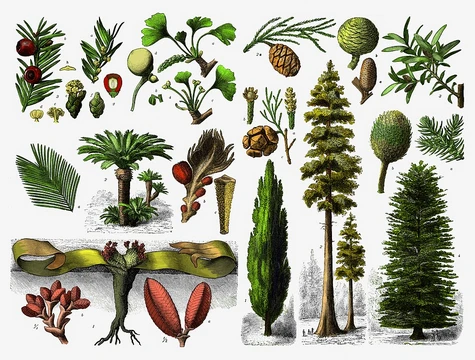
Pinus longaeva
A long-living pine species found in high mountains of the western United States.

The Great Basin bristlecone pine, also called the intermountain or western bristlecone pine, is a remarkably long-lived tree that grows in the high mountains of California, Nevada, and Utah. In 1987, it became one of Nevada’s state trees. The oldest known non-clonal living organism on Earth is a specimen named Methuselah, which has survived for 4,858 years.
This medium-size tree typically reaches 5 to 15 meters tall, with a trunk diameter of 2.5 to 3.6 meters. Its bark is bright orange-yellow, thin, and scaly near the base. The needles grow in bundles of five, are stout, 2.5 to 4 centimeters long, and deep green to blue-green on the outer side, with a bright white band of stomata on the inner surface. Some needles remain green for up to 45 years, among the longest persistence of any plant.
The cones are ovoid-cylindrical, 5 to 10 centimeters long and 3 to 4 centimeters wide when closed. They start green or purple, turn orange-buff after 16 months, and have many thin, fragile scales, each tipped with a bristle-like spine 2 to 5 millimeters long. When mature, the cones open to 4 to 6 centimeters wide and release seeds immediately. The seeds are 5 millimeters long with a wing of 12 to 22 millimeters, and are mostly spread by wind, though Clark’s nutcrackers also help disperse them.
Old trees develop a gnarled, stunted look, especially at high altitudes, with reddish-brown bark and deep fissures. As they age, much of the vascular cambium may die, leaving only a narrow strip of living tissue connecting the roots to a few live branches.
The Great Basin bristlecone pine differs from the Rocky Mountain bristlecone pine because its needles always have two uninterrupted resin canals, lacking the small white resin flecks seen on the other species. It differs from the foxtail pine because its cone bristles are over 2 millimeters long and the cone base is more rounded. The green needles give the twisted branches a bottle-brush appearance. The name “bristlecone pine” comes from the dark purple female cones, which have incurved prickles on their surface.
The species is found in Utah, Nevada, and eastern California. In California, it is limited to the White Mountains, Inyo Mountains, and Panamint Range in Mono and Inyo counties. In Nevada, it grows in most high ranges of the Basin and Range, from the Spring Mountains near Las Vegas north to the Ruby Mountains. In Utah, it reaches northeast to South Tent in the Wasatch Range. Because many sites are hard to reach, information on location and abundance is incomplete, and environmental niche modeling using GIS has helped map its distribution.
The tree grows in large open stands, unlike the related foxtail pine, which sometimes forms dense forests. Pinus longaeva generally does not create closed canopies, covering only 15 to 50 percent of an area. It shares habitats with ponderosa pine, white fir, and the similarly long-lived limber pine. It is a vigorous primary succession species, quickly colonizing new open ground, but is a poor competitor in good soils and does best in harsh terrain. It often dominates high-elevation dolomite soils where few plants survive.
Bristlecone pines are protected in federal areas like the Ancient Bristlecone Pine Forest in California’s White Mountains and Great Basin National Park in Nevada, where cutting or gathering wood is banned. Clark’s nutcrackers may help spread seeds, though direct observations of them foraging on these seeds are lacking. The birds store conifer seeds in the ground, and some uneaten seeds grow into new plants, often producing a multi-trunk form from several seeds germinating together. The prevalence of multi-trunk individuals in areas with nutcrackers suggests the birds disperse the seeds.
An introduced fungal disease, white pine blister rust (Cronartium ribicola), is believed to affect some individuals. The species was listed as Vulnerable on the IUCN Red List in 1998, but a 2011 population survey found the population stable, with no known subpopulations shrinking. The rust had a negligible effect, so the species was moved to Least Concern.
The tree is extremely fire-sensitive, damaged even by low-intensity burns. Its resinous bark ignites quickly, and a crown fire almost always kills it. However, populations are extremely resilient, and as a primary succession species, it would likely reestablish quickly after a fire. Large-scale fires are very uncommon where it grows and are not a major threat. Historically, stands experienced low to high severity fires, with fuel structures changing over time.
- species
- Pinus longaeva
- common_names
- Great Basin bristlecone pine, intermountain bristlecone pine, western bristlecone pine
- maximum_height
- 5 to 15 m (16 to 49 ft)
- trunk_diameter
- up to 2.5 to 3.6 m (8 to 12 ft)
Quick Facts
- Genus
- Pinus
- Parent
- Pinus subsect. Balfourianae
- Species
- longaeva
Facts from the source article.
Lore & Background
Pinus longaeva is a medium-size tree with bright orange-yellow bark that is thin and scaly at the base. Its needles are in fascicles of five, deep green to blue-green, and can remain green for up to 45 years. The cones are ovoid-cylindrical, ripening orange-buff after 16 months, with bristle-like spines. The seeds are dispersed by wind and also by Clark's nutcrackers, which may store seeds in the ground, leading to multi-trunk growth forms. The species occurs in Utah, Nevada, and eastern California, often in harsh, high-elevation dolomite soils where few other plants can grow. It is a vigorous primary succession species but a poor competitor in good soils. The trees are protected in areas such as the Ancient Bristlecone Pine Forest in California and Great Basin National Park in Nevada, where cutting or gathering wood is prohibited. The tree is extremely susceptible to fire, though large-scale fires are uncommon in its habitat. However, warmer temperatures could increase fire frequency at lower elevations.
Reader's Guide
Pinus longaeva holds profound significance as one of the longest-living non-clonal organisms on Earth. These trees have a gnarled, stunted appearance, especially at high altitudes, and often survive with only a narrow strip of living tissue connecting roots to a few live branches. Their wood is so durable that dead trees can persist for up to 7,000 years. The species is a key component of high-elevation ecosystems, sharing habitats with ponderosa pine, white fir, and limber pine. Its resilience in harsh conditions and its extreme longevity make it a subject of scientific study in dendrochronology and climate history. The species is protected in federal areas, and its population is currently stable, though fire risk may increase with climate change. The bristlecone pine's ability to endure for millennia in rocky, nutrient-poor soils exemplifies adaptation to extreme environments.
Did You Know?
- The needles of Pinus longaeva can remain green for up to 45 years, among the longest persistence of any plant.
- Clark's nutcrackers may disperse Pinus longaeva seeds, as evidenced by multi-trunk growth forms in areas where the birds are present.
Frequently Asked Questions
What is Pinus longaeva?
Pinus longaeva is a slow-growing pine native to the high-elevation ranges of California, Nevada, and Utah, often called the Great Basin bristlecone pine or western bristlecone pine. It is best known as the species that produces the oldest verified living non-clonal organisms on Earth.
Where does Pinus longaeva grow?
This species is restricted to the upper mountain zones of three western U.S. states—California, Nevada, and Utah—where cold, dry, high-altitude conditions slow its growth to a crawl and help explain its extraordinary lifespan.
How big does Pinus longaeva get?
Despite living for millennia, the tree stays relatively small, typically reaching 5 to 15 meters in height with a trunk diameter of roughly 2.5 to 3.6 meters. Its modest stature is a direct result of the extremely slow growth imposed by its harsh alpine habitat.
More in Conifers And Gymnosperms 1-24
Spotted an error? Know more?
This is a living reference — every entry is fact-audited, and reader corrections feed straight into our audit queue. Suggest an edit · See this site's audit record