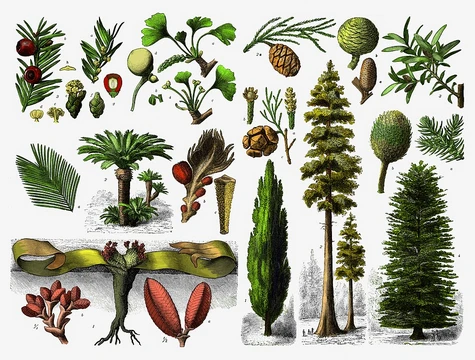
Pinus sylvestris
A resilient Eurasian pine with distinctive orange-red bark.
Last updated
The species is the only pine native to northern Europe, ranging from Western Europe to Eastern Siberia.[1] Belonging to the Pinaceae family, Pinus sylvestris is a tree species whose natural distribution covers Eurasia.[2]
Scientific classification
- CladeTracheophytes
- CladeGymnosperms
- ClassPinopsida
- OrderPinales
- FamilyPinaceae
- GenusPinus
- GenusPinus
- SpeciesPinus sylvestris
Named by L.
Close relatives
Other species of Pinus with a Codexery entry.
- Pinus elliottii Pinus elliottii
- Pinus halepensis Pinus halepensis
- Pinus lambertiana Pinus lambertiana
- Pinus longaeva Pinus longaeva
- Pinus pinaster Pinus pinaster
- Pinus pinea Pinus pinea
- Pinus ponderosa Pinus ponderosa
- Pinus strobus Pinus strobus
Sources: Wikipedia taxobox: Pinus sylvestris (CC BY-SA 4.0)
Conservation status
Least Concern (LC)
- LC▲ this species
- NT
- VU
- EN
- CR
- EW
- EX
Source: IUCN Red List assessment · GBIF copy of the Red List category
Where the pinus sylvestris has been recorded
Each dot is a place where the species has been observed and reported (1,190,614 records, half-degree grid) — not a modelled range. 397 inland records left out (institution coordinates).
Map: drawn by Codexery. Data: GBIF occurrence search (records CC0 / CC BY) · Natural Earth basemap (public domain) · place coordinates: Wikipedia (CC BY-SA 4.0)
Quick Facts
- Species
- sylvestris
Facts from the source article.
Key facts and history
The leaves are glaucous blue-green needles, 2.5–5 cm long, produced in fascicles of two.[3] Seed cones are red at pollination, then pale brown, expanding to full size in their second year.[4] Historical records indicate it also occurred in Wales and England until about 300–400 years ago.[5] Only 17,000 ha of this ancient forest remain, just over 1% of the estimated original 1,500,000 ha.[6]
When fully grown, contemporary specimens of this tree can attain heights of 35 m and trunk diameters of 1 m, though on very productive sites they can exceptionally exceed 45 m in height and 1.7 m in trunk diameter.[7] A specimen in Estonia, aged over 210 years, holds the record for the tallest at 46.6 m.[8] Young trees display a thick, flaky, orange-red bark that transitions to a scaly, gray-brown appearance as the tree matures, though the upper portion may sometimes retain the younger coloration.[9] Within Britain, the natural occurrence of this pine is currently restricted to Scotland.[5]
What the cited sources add
The Trees for Life account states the native pinewoods now cover approximately 17,000 hectares in isolated remnants.[10] The Fire Sciences Laboratory describes Scots pine as the most widely distributed pine in the world.[11] The same source notes Scots pine has more branches per whorl than red pine, making it weaker at nodes and subject to wind damage.[11] Bispham's Building Conservation Directory states that historically, Pinus sylvestris was recognized as a durable building material easily worked.[12]
The same source notes that slow-grown old-stand timber from Baltic ports was recognized by architects and craftsmen of the period.[12] The Fire Sciences Laboratory reports that young Scots pine trees are easily killed by fire due to their thin bark and shallow roots.[11]
References
- Wikipedia, "Pinus sylvestris" (CC BY-SA 4.0), which cites: Sullivan, "Pinus sylvestris", Fire Sciences Laboratory, Rocky Mountain Research Station, United States Department of Agriculture, 1993; "Scots Pine (Pinus sylvestris)", A–Z of British Trees (we also read that source) en.wikipedia.org
- Wikipedia, "Pinus sylvestris" (CC BY-SA 4.0), which cites: Bispham, "The Building Conservation Directory", Cathedral Communications, 2015, p. 123–126; Wu, "Response of Nitrogen Metabolism in Masson Pine Needles to Elevated CO2", Forests, 2020, p. 390 (we also read that source) en.wikipedia.org
- Wikipedia, "Pinus sylvestris" (CC BY-SA 4.0), which cites: Farjon, "Pines: Drawings and descriptions of the genus Pinus", Koninklijke Brill, 2005; Featherstone, "Species profile: Scots pine", Trees for Life; Steven, "The Native Pinewoods of Scotland", Oliver and Boyd, 1959 (we also read that source) en.wikipedia.org
- Wikipedia, "Pinus sylvestris" (CC BY-SA 4.0), which cites: Farjon, "Pines: Drawings and descriptions of the genus Pinus", Koninklijke Brill, 2005; Featherstone, "Species profile: Scots pine", Trees for Life (we also read that source) en.wikipedia.org
- Wikipedia, "Pinus sylvestris" (CC BY-SA 4.0), which cites: Featherstone, "Species profile: Scots pine", Trees for Life; Mirov, "The Genus Pinus", Ronald Press Company, 1967; Steven, "The Native Pinewoods of Scotland", Oliver and Boyd, 1959; Carlisle, "Biological Flora of the British Isles: Pinus sylvestris L.", Journal of Ecology, 1968, p. 269–307 (original not read by us) en.wikipedia.org
- Wikipedia, "Pinus sylvestris" (CC BY-SA 4.0), which cites: "Scots pine facts and information", Trees for Life (we also read that source) en.wikipedia.org
- Wikipedia, "Pinus sylvestris" (CC BY-SA 4.0), which cites: Rushforth, "Bäume", Hallwag AG, 1986; Marinich, "Scots Pine: Best Management Practices in Ontario", Ontario Invasive Plant Council, 2017 (original not read by us) en.wikipedia.org
- Wikipedia, "Pinus sylvestris" (CC BY-SA 4.0), which cites: "Eesti kõrgeim mänd osutus hiiglaseks ka ülejäänud maailmas", ERR Novaator, 9 February 2016; Farjon, "Pines: Drawings and descriptions of the genus Pinus", Koninklijke Brill, 2005; ; Featherstone, "Species profile: Scots pine", Trees for Life; Steven, "The Native Pinewoods of Scotland", Oliver and Boyd, 1959 (we also read that source) en.wikipedia.org
- Wikipedia, "Pinus sylvestris" (CC BY-SA 4.0), which cites: Marinich, "Scots Pine: Best Management Practices in Ontario", Ontario Invasive Plant Council, 2017; Featherstone, "Species profile: Scots pine", Trees for Life; ; Farjon, "Pines: Drawings and descriptions of the genus Pinus", Koninklijke Brill, 2005; ; Featherstone, "Species profile: Scots pine", Trees for Life; Steven, "The Native Pinewoods of Scotland", Oliver and Boyd, 1959 (we also read that source) en.wikipedia.org
- "Scots pine facts and information", Trees for Life. facts only, no text reused. treesforlife.org.uk
- Sullivan, "Pinus sylvestris", Fire Sciences Laboratory, Rocky Mountain Research Station, United States Department of Agriculture, 1993. facts only, no text reused. fs.usda.gov
- Bispham, "The Building Conservation Directory", Cathedral Communications, 2015, p. 123–126. facts only, no text reused. buildingconservation.com
Each numbered sentence above was checked against the source it cites before publication. Sentences citing Wikipedia adapt text from the English Wikipedia article Pinus sylvestris (contributors), used under CC BY-SA 4.0; this entry is available under the same licence. Other sources were used for facts only; no text or images are copied from them.
More in Conifers And Gymnosperms
Sources
Compiled from Wikipedia and the sources listed below. Text from Wikipedia is available under CC BY-SA 4.0; this entry is adapted from it.
- Wikipedia: Pinus sylvestris (CC BY-SA 4.0).
- Conservation status: IUCN Red List assessment.
- Occurrence records: GBIF (CC0 / CC BY). Basemap: Natural Earth (public domain).
Spotted an error? Know more?
Reader corrections go straight into our review queue. Suggest an edit · How this site is sourced