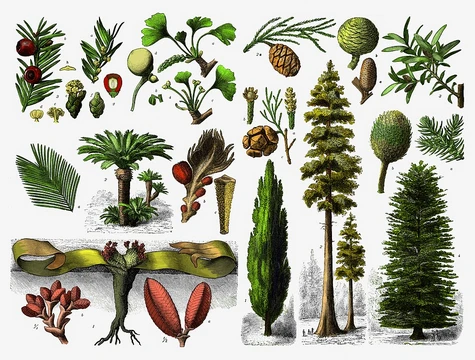
Pinus lambertiana
The tallest and most massive pine, with among the longest cones of any conifer.
Last updated
Pinus lambertiana, known as sugar pine, is the tallest and largest species within the genus Pinus.[1] The sweet resin that gave this tree its common name was used as a sweetener by Native Americans, and John Muir considered it superior to maple sugar.[2] David Douglas gave the species its scientific name in 1826, choosing to honor Aylmer Bourke Lambert, a botanist from London.[3][4]
Scientific classification
- CladeTracheophytes
- CladeGymnosperms
- ClassPinopsida
- OrderPinales
- FamilyPinaceae
- GenusPinus
- GenusPinus
- SpeciesPinus lambertiana
Named by Douglas
Close relatives
Other species of Pinus with a Codexery entry.
- Pinus elliottii Pinus elliottii
- Pinus halepensis Pinus halepensis
- Pinus longaeva Pinus longaeva
- Pinus pinaster Pinus pinaster
- Pinus pinea Pinus pinea
- Pinus ponderosa Pinus ponderosa
- Pinus strobus Pinus strobus
- Pinus sylvestris Pinus sylvestris
Sources: Wikipedia taxobox: Pinus lambertiana (CC BY-SA 4.0)
Conservation status
Least Concern (LC)
- LC▲ this species
- NT
- VU
- EN
- CR
- EW
- EX
Source: IUCN Red List assessment · GBIF copy of the Red List category
How big is it?
Largest length in the source, 0.56 m, next to a 1.8 m person.
Diagram: drawn by Codexery, schematic shapes to scale (not a likeness). Length: Wikipedia: Pinus lambertiana
Key facts and history
Sugar pine typically grows 40–60 m tall, with exceptional specimens reaching 82 m, and has a trunk diameter of 1.2–2.5 m.[1] Its bark is 5–10 cm thick and ranges from brown to purple.[5] The needles grow in bundles of five and are 5–11 cm long.[5][6] The seeds are 1–2 cm long with a 2–3 cm wing for wind dispersal.[6]
The species occurs from Oregon and California south to Baja California, in the Cascade Range, Sierra Nevada, Coast Ranges, and Sierra San Pedro Martir.[7][8] A specimen found in 2015 within Yosemite National Park stands 83.45 m tall, making it the tallest sugar pine ever recorded.[1] The species shows greater abundance in southern parts of its range and occupies elevations from 500 to 1500 m.[7] The PineRefSeq consortium sequenced the 31 gigabase genome in 2016, placing it among the largest genomes ever assembled.[9]
White pine blister rust, a fungal pathogen accidentally brought from Europe in 1909, has caused severe damage to sugar pine populations.[10][11]
What the cited sources add
The US Forest Service account notes that sugar pines may live 400–500 years and are second only to giant sequoia in total volume.[8] The same source reports that trees up to 76 m tall and 3 m in diameter have been recorded.[8] The Oregon State University landscape plants description states that needles persist 2–3 years and cones are 28–46 cm long, sometimes reaching 56 cm.[4] The Sugar Pine Foundation website explains that they find trees resistant to blister rust and plant them in forests to build a resilient white pine population.[12]
The mountain pine beetle, which originates from western North American forests, has led to extensive death of sugar pine and other commercially important species.[13]
References
- Wikipedia, "Pinus lambertiana" (CC BY-SA 4.0), which cites: Arno, "Northwest Trees: Identifying & Understanding the Region's Native Trees", Mountaineers Books, 2020, p. 26, 30–35; "3 Sierra sugar pines added to list of 6 biggest in world", Associated Press, 31 Jan 2021 (we also read that source) en.wikipedia.org
- Wikipedia, "Pinus lambertiana" (CC BY-SA 4.0), which cites: "Sugar pine", Oregonencyclopedia.org; Saunders, "Edible and Useful Wild Plants of the United States and Canada", Courier Dover Publications, 1976, p. 219 (we also read that source) en.wikipedia.org
- Wikipedia, "Pinus lambertiana" (CC BY-SA 4.0), which cites: Arno, "Northwest Trees: Identifying & Understanding the Region's Native Trees", Mountaineers Books, 2020, p. 26, 30–35; Muir, "The Mountains of California", Random House Publishing Group, 2010, p. 112–114 (we also read that source) en.wikipedia.org
- "Oregon State University", Landscape Plants. facts only, no text reused. landscapeplants.oregonstate.edu
- Wikipedia, "Pinus lambertiana" (CC BY-SA 4.0), which cites: Arno, "Northwest Trees: Identifying & Understanding the Region's Native Trees", Mountaineers Books, 2020, p. 26, 30–35; Arno, "Northwest Trees: Identifying & Understanding the Region's Native Trees", Mountaineers Books, 2020, p. 26, 30–35; Arno, "Northwest Trees: Identifying & Understanding the Region's Native Trees", Mountaineers Books, 2020, p. 26, 30–35 (we also read that source) en.wikipedia.org
- Wikipedia, "Pinus lambertiana" (CC BY-SA 4.0), which cites: ; Arno, "Northwest Trees: Identifying & Understanding the Region's Native Trees", Mountaineers Books, 2020, p. 26, 30–35; ; "Oregon State University", Landscape Plants; Habeck, "Pinus lambertiana", US Forest Service, 1990-10-26; Arno, "Northwest Trees: Identifying & Understanding the Region's Native Trees", Mountaineers Books, 2020, p. 26, 30–35; (we also read that source) en.wikipedia.org
- Wikipedia, "Pinus lambertiana" (CC BY-SA 4.0), which cites: Arno, "Northwest Trees: Identifying & Understanding the Region's Native Trees", Mountaineers Books, 2020, p. 26, 30–35 (we also read that source) en.wikipedia.org
- Habeck, "Pinus lambertiana", US Forest Service, 1990-10-26. facts only, no text reused. fs.usda.gov
- Wikipedia, "Pinus lambertiana" (CC BY-SA 4.0), which cites: Stevens, "Sequence of the Sugar Pine Megagenome", Genetics, 2016, p. 1613–1626; Stevens, "Sequence of the Sugar Pine Megagenome", Genetics, 2016, p. 1613–1626 (original not read by us) en.wikipedia.org
- Wikipedia, "Pinus lambertiana" (CC BY-SA 4.0), which cites: "National Wildlife Federation Field Guide to Trees of North America", Sterling, 2008, p. 79 (original not read by us) en.wikipedia.org
- Wikipedia, "Pinus lambertiana" (CC BY-SA 4.0), which cites: Maloney, "White Pine Blister Rust on High Elevation White Pines in California" (original not read by us) en.wikipedia.org
- "Sugar Pine Foundation", Sugarpinefoundation.org. facts only, no text reused. sugarpinefoundation.org
- "Mountain pine beetle", Ontarios invading species awareness program, 2012. facts only, no text reused. invadingspecies.com
Each numbered sentence above was checked against the source it cites before publication. Sentences citing Wikipedia adapt text from the English Wikipedia article Pinus lambertiana (contributors), used under CC BY-SA 4.0; this entry is available under the same licence. Other sources were used for facts only; no text or images are copied from them.
More in Conifers And Gymnosperms
Sources
Compiled from Wikipedia and the sources listed below. Text from Wikipedia is available under CC BY-SA 4.0; this entry is adapted from it.
- Wikipedia: Pinus lambertiana (CC BY-SA 4.0).
- Conservation status: IUCN Red List assessment.
- Word definitions: the , each quoted from its Wikipedia article.
Spotted an error? Know more?
Reader corrections go straight into our review queue. Suggest an edit · How this site is sourced