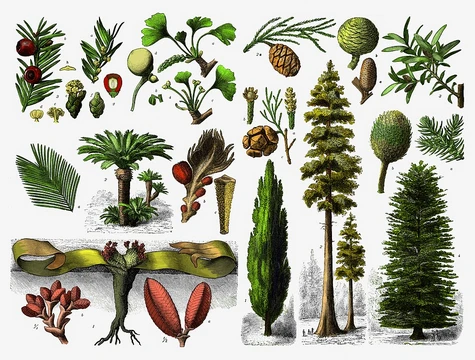
Pinus halepensis
A resilient Mediterranean pine with flaky upper bark and cones that open slowly over years.
Last updated
It grows 15 to 25 m tall with a trunk diameter up to 60 cm.[1] The Mediterranean region is the native range of a pine species known both as Aleppo pine and Jerusalem pine, which is scientifically named Pinus halepensis.[2] At the trunk's base, the bark exhibits an orange-red hue, is thick, and has deep fissures, whereas higher up in the crown it becomes thin and flakes off.[1]
Scientific classification
- CladeTracheophytes
- CladeGymnosperms
- ClassPinopsida
- OrderPinales
- FamilyPinaceae
- GenusPinus
- GenusPinus
- SpeciesPinus halepensis
Named by Mill.
Close relatives
Other species of Pinus with a Codexery entry.
- Pinus elliottii Pinus elliottii
- Pinus lambertiana Pinus lambertiana
- Pinus longaeva Pinus longaeva
- Pinus pinaster Pinus pinaster
- Pinus pinea Pinus pinea
- Pinus ponderosa Pinus ponderosa
- Pinus strobus Pinus strobus
- Pinus sylvestris Pinus sylvestris
Sources: Wikipedia taxobox: Pinus halepensis (CC BY-SA 4.0) · order, family and genus agree with WoRMS AphiaID 1492703 (CC BY 4.0)
Conservation status
Least Concern (LC)
- LC▲ this species
- NT
- VU
- EN
- CR
- EW
- EX
Source: IUCN Red List assessment · GBIF copy of the Red List category
Where the pinus halepensis has been recorded
Each dot is a place where the species has been observed and reported (388,831 records, half-degree grid) — not a modelled range. 197 inland records left out (institution coordinates). 1 isolated far-off record not drawn.
Map: drawn by Codexery. Data: GBIF occurrence search (records CC0 / CC BY) · Natural Earth basemap (public domain) · place coordinates: Wikipedia (CC BY-SA 4.0)
Quick Facts
- Species
- halepensis
Facts from the source article.
Key facts and history
Miller probably never visited Aleppo but noted large specimens at Goodwood transplanted in 1739.[3] The seeds are 5 to 6 mm long with a 20 mm wing and are wind-dispersed.[1] The species is generally found at low altitudes, mostly from sea level to 200 m.[4] Paired needles, which are a distinct yellowish-green, measure between 6 and 12 cm in length and are notably slender.[1]
After 24 months, the narrow, conic cones, which span 5 to 12 cm in length, mature to a glossy red-brown color.[1] The cones' opening, which usually takes place over several years, is accelerated when they are subjected to heat, for instance from wildfires.[1] South Africa classifies this tree as an invasive species.[5] The painting The Big Trees by Paul Cézanne was inspired by an Aleppo pine located in his garden in Aix-en-Provence.[6]
What the cited sources add
Open and disturbed areas are rapidly colonized by this tree, as noted in sources like Farjon and Rushforth.[4] The timber from this species is prized because of its hardness and density.[7] When planing seasoned timber, tear-out is a common problem that can be mitigated by employing sharp blades.[8] War memorials frequently feature plantings of this tree.[9]
References
- Wikipedia, "Pinus halepensis" (CC BY-SA 4.0), which cites: Farjon, A. (2005). Pines. Drawings and Descriptions of the genus Pinus. Brill, Leiden. .; Rushforth, K. (1999). Trees of Britain and Europe. Collins .; Nahal, I. (1962). Le Pin d'Alep (Pinus halepensis Miller). Étude taxonomique, phytogéographique, écologique et sylvicole. Annales de l'École National des Eaux e (original not read by us) en.wikipedia.org
- Wikipedia, "Pinus halepensis" (CC BY-SA 4.0), which cites: Aisner, "Ontogeny of pine cone opening behaviour in the black rat, Rattus rattus", Animal Behaviour, 1992-08-01, p. 327–336 (original not read by us) en.wikipedia.org
- Wikipedia, "Pinus halepensis" (CC BY-SA 4.0), which cites: Miller, "The Gardener's Dictionary", biodiversitylibrary.org, 1768 (original not read by us) en.wikipedia.org
- Wikipedia, "Pinus halepensis" (CC BY-SA 4.0), which cites: Farjon, A. (2005). Pines. Drawings and Descriptions of the genus Pinus. Brill, Leiden. .; Rushforth, K. (1999). Trees of Britain and Europe. Collins . (original not read by us) en.wikipedia.org
- Wikipedia, "Pinus halepensis" (CC BY-SA 4.0), which cites: "Aleppo pine – Invasive Species South Africa", invasives.org.za; Facy, B., "Aleppo and Brutia pines - Pinus halepensis/Pinus brutia", EUFORGEN Technical Guidelines for Genetic Conservation and Use, 2003 (original not read by us) en.wikipedia.org
- Wikipedia, "Pinus halepensis" (CC BY-SA 4.0), which cites: Cézanne, P. "Visions". In Architectural Digest, December 2005: 117. (original not read by us) en.wikipedia.org
- Wikipedia, "Pinus halepensis" (CC BY-SA 4.0), which cites: F.T. Maestre, J. Cortina . "Are Pinus halepensis plantations useful as a restoration tool in semiarid Mediterranean areas?" Forest Ecology and Management, 2004 (original not read by us) en.wikipedia.org
- Wikipedia, "Pinus halepensis" (CC BY-SA 4.0), which cites: Reducing Tear Out when Wood Planingwww.evenfallstudios.com (original not read by us) en.wikipedia.org
- Wikipedia, "Pinus halepensis" (CC BY-SA 4.0), which cites: "Lone Pine tree at the Australian War Memorial" (original not read by us) en.wikipedia.org
Each numbered sentence above was checked against the source it cites before publication. Sentences citing Wikipedia adapt text from the English Wikipedia article Pinus halepensis (contributors), used under CC BY-SA 4.0; this entry is available under the same licence. Other sources were used for facts only; no text or images are copied from them.
More in Conifers And Gymnosperms
Sources
Compiled from Wikipedia and the sources listed below. Text from Wikipedia is available under CC BY-SA 4.0; this entry is adapted from it.
- Wikipedia: Pinus halepensis (CC BY-SA 4.0).
- Classification: the source article's taxobox; order, family and genus checked against WoRMS, the World Register of Marine Species (CC BY 4.0).
- Conservation status: IUCN Red List assessment.
- Occurrence records: GBIF (CC0 / CC BY). Basemap: Natural Earth (public domain).
Spotted an error? Know more?
Reader corrections go straight into our review queue. Suggest an edit · How this site is sourced