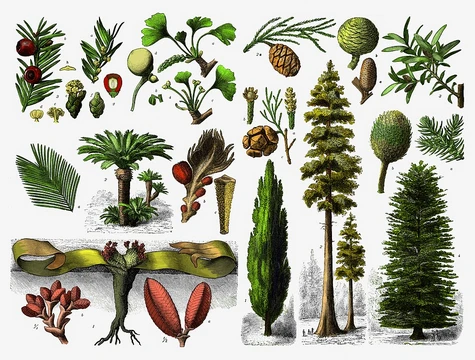
Tsuga
Genus of conifers with hemlock common name, not poisonous.
Last updated
Tsuga is a genus of conifers in the pine family, subfamily Abietoideae, whose name comes from the Japanese word for Tsuga sieboldii.[1] The English common name "hemlock" for Tsuga species comes from the smell of their crushed leaves being similar to the poisonous plant hemlock, but unlike that plant, Tsuga species are not toxic.[2] Depending on the taxonomic authority consulted, the genus Tsuga contains between eight and ten species, with four found in North America and four to six in eastern Asia.[3]
Scientific classification
- CladeTracheophytes
- CladeGymnosperms
- ClassPinopsida
- OrderPinales
- FamilyPinaceae
- GenusTsuga
Named by (Endl.) Carrière
Sources: Wikipedia taxobox: Tsuga (CC BY-SA 4.0)
Quick Facts
- Field
- Botany
- Species count
- 8–10 (depending on authority)
- Distribution
- North America and eastern Asia
Facts from the source article.
Key facts and history
Leaves are flattened, 5 to 35 mm long and 1 to 3 mm broad, arranged spirally on the stem with twisted bases so they lie flat.[3] The undersides have two white stomatal bands separated by an elevated midvein, except in T. mertensiana where stomata also appear on the upper surface.[3] Seed cones are small, ovoid to oblong-cylindric, 15 to 40 mm long, except in T. mertensiana where they are cylindrical and 35 to 80 mm.[3] Tsuga trees are evergreen, reach heights of 10 to 60 m, and have crowns that are conical or irregular in shape.[3]
The tips of the leading shoots typically hang downward, and the branches grow horizontally from the trunk in flattened sprays that curve down at their ends.[3] Twigs from the Early Cretaceous of Inner Mongolia, China, represent the oldest fossils assigned to Tsuga, although their connection to modern species is not certain.[4]
References
- Wikipedia, "Tsuga" (CC BY-SA 4.0), which cites: Sunset Western Garden Book, 1995:606–607 (original not read by us) en.wikipedia.org
- Wikipedia, "Tsuga" (CC BY-SA 4.0), which cites: Mitchell, "Conifers in the British Isles: a descriptive handbook", 1972, p. 302; Farjon, "A handbook of the world's Conifers", Brill Publishers, 2010, p. 533–1111 (we also read that source) en.wikipedia.org
- Wikipedia, "Tsuga" (CC BY-SA 4.0), which cites: Farjon, "Pinaceae. Drawings and Descriptions of the Genera", Koeltz Scientific Books, 1990; Rushforth, "Conifers", Helm, 1987; {{Gymnosperm Database |family= Pinaceae |genus= Tsuga |access-date= 2007-05-16 |ref= }}; {{eFloras|2|133931|Tsuga |family= Pinaceae |first1= Liguo |last1= Fu |first2= Nan |last2= Li |first3= Thomas S. |last3= Elias |first4= Robert R. |last4= Mill |a; {{eFloras|1|133931|Tsuga |family= Pinaceae |first= Ronald J. |last= Taylor |access-date= 2007-05-16 |ref= }} (we also read that source) en.wikipedia.org
- Wikipedia, "Tsuga" (CC BY-SA 4.0), which cites: Wu, "Tsuga seed cones from the late Paleogene of southwestern China and their biogeographical and paleoenvironmental implications", Palaeoworld, 2020, p. 617–628; Li, "Exceptionally well-preserved seed cones of a new fossil species of hemlock, Tsuga weichangensis sp. nov. (Pinaceae), from the Lower Miocene of Hebei Province, North China", Journal of Systematics and Evolution, Janu; Xiao, "Influence of climate factors on the global dynamic distribution of Tsuga (Pinaceae)", Ecological Indicators, January 2024 (original not read by us) en.wikipedia.org
Each numbered sentence above was checked against the source it cites before publication. Sentences citing Wikipedia adapt text from the English Wikipedia article Tsuga (contributors), used under CC BY-SA 4.0; this entry is available under the same licence. Other sources were used for facts only; no text or images are copied from them.
More in Conifers And Gymnosperms
Sources
Compiled from Wikipedia and the sources listed below. Text from Wikipedia is available under CC BY-SA 4.0; this entry is adapted from it.
- Wikipedia: Tsuga (CC BY-SA 4.0).
- Word definitions: the , each quoted from its Wikipedia article.
Spotted an error? Know more?
Reader corrections go straight into our review queue. Suggest an edit · How this site is sourced