
Pinus strobus
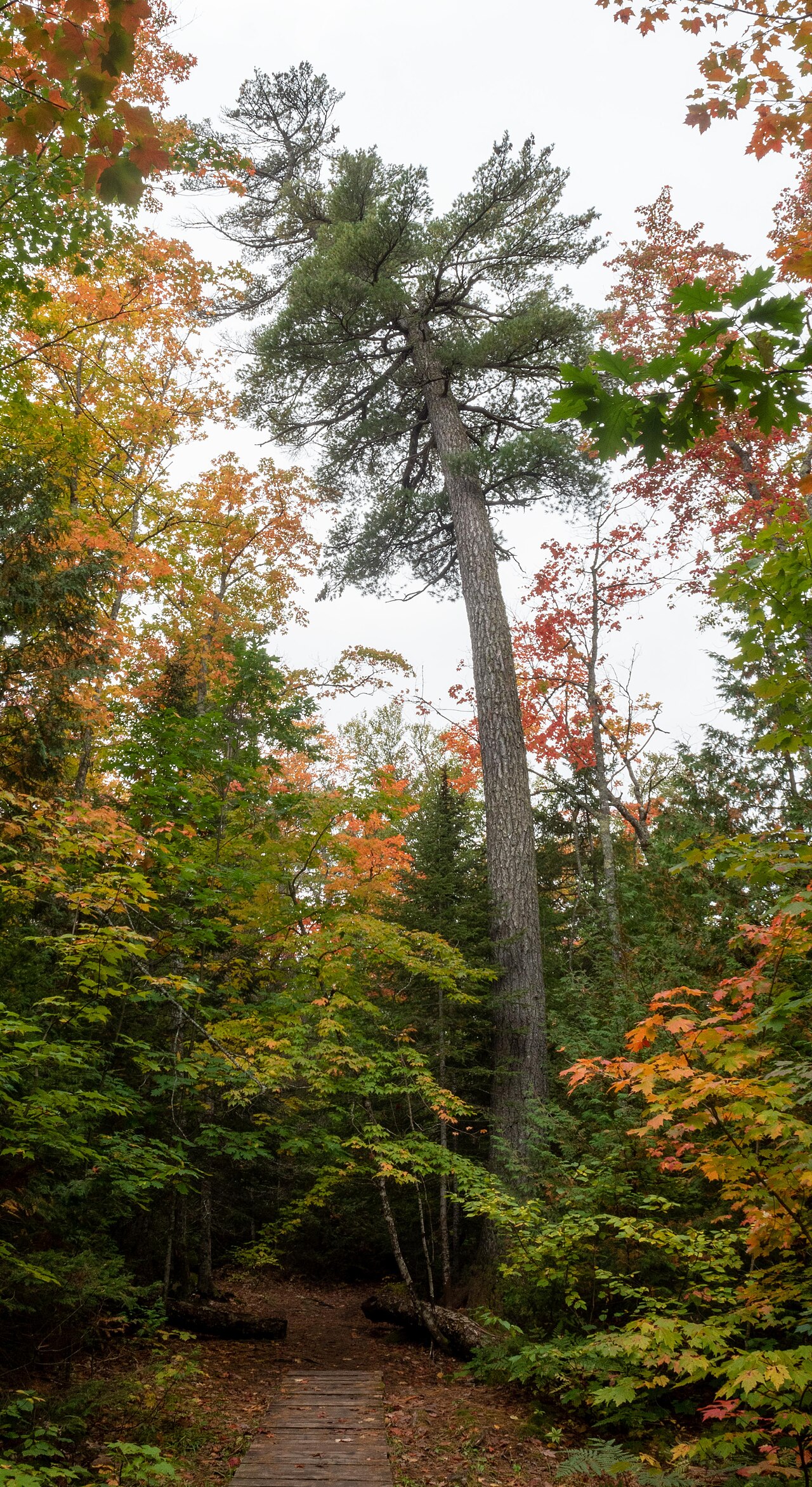
Eastern white pine is the tallest tree in eastern North America.

OlyScientist · CC BY-SA 4.0
**Pinus strobus**, known as eastern white pine, northern white pine, white pine, Weymouth pine (in Britain), or soft pine, is a large conifer native to eastern North America. Its range stretches from Newfoundland, Canada, west through the Great Lakes region to southeastern Manitoba and Minnesota, then south along the Appalachian Mountains and upper Piedmont to northernmost Georgia, with rare occurrences at higher elevations in northeastern Alabama. It is considered rare in Indiana. For the Haudenosaunee, this tree is the central symbol of their confederation, called the "Tree of Peace."
**Distribution**
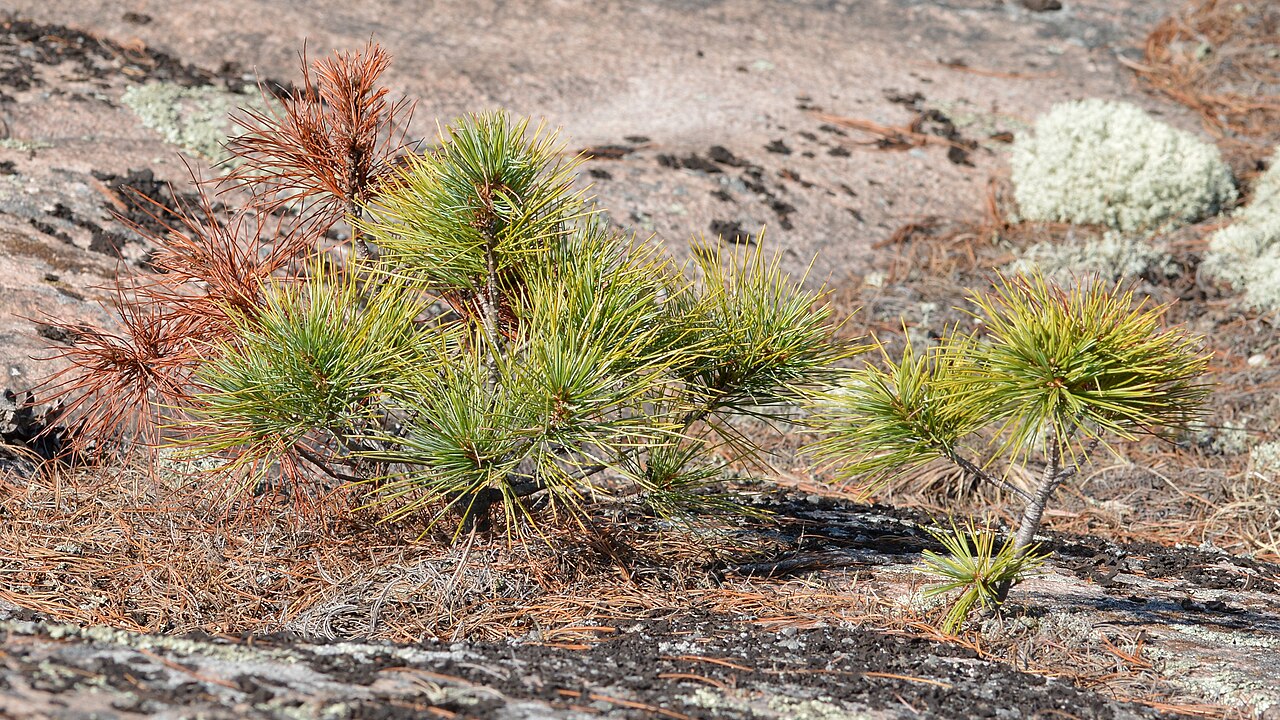
*P. strobus* grows in cool-temperate, hemiboreal, and southern-mid boreal forests of eastern North America. It favors well-drained or sandy soils and humid climates, but also tolerates boggy areas and rocky highlands. In mixed forests, it towers over many other trees, including large broadleaf hardwoods, and provides food and shelter for birds like the red crossbill and small mammals such as squirrels. Fossilized leaves and pollen have been found by paleobotanist Brian Axsmith in the Gulf Coastal Plain, where the tree no longer grows. Eastern white pine forests once covered much of north-central and northeastern North America, but only 1% of old-growth stands remain after extensive logging from the 18th to early 20th centuries. Virgin stands are protected in Great Smoky Mountains National Park, and other confirmed old-growth sites include Algonquin Provincial Park, Quetico Provincial Park, Algoma Highlands, and Sainte-Marguerite River Old Forest in Canada; Estivant Pines, Huron Mountains, Porcupine Mountains State Park, and Sylvania Wilderness Area in Michigan; Hartwick Pines State Park in Michigan's Lower Peninsula; Menominee Indian Reservation in Wisconsin; Lost 40 SNA and Boundary Waters Canoe Area Wilderness in Minnesota; White Pines State Park in Illinois; Cook Forest State Park, Hearts Content Scenic Area, and Anders Run Natural Area in Pennsylvania; and Linville Gorge Wilderness in North Carolina. Small groves or individual old-growth specimens appear across the U.S. range, including Ordway Grove in Maine, Ice Glen in Massachusetts, and Adirondack Park in New York. Many large specimens come from advanced old-field succession, such as the tall stands in Mohawk Trail State Forest and William Cullen Bryant Homestead in Massachusetts. As an introduced species, *P. strobus* has naturalized in the Outer Western Carpathians of the Czech Republic and southern Poland, spreading from ornamental plantings.
**Description**
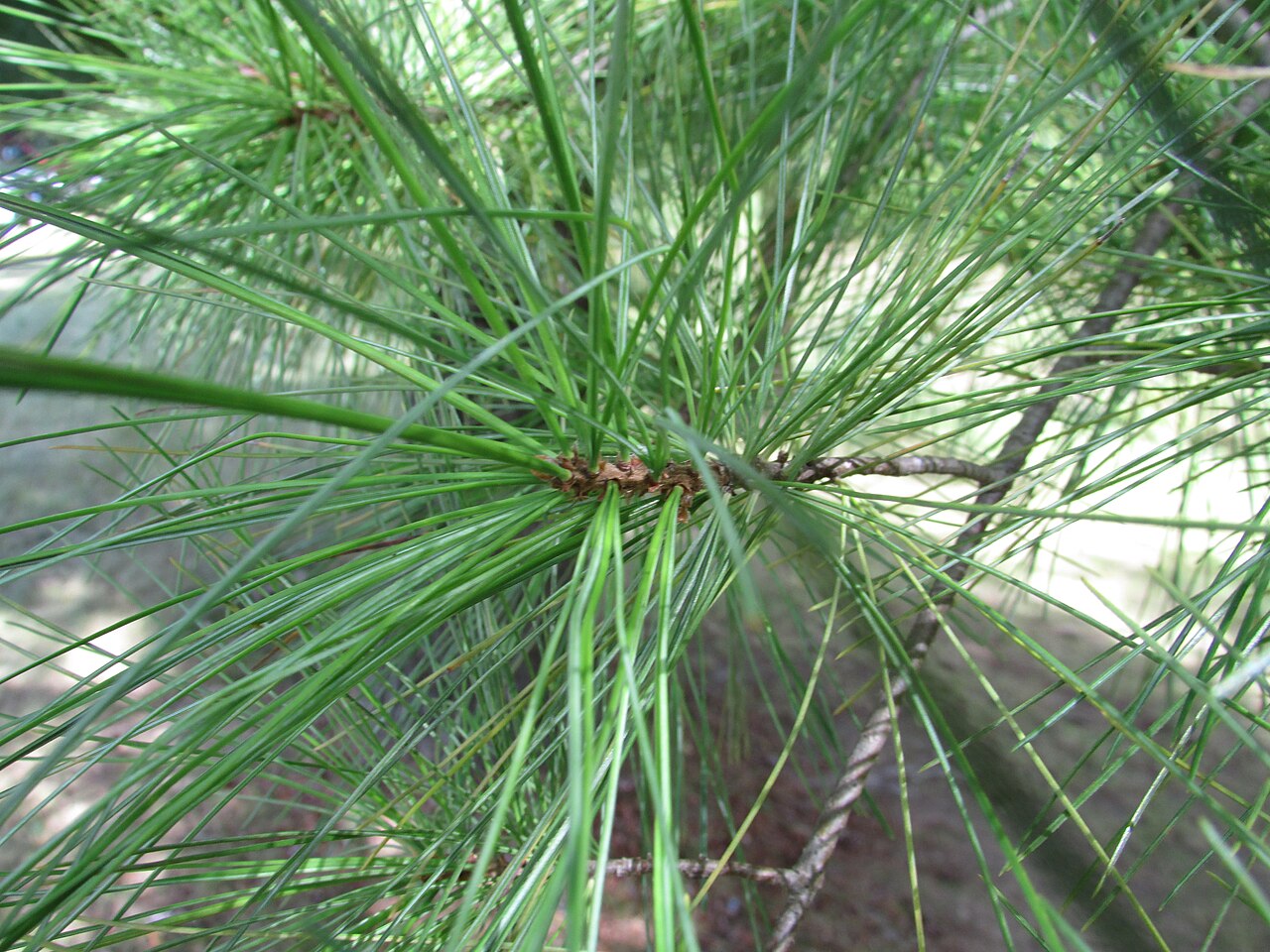
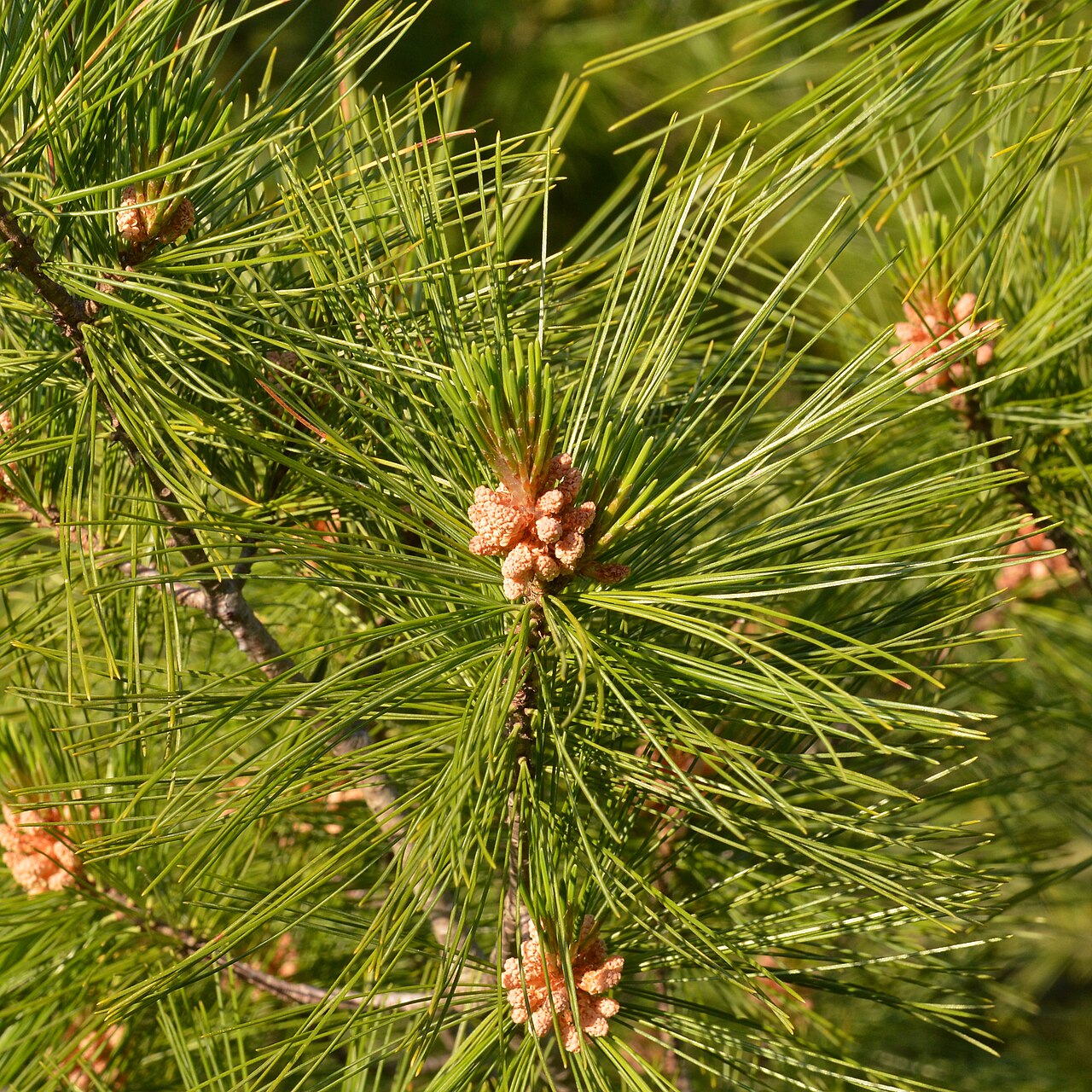
Eastern white pine is an evergreen with a deep, asymmetrically cylindrical crown of outstretched, thin branches that are gently upward-angled to nearly horizontal in well-separated annual tiers. Like other members of the white pine group (*Pinus* subgenus *Strobus*), its needles occur in fascicles of five (rarely three or four) with a deciduous sheath. The needles are flexible, bluish-green, finely serrated, and 5–13 cm long. Seed cones are slender, 8–16 cm long (rarely longer) and 4–5 cm broad when open, with scales that have a rounded apex and slightly reflexed, often resinous tip. Seeds are 4–5 mm long with a slender 15–20 mm wing, dispersed by wind, with cone production peaking every 3 to 5 years. Pollen and seed cones emerge separately with new growth; pollen cones are 5–15 mm long and straw-colored in a dense band at the base of a long shoot, while seed cones are mostly 8–20 cm long near the tips of long shoots, green before maturity. Cone maturation takes two years, with cones falling the following spring. Branches are spaced about every 18 inches on the trunk, with five or six branches appearing like spokes on a wagon wheel. The tree is self-fertile, but self-pollinated seeds often produce weak, stunted, malformed seedlings. Mature trees are typically 200–250 years old, with some exceeding 400 years; a tree near Syracuse, New York, was dated to 458 years in the late 1980s, and trees in Michigan and Wisconsin reached roughly 500 years. White pines form strong, dominant roots similar to taproots, then later develop lateral roots from terminal shoots during propagation.
**Dimensions**
Eastern white pine is considered the tallest tree in eastern North America, possibly sharing that status with the deciduous tulip tree in a few overlapping areas. In precolonial stands, it was frequently reported to grow as tall as 70 m or more; no accurate records exist, but it may have reached that height on rare occasions. James Brown of Arniston, a forester and later Inspector of Woods and Forests in Port Elgin, Ontario, wrote in 1882: "In its native habitats this pine grows to very large dimensions. We have measured many of them as they lay fe..."
- Scientific name
- Pinus strobus
- Common names
- eastern white pine, northern white pine, white pine, Weymouth pine (British), soft pine
- Native range
- eastern North America
- Leaf arrangement
- fascicles of five (rarely three or four)
- Seed cone length
- 8–16 cm (3+1⁄4–6+1⁄4 in)
Lore & Background
Pinus strobus is an evergreen tree with a deep, asymmetrically cylindrical crown formed by outstretched, thin branches that are gently upward angled to nearly horizontal, arranged in well-separated annual tiers. Its leaves, or needles, are flexible, bluish-green, and finely serrated, occurring in bundles of five (rarely three or four) with a deciduous sheath. The seed cones are slender, opening to a broad width, with scales that have a rounded apex and a slightly reflexed, often resinous tip; the seeds themselves are small with a slender wing, adapted for wind dispersal, with cone production peaking every three to five years. Pollen and seed cones emerge separately with new growth, the former straw-coloured and clustered near the base of long shoots, the latter green and found near the tips, maturing over two years and falling the following spring. Branches are spaced roughly every 18 inches on the trunk, often arranged like spokes on a wagon wheel. The tree is self-fertile, though such seeds produce weak seedlings. Mature trees commonly live 200 to 250 years, with some exceeding 400 years; individuals in New York, Michigan, and Wisconsin have been dated to roughly 458 and 500 years old. It develops strong, dominant roots similar to taproots, later producing lateral roots from terminal shoots. Historically, the species was the tallest in eastern North America, with precolonial stands occasionally reported to reach over 70 metres, though no precise records exist. It is native to cool-temperate, hemiboreal, and southern-mid boreal forests from Newfoundland and the Great Lakes region south along the Appalachians to northern Georgia, preferring well-drained or sandy soils and humid climates, but also tolerating boggy areas and rocky highlands. Only about one percent of its original old-growth forests remain after extensive logging from the 18th to early 20th centuries, with protected virgin stands in places like Great Smoky Mountains National Park, Algonquin Provincial Park, and the Sylvania Wilderness Area. The species has also naturalized in parts of the Czech Republic and southern Poland from ornamental plantings.
Reader's Guide
Eastern white pine forests originally covered much of north-central and northeastern North America, but only 1% of the old-growth forests remain after extensive logging from the 18th century to early 20th century. Old-growth stands are protected in several locations, including Great Smoky Mountains National Park, Algonquin Provincial Park, and Cook Forest State Park. The tree provides food and shelter for numerous forest birds, such as the red crossbill, and small mammals such as squirrels. As an introduced species, P. strobus is now naturalizing in the Outer Western Carpathians in Czech Republic and southern Poland. The Haudenosaunee use the tree as the central symbol of their confederation, calling it the 'Tree of Peace,' with the Seneca name o'sóä' and the Mohawk name onerahtase'ko:wa. Within the Wabanaki Confederacy, the Mi'kmaq call it guow, the Wolastoqewiyik and Peskotomuhkatiyik call it kuw or kuwes, and the Abenaki use kowa.
Did You Know?
- Fossilized white pine leaves and pollen have been discovered by Brian Axsmith in the Gulf Coastal Plain, where the tree no longer occurs.
- Eastern white pine is self-fertile, but seeds produced this way tend to result in weak, stunted, and malformed seedlings.
Gallery
Frequently Asked Questions
Who is Pinus strobus?
Pinus strobus is a large native conifer of eastern North America, commonly called eastern white pine, northern white pine, Weymouth pine, or soft pine. It holds the title of the tallest tree species in eastern North America.
Where does Pinus strobus grow in the wild?
Its native range stretches from Newfoundland, Canada, west through the Great Lakes region into southeastern Manitoba and Minnesota, and south along the Appalachian Mountains to northernmost Georgia. It is notably rare in Indiana and very rare at higher elevations in northeastern Alabama.
Why is Pinus strobus culturally significant?
The Haudenosaunee maintain the eastern white pine as the central symbol of their multinational confederation. Beyond that cultural role, it stands as the tallest tree in eastern North America, making it a defining figure among the region's conifers.
More in Conifers & Allies 1-20
Spotted an error? Know more?
This is a living reference — every entry is fact-audited, and reader corrections feed straight into our audit queue. Suggest an edit · See this site's audit record