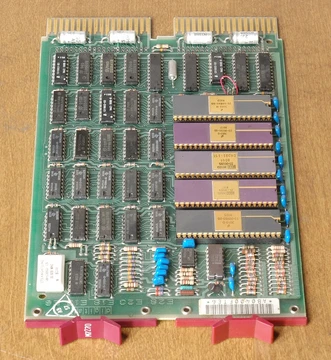
Thermal management (electronics)
Thermal management improves reliability and prevents premature failure in electronics.

All electronic devices and circuitry produce excess heat, so managing that heat is essential for reliability and to avoid early failure. Unless other forms of energy are at play, the heat given off equals the power going in. Cooling methods include various heat sinks, thermoelectric coolers, forced air systems and fans, heat pipes, and other approaches. In very cold environments, components may actually need to be heated to work properly.
The thermal resistance of a semiconductor device is often given as the resistance from its junction to its case, measured in °C/W. A heat sink rated at 10 °C/W will become 10 °C hotter than the air around it when dissipating 1 watt. So, a lower °C/W rating means a more efficient heat sink. For two devices in the same package, a lower junction-to-ambient resistance (RθJ-C) indicates better efficiency. However, comparing devices in different packages—like a DirectFET MT versus a wirebond 5x6mm PQFN—their junction-to-case or junction-to-ambient values may not directly reflect efficiency. Differences in die orientation, surrounding metal mass, die attach methods, and molding thickness can all produce very different resistance numbers, potentially masking the true efficiency.
A heat sink’s thermal mass acts like a capacitor (storing heat instead of electrical charge), and its thermal resistance acts like an electrical resistor (showing how quickly stored heat can be released). Together, they form a thermal RC circuit with a time constant equal to R times C. This time constant helps calculate how a device handles dynamic heat, similar to electrical circuits.
Thermal interface material (TIM), sometimes called mastic, fills gaps between surfaces like microprocessors and heat sinks to improve heat transfer. It conducts heat better in the Z-direction (through its thickness) than in the X-Y plane.
In personal computers, the retail heat sink market grew significantly due to technology advances and public interest. By the early 2000s, CPUs were generating more heat than before, raising the need for quality cooling. Overclocking always demands more cooling, and hotter chips made that even more important for enthusiasts. Efficient heat sinks are critical for overclocked systems because better cooling allows faster, stable operation, which generally boosts performance.
- Thermal resistance units
- °C/W
- Copper thermal conductivity
- 401 W/(m·K) at 300 K
- Aluminum thermal conductivity
- 237 W/(m·K) at 300 K
Lore & Background
Heat sinks are widely used in electronics and have become essential to modern microelectronics. In common use, a heat sink is a metal object brought into contact with an electronic component's hot surface—though in most cases, a thin thermal interface material mediates between the two surfaces. Microprocessors and power handling semiconductors are examples of electronics that need a heat sink to reduce their temperature through increased thermal mass and heat dissipation (primarily by conduction and convection and to a lesser extent by radiation). A heat sink usually consists of a metal structure with one or more flat surfaces to ensure good thermal contact with the components to be cooled, and an array of comb or fin like protrusions to increase the surface contact with the air, and thus the rate of heat dissipation. A heat sink is sometimes used in conjunction with a fan to increase the rate of airflow over the heat sink, known as a forced air system.
Due to technological developments and public interest, the retail heat sink market rose high. In the early 2000s, CPUs were produced that emitted more and more heat than earlier, escalating requirements for quality cooling systems. Overclocking has always meant greater cooling needs, and the inherently hotter chips meant more concerns for the enthusiast. Efficient heat sinks are vital to overclocked computer systems because the higher a microprocessor's cooling rate, the faster the computer can operate without instability; generally, faster operation leads to higher performance. Many companies now compete to offer the best heat sink for PC overclocking enthusiasts.
A thermal interface material or mastic (TIM) is used to fill the gaps between thermal transfer surfaces, such as between microprocessors and heatsinks, in order to increase thermal transfer efficiency. It has a higher thermal conductivity value in Z-direction than xy-direction. Heat sinks function by efficiently transferring thermal energy from an object at high temperature to a second object at a lower temperature with a much greater heat capacity. The most common design of a heat sink is a metal device with many fins. The high thermal conductivity of the metal combined with its large surface area result in the rapid transfer of thermal energy to the surrounding, cooler, air.
Reader's Guide
Thermal management is fundamental to the reliability and performance of electronic devices. The thermal resistance of a device, quoted from junction to case in °C/W, provides a key metric: a heatsink rated at 10 °C/W will get 10 °C hotter than the surrounding air when it dissipates 1 Watt of heat, so a lower °C/W value indicates greater efficiency. However, when comparing different semiconductor packages, junction-to-ambient or junction-to-case resistance values may not correlate directly to comparative efficiencies due to variations in die orientation, metal mass, die attach mechanics, and molding thickness. A heatsink's thermal mass and thermal resistance form a thermal RC circuit with an associated time constant, which can be used to calculate dynamic heat dissipation capability. Thermal interface materials (TIMs) fill gaps between surfaces to increase transfer efficiency, with higher conductivity in the Z-direction than the xy-direction. Heat sinks are constructed from good thermal conductors such as silver, gold, copper, or aluminum alloy; copper (401 W/(m·K) at 300 K) is significantly more expensive than aluminum (237 W/(m·K) at 300 K) but is also roughly twice as conductive. In applications beyond personal computers, temporary heat sinks are used while soldering circuit boards to prevent damage to sensitive components, and in electric vehicles, battery performance is specified for working temperatures in the +20 °C to +30 °C range, with heating and cooling systems employed to maintain that range.
Did You Know?
- Copper has a thermal conductivity of 401 W/(m·K) at 300 K, roughly twice that of aluminum at 237 W/(m·K).
- Thermal interface material has higher thermal conductivity in the Z-direction than in the xy-direction.
- In extreme low environmental temperatures, it may be necessary to heat electronic components to achieve satisfactory operation.
More in Computer Cooling and Sound Cards 1-24
Spotted an error? Know more?
Reader corrections go straight into our review queue. Suggest an edit · How this site is sourced