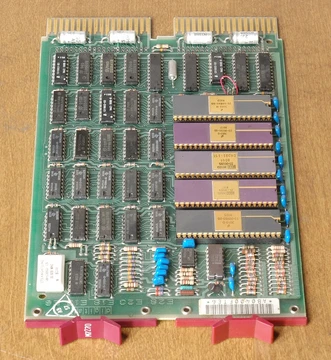
Apple II sound cards
Third-party cards gave the Apple II multi-voice sound it lacked.

Apple II sound cards were third-party expansion devices that added multi-voice music, speech, and sound effects to the Apple II series, which natively had only a 1-bit speaker toggled by software. These cards offloaded sound generation from the CPU, enabling complex audio without the extreme timing constraints of the built-in speaker.
- First music card
- ALF Apple Music Synthesizer (later Music Card MC16), demonstrated late 1978, shipping June 1979
- Voices per card
- 3 (MC16), 9 (MC1), 3 (Juke Box Synthesizer), 16 (Super Music Synthesizer), 16 stereo (Mountain Computer Music System)
- Notable chip
- AY-3-8910 (Mockingboard, Echo Plus); TI SN76489N (MC1); TMS 5220 (Echo II, Echo Plus)
- Notable users
- Herbie Hancock, Keith Emerson (Alpha Syntauri); Frank Serafine (Mountain/Syntauri for Tron, 1982)
- Stereo capability
- Phasor, Echo Plus, Sonic Blaster (Apple IIGS, 8-bit, 15,184 Hz stereo, 30,368 Hz mono)
Lore & Background
The Apple II's built-in speaker was limited to 1-bit output, producing only clicks by toggling voltage on and off. Generating pitched sounds required the CPU to toggle the signal at precise intervals, placing extreme constraints on software design. By the early 1980s, competitors like the Commodore 64 offered dedicated sound chips that freed the CPU, making third-party sound cards a necessary upgrade for Apple II users wanting comparable audio.
The first such card was ALF's Apple Music Synthesizer (later Music Card MC16), demonstrated in late 1978 and shipping in volume by June 1979. It offered three voices and graphical music entry, a first for personal computers. Later cards increased voice counts: the ALF Music Card MC1 used three TI SN76489N chips for nine voices, while the Sweet Micro Systems Mockingboard used the AY-3-8910 chip and became the closest thing to a standard sound card. Applied Engineering's Phasor could play songs written for the ALF, Mockingboard, and Super Music Synthesizer, and claimed they sounded better on Phasor.
Music systems like the Alpha Syntauri and Passport Designs Soundchaser added external piano-style keyboards for live performance. The Alpha Syntauri was used by Herbie Hancock, Keith Emerson, and Frank Serafine, who created sound effects for the 1982 film Tron. Speech synthesis was provided by the Echo II and Echo Plus cards, the latter adding stereo sound chips. The Sonic Blaster, introduced by 1988 for the Apple IIGS, offered 8-bit sampling at 15,184 Hz stereo or 30,368 Hz mono.
Reader's Guide
The significance of Apple II sound cards lies in their role as essential upgrades that compensated for the platform's fundamental audio limitation. Without them, Apple II software was restricted to simple clicks and beeps that consumed the CPU entirely. These cards enabled music composition, speech synthesis, and sound effects that were competitive with contemporary machines like the Commodore 64. The Mockingboard became a de facto standard, with later cards like the Phasor offering backward compatibility. The Alpha Syntauri system attracted professional musicians, and its use in film sound effects for Tron demonstrated the Apple II's potential as a creative tool. The Echo series brought speech synthesis to educational and accessibility applications. While the Apple IIGS eventually included improved sound hardware, these third-party cards defined the audio experience for the vast majority of Apple II users throughout the 1980s.
Did You Know?
- The Apple II's built-in speaker could only produce clicks by toggling a 1-bit voltage on and off.
- The ALF Music Card MC16, first demonstrated in 1978, offered graphical music entry—a first for any personal computer.
- The Mockingboard used the AY-3-8910 sound generator chip and was the closest thing to a standard sound card for the Apple II.
- Frank Serafine used a Mountain Computer Music System and Alpha Syntauri to create sound effects for the 1982 film Tron.
More in Computer Cooling and Sound Cards 1-24
Spotted an error? Know more?
Reader corrections go straight into our review queue. Suggest an edit · How this site is sourced