
Hildegard of Bingen
Benedictine abbess, polymath, and visionary of the High Middle Ages.

FbrG · CC BY-SA 4.0
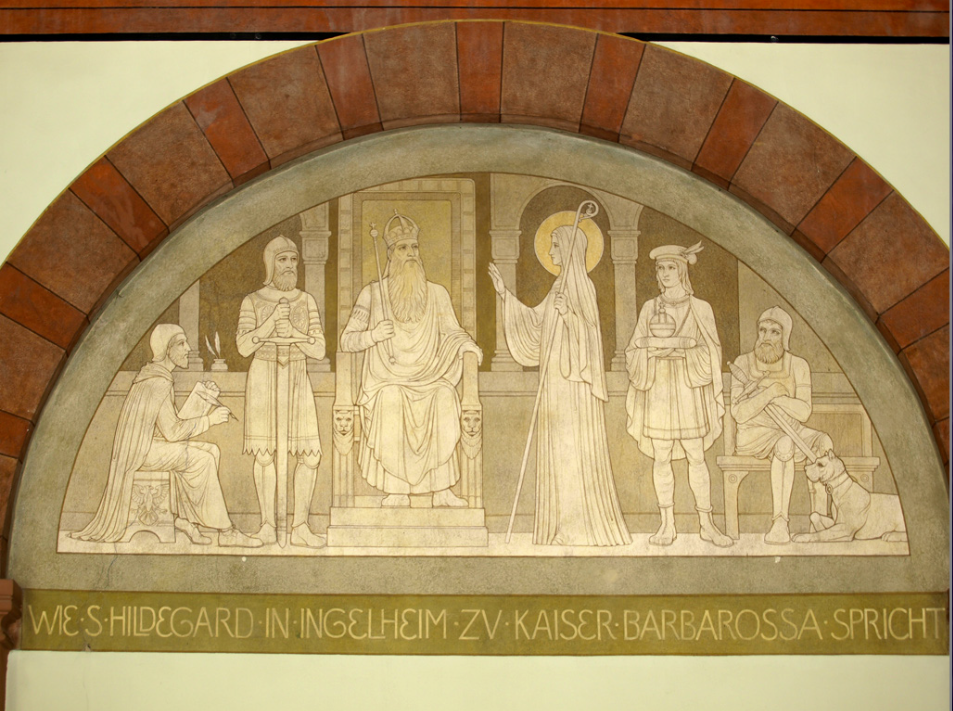
Hildegard of Bingen, a German Benedictine abbess and polymath active during the High Middle Ages, is remembered as a writer, composer, philosopher, mystic, visionary, and medical practitioner. Born into a family of the free lower nobility, she was offered as an oblate to the monastery at Disibodenberg, where she was enclosed with the visionary Jutta. Upon Jutta’s death, Hildegard was elected leader of the community. Seeking greater independence, she moved her nuns to Rupertsberg in 1150, founding a new monastery there, and later established a second convent at Eibingen. Hildegard is among the most recorded composers of sacred monophony in modern history, with more surviving chants than any other medieval composer; she wrote both the music and the words for her works. Her first major work, *Scivias*, includes supervised miniature illuminations. She also composed an early example of liturgical drama, considered the oldest surviving morality play. Beyond music, she wrote theological, botanical, and medicinal texts, as well as letters, hymns, and antiphons. She invented a constructed language. Scholars have regarded her as a founder of scientific natural history in Germany. Though her formal canonization process was complex, she has long been listed as a saint in regional Catholic calendars. In 2012, Pope Benedict XVI extended her liturgical cult to the entire Church and named her a Doctor of the Church, citing her holiness and the originality of her teaching.
- field
- Theology, music, medicine, natural history
- nationality
- German
- known_for
- Sacred monophony, founding monasteries, theological and medicinal works, constructed language Lingua Ignota
Lore & Background
Hildegard of Bingen was a German Benedictine abbess and polymath active during the High Middle Ages, known as the "Sibyl of the Rhine." She wrote theological, botanical, and medicinal works, as well as letters, hymns, and antiphons for the liturgy, and composed poems. She supervised the miniature illuminations in the Rupertsberg manuscript of her first major work, *Scivias*. Her composition *Ordo Virtutum* is an early example of liturgical drama and arguably the oldest surviving morality play. She also invented a constructed language. Hildegard is one of the best-known composers of sacred monophony and the most recorded in modern history; more chants survive by her than by any other medieval composer, and she is one of the few known to have written both music and words. Her convent at Disibodenberg elected her as mother superior in 1136, and she later founded the monasteries of Rupertsberg in 1150 and Eibingen in 1165. Born around 1098 to a family of the free lower nobility, she was sickly from birth and experienced visions from a very young age. She was enclosed as an oblate with the visionary Jutta at Disibodenberg, where she learned to read and write, and likely assisted in reciting psalms, gardening, handiwork, and tending the sick. Upon Jutta’s death, Hildegard was unanimously elected leader of the community. She sought greater independence, moving her nuns to Rupertsberg after a period of illness she attributed to divine displeasure. Before her death in 1179, she defended the burial of an excommunicated man, arguing he had been reconciled to the church. She also had a close friendship with the nun Richardis von Stade, whose election as abbess elsewhere caused Hildegard great distress, leading her to plead with church officials to prevent the separation.
Reader's Guide
Hildegard of Bingen was a Benedictine abbess and polymath whose work spanned theology, music, medicine, and natural history. She composed sacred monophony, writing both the music and lyrics for her chants, and more of her compositions survive than from any other medieval composer. Her first major theological work, *Scivias*, includes supervised miniature illuminations. She also wrote an early example of liturgical drama, considered the oldest surviving morality play, and invented a constructed language. Her medical and botanical writings, alongside her theological texts, demonstrate her wide-ranging expertise, leading some scholars to regard her as the founder of scientific natural history in Germany. Beyond her writings, she founded two monasteries, at Rupertsberg and Eibingen, after leading her community from Disibodenberg. Her life was marked by visionary experiences, which she described from a young age, and she corresponded extensively with church officials, including a notable effort to prevent the transfer of her close companion Richardis von Stade to another convent. Hildegard’s legacy is recognized by the Catholic Church, which extended her liturgical cult to the entire church and named her a Doctor of the Church for the holiness of her life and the originality of her teaching.
Did You Know?
- Hildegard is the most recorded composer of sacred monophony in modern history.
- She invented a constructed language called Lingua Ignota.
- Her work Ordo Virtutum is arguably the oldest surviving morality play.
Monastic Leadership and the Fight for Autonomy
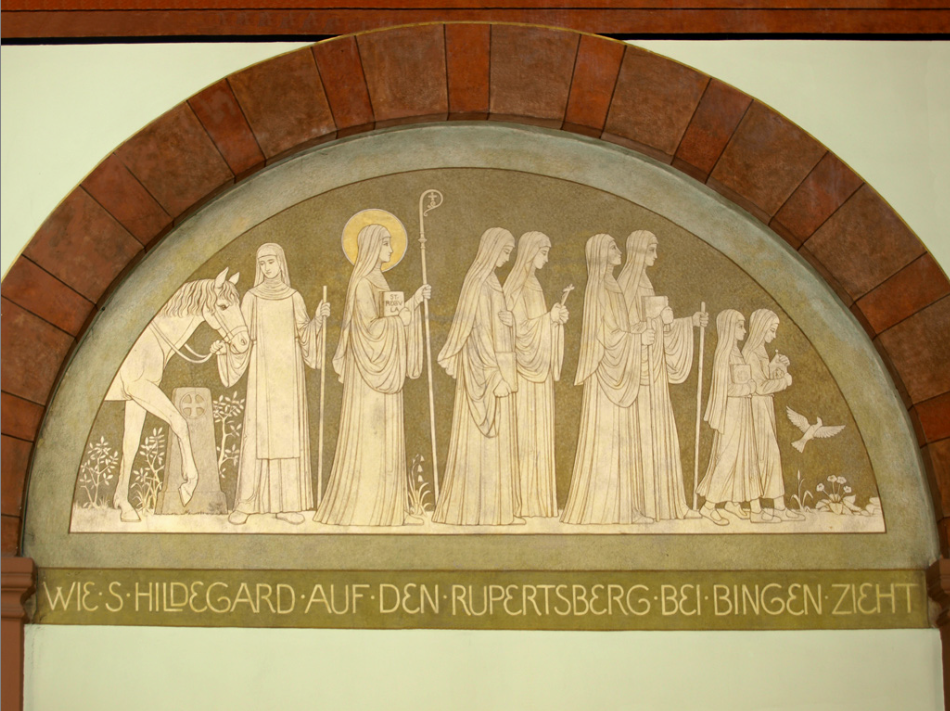
Hildegard's path to independence within the Church was neither smooth nor guaranteed. After Jutta's death in 1136, the nuns of Disibodenberg unanimously chose Hildegard as their magistra. Yet Abbot Kuno sought to keep her under his authority by appointing her as prioress rather than granting full autonomy. Hildegard pushed back, requesting permission to relocate her community to Rupertsberg—a deliberate step toward a simpler, more self-sufficient existence, trading a well-established stone complex for a temporary dwelling. When Kuno refused, she bypassed him entirely, securing approval from Archbishop Henry I of Mainz. The standoff only broke when Hildegard fell gravely ill, paralyzed in bed, an affliction she attributed to divine displeasure at her disobedience. Only then did Kuno concede, and in 1150, Hildegard and roughly twenty nuns established their own monastery at St. Rupertsberg, with Volmar serving as provost, confessor, and scribe. Five years later, she founded a second house at Eibingen. Even on her deathbed in 1179, she defied the clergy of Mainz, refusing to allow the exhumation of a man buried at Rupertsberg who had died after excommunication but, she insisted, had been reconciled to the Church.
A Polymath's Creative Output
Few figures from the medieval period left behind a body of work as varied as Hildegard's. She composed sacred monophonic chants, and remarkably, more of her melodies survive than those of any other composer from the entire Middle Ages. She was also one of the very few known composers of that era to have written both the text and the music herself. Among her compositions, the Ordo Virtutum stands as an early example of liturgical drama and is arguably the oldest surviving morality play. Beyond music, she authored theological treatises, botanical and medicinal writings, letters, hymns, antiphons for liturgical use, and poetry. She also supervised the creation of miniature illuminations for the Rupertsberg manuscript of Scivias, her first major work. Perhaps most astonishingly, she devised a constructed language called Lingua Ignota, a linguistic creation with no clear parallel in her time. Scholars have further credited her as a founder of scientific natural history in Germany, a testament to the breadth of her intellectual curiosity. In the modern era, her musical output has become the most recorded of any medieval composer, ensuring her creative voice continues to resonate across centuries.
Visions, Mentorship, and the Bond with Richardis
Hildegard's life was shaped from its earliest days by visions she experienced from a very young age. These experiences, combined with her sickly constitution, led her parents—Mechtild and Hildebert of the free lower nobility serving Count Meginhard of Sponheim—to offer her as an oblate to the Benedictine monastery at Disibodenberg. There she was enclosed alongside Jutta, daughter of Count Stephan II of Sponheim, who was about six years her senior. Jutta, herself a visionary who drew many visitors, taught Hildegard to read and write, though Hildegard acknowledged her own unlearned nature. Their daily life together involved reciting psalms, tending gardens, handiwork, and caring for the sick. After Jutta's death in 1136, Hildegard carried forward their shared spiritual legacy. Later, while completing Scivias, she formed a deep personal bond with fellow nun Richardis von Stade. When Richardis was elected abbess of a distant convent in 1151, Hildegard wrote to the Pope, church officials, and Richardis's own family, insisting their separation was contrary to God's will. When Richardis died a year later, Hildegard grieved deeply, assuring her brother that she held her friend in "divine love" and was confident in her salvation.
Legacy, Canonization, and Enduring Influence
Hildegard of Bingen, often called the "Sibyl of the Rhine," occupies a singular place in both medieval and modern history. Although the formal process of her canonization remains complicated, regional Catholic calendars had listed her as a saint for centuries before the twenty-first century. In 2012, Pope Benedict XVI took two significant steps: on 10 May, he extended her liturgical cult to the entire Catholic Church through a process termed "equivalent canonization," and on 7 October, he declared her a Doctor of the Church, citing "her holiness of life and the originality of her teaching." Her influence extends well beyond the ecclesiastical sphere. Scholars have regarded her as a foundational figure in the development of scientific natural history in Germany, recognizing the systematic nature of her botanical and medicinal observations. In the realm of music, she stands as one of the best-known composers of sacred monophony and, in modern times, the most recorded medieval composer. Her legacy thus spans theology, science, music, and language—a rare constellation of achievement that continues to draw scholars, musicians, and the faithful alike to her remarkable life and work.
Gallery


Frequently Asked Questions
What is Hildegard of Bingen's musical legacy?
She is celebrated as one of the finest composers of sacred monophony in the medieval tradition. Her liturgical songs, gathered in works like the Symphonia armonie celestium revelationum, remain among the most performed pieces of the twelfth century.
What is Lingua Ignota?
It is a constructed language and glossary that Hildegard reportedly devised as part of her visionary writings. It pairs invented words with Latin definitions and stands as one of the earliest known examples of a fictional language in Western history.
Why is Hildegard of Bingen called the 'Sibyl of the Rhine'?
The epithet reflects her reputation as a visionary and prophetess whose mystical experiences and theological writings earned her a status comparable to the ancient oracles. It underscores how her contemporaries regarded her revelations as carrying an almost otherworldly authority.
What did Hildegard of Bingen contribute to medicine and natural history?
Beyond her music and theology, she authored practical texts on herbal remedies, diet, and the natural world, drawing on both observation and her mystical framework. Her medical works, particularly the Physica and Causae et Curae, were widely copied and consulted throughout the medieval period.
More in Composers & Musicians 1-21
Spotted an error? Know more?
This is a living reference — every entry is fact-audited, and reader corrections feed straight into our audit queue. Suggest an edit · See this site's audit record