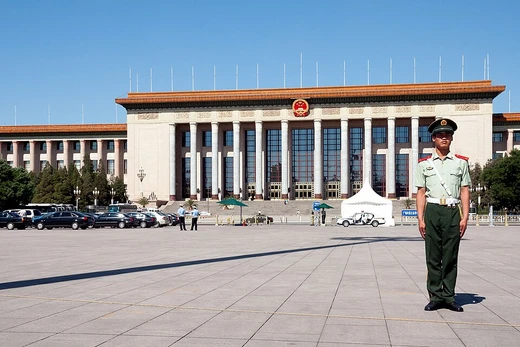
Politics of India
India's politics follow a parliamentary secular democratic republic system.

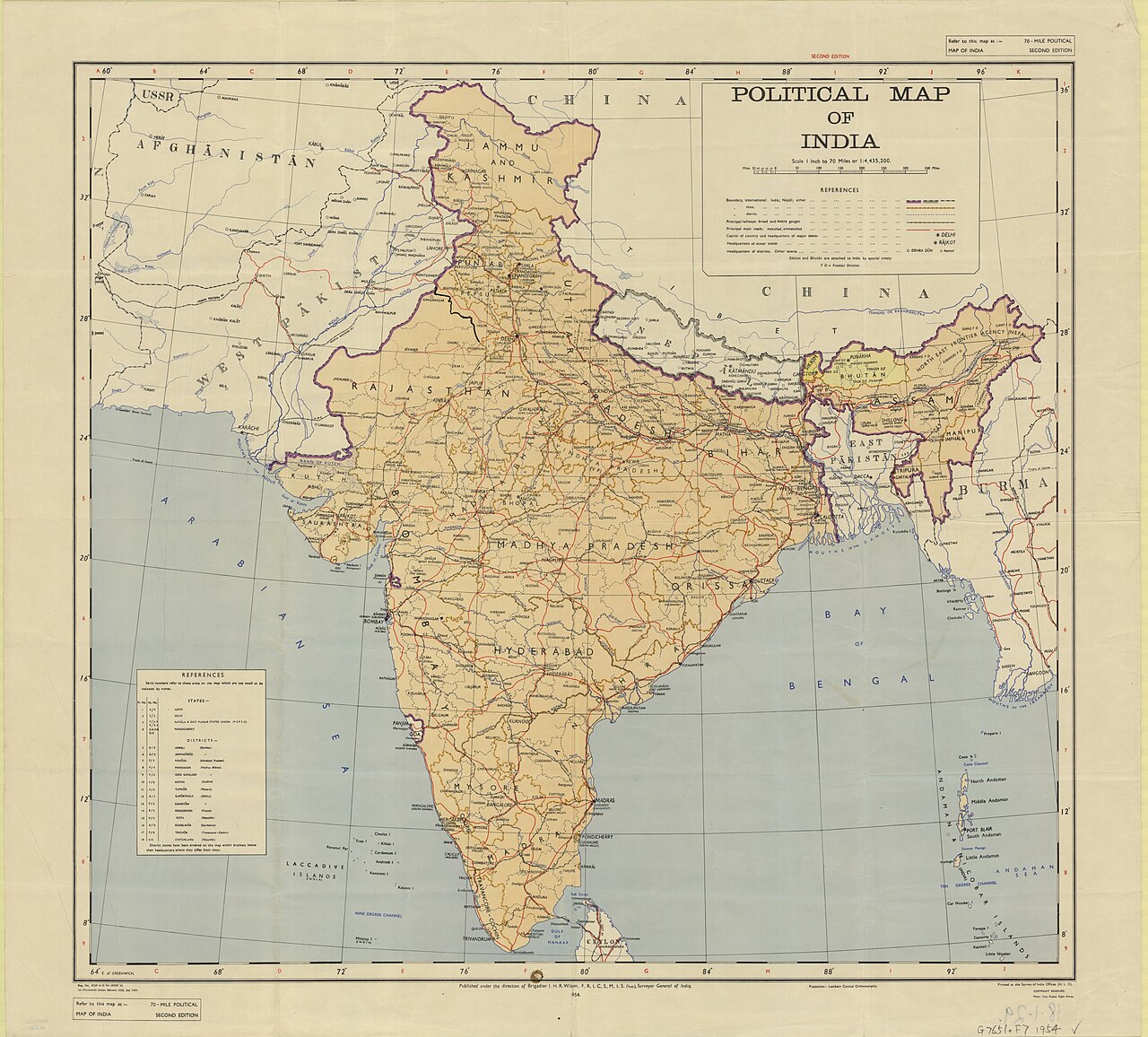
Survey of India · Public domain
India is a parliamentary secular democratic republic, as defined by its constitution, which was finalized in late 1949 and came into force in early 1950. The constitution describes the nation as a "Union of States," and its governance structure is quasi-federal, blending features of federal and unitary systems. The country comprises 28 states and 8 union territories, totaling 36 subnational entities. States possess their own governments and are self-governing, while union territories are administered directly by the union government through a lieutenant governor or administrator appointed by the president. The president serves as the ceremonial head of state, holding formal executive power, and appoints the prime minister—the head of government—along with ministers from among members of parliament, following parliamentary elections.
The union government follows the Westminster model, with executive, legislative, and judicial branches. The legislature is bicameral: the Rajya Sabha (Council of States), representing the states, has up to 250 members, with 233 elected indirectly by state legislatures and 12 nominated by the president; the Lok Sabha (House of the People), representing the people, has 543 members elected directly from single-member districts using a first-past-the-post system. State-level legislatures, called Vidhan Sabhas, represent residents of each state. Elections for union and state governments occur every five years unless otherwise specified, with governments formed by parties securing a majority in the respective lower houses.
The judiciary is independent, headed by the Supreme Court, which protects the constitution, resolves disputes between the center and states or among states, nullifies laws contradicting the constitution, and enforces fundamental rights through writs. India’s first general election in 1951 was won by the Indian National Congress, which dominated until 1977, when a non-Congress government first formed. The 1990s ended single-party dominance, ushering in coalition governments. The most recent Lok Sabha elections, held in seven phases from April to June 2024, resulted in the National Democratic Alliance forming the government. In recent decades, Indian politics has become dynastic, attributed to party stability, weak party organizations, limited independent civil society support, and centralized election financing. As
- Government type
- Parliamentary secular democratic republic
- Number of states
- 28
- Number of union territories
- 8
- Legislature
- Bicameral (Rajya Sabha and Lok Sabha)
- Head of state
- President of India
Lore & Background
India's political system is modeled after the Westminster system, with the union government composed of executive, legislature, and judiciary. The president is the ceremonial head of state and commander-in-chief, while the prime minister, appointed by the president based on parliamentary elections, serves as head of government. State governments are self-governing in the 28 states, each with its own executive, legislative, and judiciary branches, while union territories are directly governed by the union government. The judiciary is independent, headed by the Supreme Court, which protects the constitution, settles disputes, and enforces fundamental rights. In recent decades, politics has become dynastic, attributed to party stability, absence of party organizations, and centralized election financing.
Reader's Guide
The politics of India are significant as they define the governance of the world's largest democracy, operating under a constitution that establishes a quasi-federal system balancing central and state powers. The constitution, adopted in late 1949 and effective from early 1950, describes India as a sovereign, socialist, secular democratic republic. It designates the nation as a "Union of States," comprising 28 states and 8 union territories, with a quasi-federal structure blending federal and unitary elements. States possess self-governing administrations, while union territories are directly administered by the union government through a presidentially appointed lieutenant governor or administrator. The bicameral parliament, consisting of the Rajya Sabha (Council of States) representing the states and the Lok Sabha (House of the People) representing the populace, ensures checks and balances. The Lok Sabha’s 543 members are elected via a first-past-the-post system from single-member districts, while most of the Rajya Sabha’s 245 members are indirectly elected by state legislative assemblies. An independent judiciary, headed by the Supreme Court, protects the constitution, resolves disputes between central and state governments, and enforces fundamental rights. Regular elections occur every five years, with the first general election in 1951 won by the Indian National Congress, which dominated until 1977. The 1990s marked a shift from single-party rule to coalition governments, as seen in the latest 2024 elections. Recent decades have seen a trend toward dynastic politics, attributed to party stability, weak party organizations, and centralized election financing. India was ranked the 19th most electoral democratic country in Asia in 2023.
Definition and Scope of the Discipline
Comparative politics is the systematic examination of political systems across the globe, investigating how different nations structure their governance, conduct elections, and produce policy outcomes. The field seeks to explain why political systems share certain features or diverge from one another, and how developmental shifts unfold between them. It is 'comparative' because it identifies similarities and differences across regimes, and 'systematic' because it searches for recurring trends and regularities. The discipline covers broad themes such as democratization, globalization, and political integration. Over the past four decades, a wave of new theoretical frameworks has enriched the field, including political culture, dependency theory, developmentalism, corporatism, comparative political economy, state-society relations, and new institutionalism. Concrete examples of the work include contrasting presidential versus parliamentary systems, or comparing multi-party arrangements in Canada with the two-party structure in the United States. Importantly, the field requires analysis anchored at a fixed point in time rather than stretching across different eras.
Historical Roots and the Two Foundational Traditions
The intellectual lineage of comparative politics stretches back to ancient Greek philosophy. Harry H. Eckstein traces the field's origins to Aristotle, identifying a continuous thread of contributors that runs through Machiavelli, Montesquieu, Gaetano Mosca, Max Weber, Vilfredo Pareto, Robert Michels, James Bryce, and Carl Joachim Friedrich. Philippe C. Schmitter identifies two foundational traditions within this lineage. The first, which he labels 'sociological constitutionalism,' traces to Aristotle and encompasses scholars like Polybius, Tocqueville, Marx, Weber, Durkheim, and in the twentieth century, figures such as Stein Rokkan, T. H. Marshall, Seymour Martin Lipset, and Juan Linz. The second, 'legal constitutionalism,' traces to Plato and includes Léon Duguit, Georges Burdeau, Woodrow Wilson, and later scholars like Maurice Duverger, Giovanni Sartori, and Carl Joachim Friedrich. These two streams represent fundamentally different philosophical approaches to understanding how political systems are organized and how they function in practice.
Methodological Identity and the Shift to Subnational Analysis
A central debate within the field concerns whether comparative politics is defined by its subject matter or by its method. Arend Lijphart contends that the discipline lacks a fixed substantive focus; instead, it is characterized by a methodological commitment to the comparative approach, addressing 'the how' rather than 'the what' of political analysis. Peter Mair and Richard Rose offer a slightly different framing, arguing that the field combines a substantive focus on national political systems with a method of identifying and explaining cross-country similarities and differences through shared conceptual frameworks. In the United States, the term is sometimes used loosely to mean 'the politics of foreign countries,' a usage that scholars dispute. More recently, the field has shifted markedly toward subnational comparisons, moving beyond the traditional between-country approach. This subnational research now contributes significant methodological, theoretical, and substantive insights to political science, expanding the discipline's analytical toolkit considerably.
Practical Significance: The India–United States Illustration
Comparative politics plays a vital role in understanding how political systems function and why they differ so markedly. Political structures vary dramatically across nations due to historical, social, ethical, and racial factors, and even seemingly similar organizations operate differently in different contexts. A striking illustration involves India and the United States: both are majority-rule democracies, yet the U.S. employs a liberal, democratic presidential system while India operates a parliamentary system. The U.S. has a president as its head of government; India has a prime minister. Decision-making processes also differ in scope and structure between the two. This field is critical to international relations and conflict resolution, helping clarify global legislative issues and current geopolitical conditions. Although both comparative politics and international relations are subfields of political science, comparative politics specifically examines how international strategies and global frameworks influence domestic political behavior and institutional functioning.
Gallery




More in Comparative Politics 1-23
Spotted an error? Know more?
This is a living reference — every entry is fact-audited, and reader corrections feed straight into our audit queue. Suggest an edit · See this site's audit record