
Politics of Germany

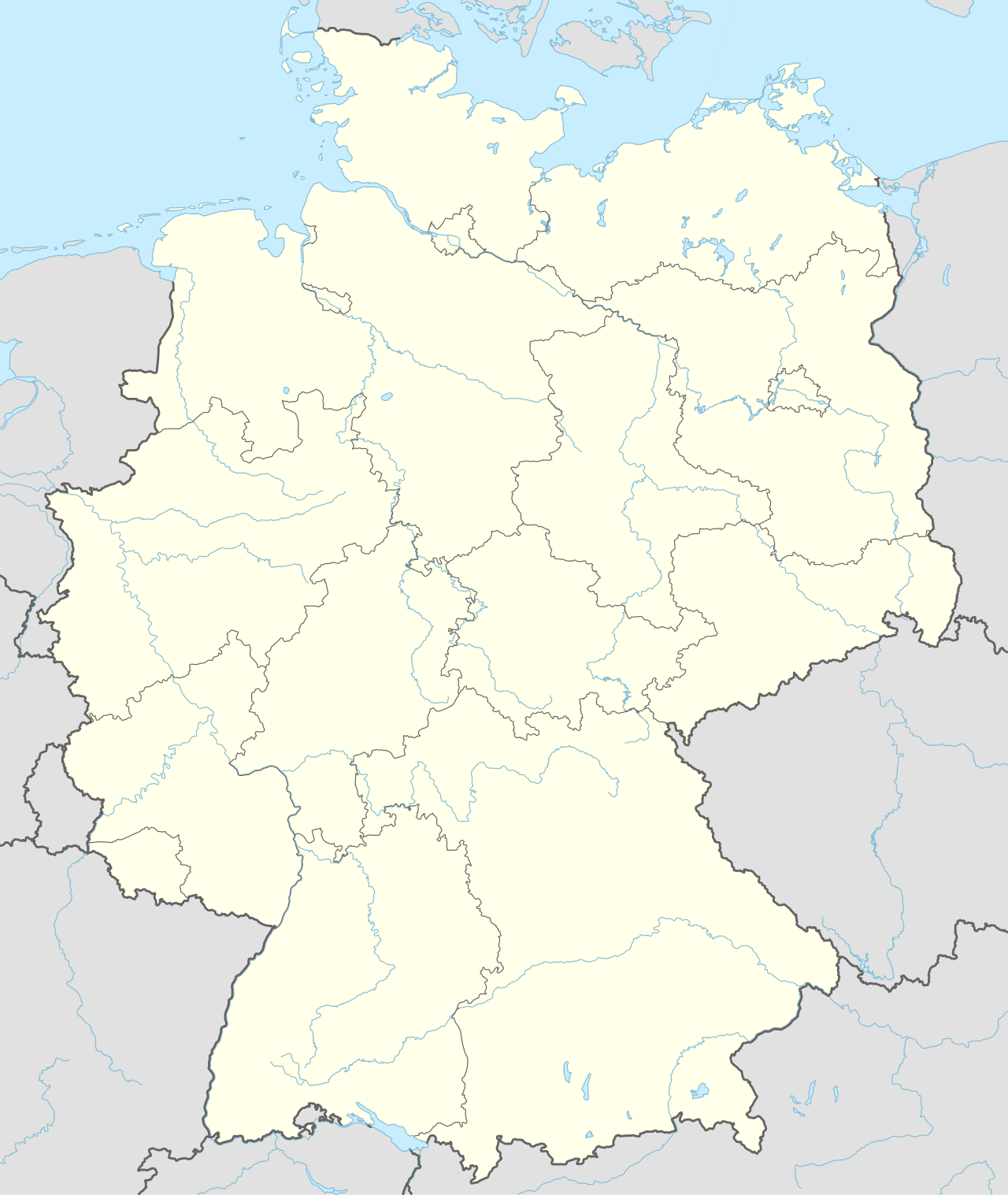
NordNordWest · CC BY-SA 3.0 de
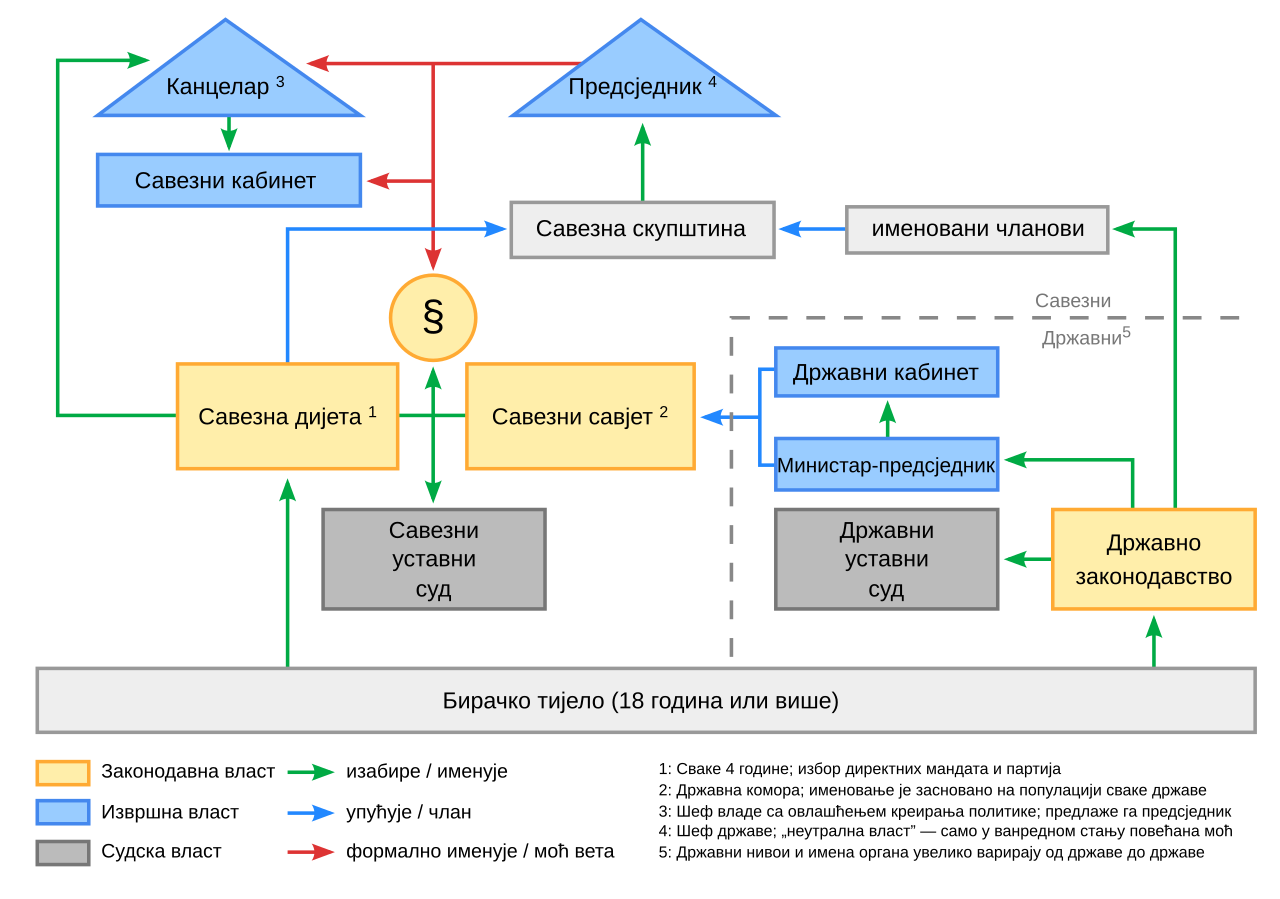
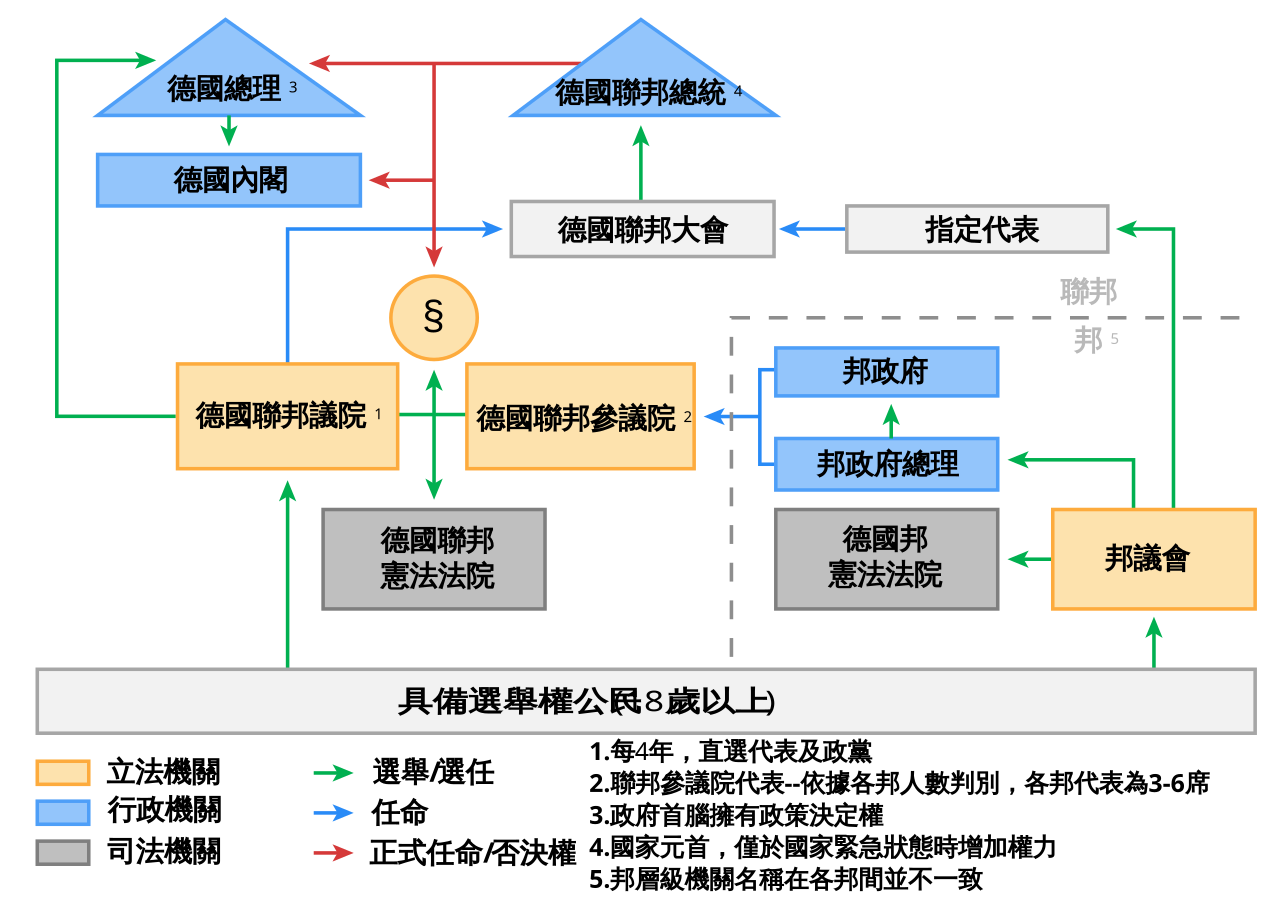
Germany is a democratic and federal parliamentary republic, with its political system defined by the 1949 constitution, known as the Basic Law, which remained largely unchanged after reunification in 1990. This constitution places strong emphasis on protecting individual liberty through an extensive catalogue of human and civil rights, and it divides powers between the federal and state levels as well as among the legislative, executive, and judicial branches. Federal legislative authority is held by the Bundestag, the national parliament, and the Bundesrat, which represents the Länder, Germany’s regional states. The judiciary operates independently from both the executive and the legislature, though it is common for leading members of the executive to also serve in the legislature.
Since 1949, the federal system has been dominated by two major parties: the Christian Democratic Union (CDU) and the Social Democratic Party of Germany (SPD). West Germany was a founding member of the European Community in 1958, which later became the European Union in 1993, and Germany has been part of the Schengen Area and the eurozone since 1999. It is also a member of the United Nations, NATO, the G7, the G20, and the OECD. According to the V-Dem Democracy indices, Germany ranked as the 15th most electoral democratic country in the world in 2023.
Historically, from 1949, Christian Democratic chancellors led for 20 years until a Social Democrat–Liberal coalition took over. From 1982, CDU leader Helmut Kohl served as chancellor for 16 years in coalition with the Liberals, a period that included German reunification in 1990, when the German Democratic Republic joined the Federal Republic and five new Länder were established or reestablished in its territory. After Kohl’s long tenure, the SPD and Greens won the 1998 Bundestag elections, forming a “red-green” coalition that brought the Greens into national government for the first time. The SPD’s Gerhard Schröder became chancellor, positioning himself as a centrist. His government faced early disputes between moderate and left wings of the SPD, leading to some voter disaffection, but the coalition won re-election in 2002, aided by effective handling of a major flood, opposition to the 2003 Iraq invasion, and the unpopularity of the CDU’s candidate in the east. In its second term, the coalition enacted the Agenda 2010 labor marke
- type
- Federal parliamentary republic
- legislature
- Bundestag and Bundesrat
- dominant_parties
- Christian Democratic Union (CDU) and Social Democratic Party (SPD)
- democracy_rating_2022
- Full democracy (Economist Intelligence Unit)
- electoral_democracy_rank_2023
- 15th most electoral democratic country (V-Dem Democracy indices)
Lore & Background
In the former GDR territory, five Länder were established or reestablished, and Berlin united as one Land. The political system remained largely unchanged, though two distinct party systems emerged: the Greens and Liberals remained mostly West German, while in the East the former socialist state party (now The Left Party) flourished alongside the CDU and SPD. The federal system has been dominated since 1949 by the Christian Democratic Union and the Social Democratic Party. The judiciary is independent of the executive and legislature, though leading executive members often also serve in the legislature. The 1949 Basic Law, which remained in effect with minor amendments after reunification, emphasizes individual liberty through an extensive catalogue of rights and divides powers between federal and state levels and among legislative, executive, and judicial branches. West Germany was a founding member of the European Community in 1958, which became the EU in 1993. Germany is part of the Schengen Area, has been a eurozone member since 1999, and is a member of the UN, NATO, G7, G20, and OECD. In 2023, the V-Dem Democracy indices ranked Germany the 15th most electoral democratic country globally.
Reader's Guide
Germany’s political system is a democratic and federal parliamentary republic, with legislative power shared between the national parliament and a body representing the sixteen regional states. The 1949 Basic Law, which remained largely unchanged after reunification, enshrines extensive protections for individual liberty and separates powers across federal and state levels as well as among legislative, executive, and judicial branches. The judiciary operates independently, though executive leaders commonly also serve as legislators. Since 1949, the Christian Democratic Union and the Social Democratic Party have dominated federal politics. West Germany was a founding member of the European Community in 1958, later the European Union, and participates in the Schengen Area and eurozone. It also belongs to NATO, the United Nations, the G7, the G20, and the OECD. Post-war history saw Christian Democratic chancellors for twenty years, followed by a Social Democratic–Liberal coalition, then sixteen years under Helmut Kohl’s Christian Democratic–Liberal government, which oversaw reunification in 1990. After Kohl, a Social Democratic–Green coalition took office, implementing labor market reforms that later contributed to economic resilience. In 2005, Angela Merkel became the first female chancellor, leading a Christian Democratic–Social Democratic grand coalition. The party system evolved distinctly between east and west, with the Left Party emerging from the former state party in the east, while Greens and Liberals remained largely western.
Did You Know?
- The Economist Intelligence Unit rated Germany a 'full democracy' in 2022.
- In 2005, Angela Merkel became the first female chancellor of Germany, leading a grand coalition between the CDU/CSU and SPD.
Defining the Discipline: Scope and Purpose
Comparative politics stands as the systematic examination of how political systems around the globe differ and converge. At its core, the discipline interrogates variations in regime types, governance architectures, electoral frameworks, policy results, and administrative practices across nations, regions, and eras. Its dual ambition is both explanatory and pattern-seeking: it asks why systems resemble or diverge from one another, while simultaneously hunting for regularities and trends that cut across borders. Contemporary scholarship gravitates toward themes like democratization, globalization, and regional integration, drawing on a rich toolkit of theoretical lenses developed over the past four decades—including political culture, dependency theory, corporatism, new institutionalism, and comparative political economy. Crucially, the discipline operates at a fixed temporal snapshot; researchers compare systems as they exist in the present rather than tracing longitudinal trajectories. The field also illuminates why seemingly parallel institutions function differently in distinct contexts, as illustrated by the contrast between the United States' liberal presidential model and India's parliamentary structure, despite both resting on majority-rule principles. Ultimately, comparative politics serves as a vital bridge to international relations, helping scholars untangle how global frameworks ripple into domestic political behavior and how domestic strategies shape international outcomes.
Two Rooted Traditions: The Intellectual Family Tree
Philippe C. Schmitter organizes the genealogy of comparative politics into two foundational lineages rooted in ancient Greek thought. The first, which he calls sociological constitutionalism and attributes to Aristotle, emphasizes understanding political institutions through their social and historical context. Its classical roster includes Polybius, Machiavelli, Montesquieu, Benjamin Constant, Tocqueville, von Stein, Marx, Ostrogorski, Weber, Durkheim, Michels, Mosca, Pareto, and Tingsten. In the twentieth century this strand was rebranded as historical political sociology, carried forward by Rokkan, T. H. Marshall, Bendix, Kirchheimer, Lipset, Linz, Daalder, Dogan, Eisenstadt, Eckstein, and Rustow. The second lineage, legal constitutionalism, traces to Plato and centers on the formal structures of constitutional governance. Its early figures include Duguit, Burdeau, Bryce, Lowell, and Wilson. The twentieth-century continuation features Duverger, Herman Finer, Samuel Finer, Sartori, Friedrich, Beer, Blondel, Hermens, and von Beyme. Together, these two streams reveal how the discipline has consistently balanced empirical social analysis with normative legal inquiry, producing a rich and sometimes contested intellectual heritage.
Methodological Identity and the Subnational Turn
A persistent debate within the discipline concerns whether comparative politics is defined by its method or by its subject matter. Arend Lijphart takes the methodological position, arguing that the field's identity lies in the comparative approach itself—it addresses the how of analysis without prescribing the what. Peter Mair and Richard Rose offer a hybrid view, insisting that the discipline requires both a substantive commitment to studying national political systems and a method of identifying and explaining cross-country similarities and differences through shared conceptual frameworks. In the United States, the term is sometimes loosely applied to mean the politics of foreign countries, a usage that many scholars dispute. Historically, the field relied heavily on between-country comparisons, but contemporary research has shifted substantially toward subnational analysis. This subnational turn contributes important methodological, theoretical, and substantive insights back into the broader comparative enterprise. When the discipline is applied to specific domains, it may adopt alternative names—for instance, comparative government when the focus is on contrasting forms of governance across states.
An Intellectual Lineage Spanning Millennia
Harry H. Eckstein traces the intellectual ancestry of comparative politics all the way back to Aristotle, identifying an unbroken chain of thinkers who shaped the discipline's evolution. From Machiavelli and Montesquieu through Gaetano Mosca, Max Weber, Vilfredo Pareto, and Robert Michels, each contributor added layers of understanding about how political power operates and how institutions emerge. Two landmark twentieth-century works crystallized the field's maturation: James Bryce's Modern Democracies (1921) and Carl Joachim Friedrich's Constitutional Government and Democracy (1937). Gerardo L. Munck has further attempted to periodize the discipline as a recognized subfield of political science, mapping its institutional development over time. The field's substantive reach extends well beyond abstract theory; it engages directly with questions of political behavior, conflict, and the causes and consequences of economic development. It also occupies a distinctive niche relative to international relations: while both are subfields of political science, comparative politics specifically examines the causes of international strategy and the ways in which worldwide approaches and frameworks influence domestic political conduct and institutional functioning. This dual orientation—simultaneously global in scope and deeply attentive to internal political dynamics—defines the discipline's enduring relevance.
Gallery
More in Comparative Politics 1-23
Spotted an error? Know more?
This is a living reference — every entry is fact-audited, and reader corrections feed straight into our audit queue. Suggest an edit · See this site's audit record