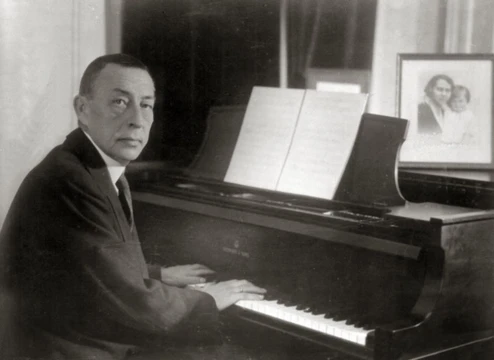
Rudolf Serkin
American classical pianist, Grammy winner, and champion of contemporary music.

Rudolf Serkin (28 March 1903 – 8 May 1991) was a Bohemian-born Austrian-American pianist widely regarded as one of the foremost Beethoven interpreters of the 20th century. Born in Cheb, Bohemia (then Austria-Hungary, now the Czech Republic) to a Russian Jewish family, he was taught to read music by his father, a former Russian basso, before he could read words. Recognized as a child prodigy, Serkin was sent to Vienna at age nine to study piano with Richard Robert and composition with Joseph Marx, making his public debut with the Vienna Philharmonic at twelve. From 1918 to 1920, he studied composition with Arnold Schoenberg and participated in Schoenberg’s Society for the Private Performance of Music. He began his regular concert career in 1920, living in Berlin with violinist Adolf Busch and his family, including Busch’s three-year-old daughter Irene, whom Serkin married fifteen years later. At seventeen, his Berlin debut featured him as keyboard soloist in Bach’s Brandenburg Concerto No. 5 with Busch’s ensemble; after the concert, Busch jokingly suggested he play the Goldberg Variations as an encore, which Serkin took seriously, finishing to an audience of only four people, including Busch, Artur Schnabel, and Alfred Einstein. During the 1920s and early 1930s, he performed across Europe as a soloist and with Busch and the Busch Quartet. With Hitler’s rise in 1933, Serkin and the Busches left Berlin for Basel, Switzerland. That year, he made his first U.S. appearance at the Coolidge Festival in Washington, D.C., with Busch. In 1936, he launched his solo U.S. career with the New York Philharmonic under Arturo Toscanini, performing Beethoven’s Fourth Piano Concerto to critical acclaim; Olin Downes praised his combination of analytical depth, artistic enthusiasm, and poetic clarity. A 1937 Carnegie Hall recital earned further praise for its colossal art and idealistic purpose. After World War II broke out in 1939, Serkin and the Busches emigrated to the United States, where he taught generations of pianists at the Curtis Institute of Music, serving as its director from 1968 to 1976. He lived in New York, Philadelphia, and on a dairy farm in Guilford, Vermont. In 1951, he and Busch founded the Marlboro Music School and Festival in Vermont to promote chamber music. He recorded extensively from the 1940s into the 1980s, including Beethoven’s Fourth Piano Concerto
- field
- Classical pianist
- nationality
- American
- known_for
- technically pristine playing; commitment to contemporary music
Verified Timeline
Lore & Background
Peter Serkin's concert career began in 1958, when he first performed at the Marlboro Music Festival. Following that, he was invited to play with major orchestras such as the Cleveland Orchestra under George Szell and the Philadelphia Orchestra with Eugene Ormandy. In 1966, at age 19, Serkin was awarded the Grammy Award for Most Promising New Classical Recording Artist. Three of his recordings garnered Grammy nominations (one features six Mozart concertos; the two others feature the music of Olivier Messiaen). Serkin was the first pianist to receive the Premio Internazionale Musicale Chigiana award in 1983 and received an honorary doctorate from the New England Conservatory of Music in 2001. In 1968, shortly after marrying and becoming a father, Serkin decided to stop playing music altogether. In the winter of 1971, he, his wife, and baby daughter Karina moved to a small rural town in Mexico. About eight months later, on a Sunday morning, Serkin heard the music of Johann Sebastian Bach being broadcast over the radio from a neighbor's house. As he listened, he said, 'It became clear to me that I should play.' He returned to the U.S. and began his musical career anew.
Reader's Guide
Peter Serkin performed around the world with leading orchestras and conductors including Claudio Abbado, Daniel Barenboim, Herbert Blomstedt, Pierre Boulez, Seiji Ozawa, Simon Rattle, James Levine, and Christoph Eschenbach. He made numerous recordings, primarily for RCA Victor. He recorded Bach's Goldberg Variations five times, the first made when he was 17, the fourth when he was 47, the fifth when he was 70. He recorded music by Mozart, Beethoven, Schubert, Chopin, Brahms, and Dvořák as well as more recent composers such as Reger, Berg, Webern, Schoenberg, Hans Werner Henze, Takemitsu, Oliver Knussen, Peter Lieberson and Stefan Wolpe. A recording of Messiaen's Vingt Regards sur L'Enfant-Jésus at age 25 became iconic, with noted 'deep understanding of the composer's sound-world and its emotional extremes, coupled with considerable instrumental prowess'. Serkin was a committed performer of new and recent music. He played works as world premieres or that were dedicated to him, by composers such as Elliott Carter, Alexander Goehr, Knussen, Lieberson and Takemitsu. Among prominent virtuosi, Peter Serkin was one of the first to experiment with period fortepianos, and the first to record late Beethoven sonatas on pianos of both the modern as well as Beethoven's era. He collaborated with Yo-Yo Ma, Lorraine Hunt Lieberson, András Schiff, Alexander Schneider, Pamela Frank, Harold Wright, the Guarneri Quartet, the Budapest Quartet, and other prominent musicians and ensembles. He was one of the founding members of TASHI. He taught at the Juilliard School, the Curtis Institute of Music and the Yale School of Music and was on faculty at the Bard College Conservatory of Music. Among those who studied piano with him is Simone Dinnerstein.
Did You Know?
- Peter Serkin won the Grammy Award for Most Promising New Classical Recording Artist in 1966 at age 19.
- He was the first pianist to receive the Premio Internazionale Musicale Chigiana award in 1983.
- In 1971, after an eight-month hiatus in Mexico, he decided to return to music after hearing Bach on a neighbor's radio.
- He recorded Bach's Goldberg Variations five times: at ages 17, 47, and 70.
- He was one of the first virtuosi to record late Beethoven sonatas on both modern and period fortepianos.
Frequently Asked Questions
Who is Rudolf Serkin?
Rudolf Serkin was a Bohemian-born Austrian-American classical pianist whose career spanned roughly eight decades. He is best remembered as one of the twentieth century's foremost interpreters of Beethoven's piano repertoire.
What made Serkin's Beethoven recordings stand out?
His Beethoven sonatas and concertos are prized for their structural transparency, restrained emotionalism, and a sense of architectural logic that many listeners find unmatched. Critics and fellow musicians often cite his accounts as a reference point for how the music should be understood.
What was Serkin's connection to Marlboro?
He co-founded the Marlboro Music School and Festival in Vermont, a gathering where he coached and performed chamber music with younger players. That teaching role became a defining second chapter of his career alongside his solo recitals.
More in Classical Virtuosos 1-24
Spotted an error? Know more?
This is a living reference — every entry is fact-audited, and reader corrections feed straight into our audit queue. Suggest an edit · See this site's audit record