Apple cider
Unfiltered, unsweetened apple juice, a seasonal autumn beverage in North America.
Last updated
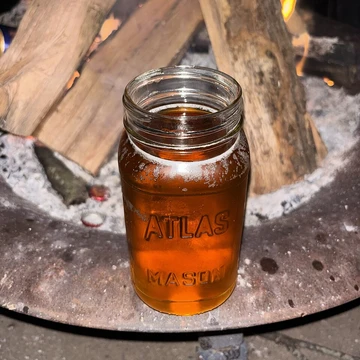
Apple cider (also called sweet cider, soft cider, or simply cider) is the name used in the United States and Canada for an unfiltered, unsweetened, non-alcoholic beverage made from apples. It is opaque due to fine apple particles in suspension and generally tangier than commercially cooked and filtered apple juice. Apple cider is seasonally produced in autumn and traditionally served on Halloween, Thanksgiving, Christmas, and New Year's Eve, sometimes heated and mulled.
Quick Facts
- Yield
- About one third of a bushel (10 liters) to make a gallon (3.78 liters) of cider
- Common preservation methods
- Pasteurization
- UV irradiation
- or addition of preservatives
- Official beverage of
- New Hampshire (U.S. state)
Facts from the source article.
Lore & Background
Historically all cider was left in its natural state, raw and unprocessed. Airborne yeasts present on apple skins or cider making machinery would start fermentation, and left on its own, alcohol would develop and forestall growth of harmful bacteria. With the advent of modern refrigeration, cider could be kept cold or frozen for long periods, slowing fermentation. However, any interruption of refrigeration could allow bacterial contamination to grow, leading to outbreaks of illness and subsequent state regulations requiring commercially produced cider to be treated with heat or UV radiation.
Natural raw cider is now a specialty seasonal beverage produced on-site at orchards and small rural mills, often made from a mixture of several different apples such as heirloom varieties Jonathan and Winesap. Many US states require that unpasteurized cider have a warning label on the bottle. Even with refrigeration, raw cider will begin to become slightly carbonated within a few weeks and eventually become hard cider as fermentation continues.
Origins and Global Expansion
Somersby is a cider brand owned by the Danish brewing giant Carlsberg Group, first introduced to consumers in Denmark in 2008. Pronounced "səməzbjʊ," the name is marketed as "Somersby Cider" across English-speaking markets. What began as a single-country launch has since grown into a genuinely global presence, with the brand now sold in more than forty countries.
Its geographic footprint spans the entirety of Europe and stretches far beyond it, reaching into Nepal, Australia, New Zealand, Malaysia, Hong Kong, Taiwan, Thailand, South Korea, Canada, Sri Lanka, South Africa, the United States, and even Laos. This remarkable expansion from a single Scandinavian origin to a product available across multiple continents underscores Carlsberg's ability to leverage its existing distribution infrastructure to push a new beverage category into markets where cider had previously been a niche or unfamiliar choice. The brand's rapid international rollout positioned it as a serious competitor in the global alcoholic beverage landscape almost from the moment of its debut.
The Lord Somersby Marketing Persona
One of the most distinctive aspects of Somersby's brand identity is the deliberate fiction surrounding its origins. Although the cider was created and first sold in Denmark by Carlsberg Group, in numerous markets around the world it is presented as the handiwork of "Lord Somersby," a fictional English nobleman. This invented character serves as a marketing device, lending the product an air of traditional English heritage and aristocratic craftsmanship that would be difficult to claim for a Danish corporate launch.
The strategy is particularly effective in English-speaking territories where the name "Somersby" naturally evokes a British place name and the title "Lord" suggests old-world pedigree. By wrapping a modern, mass-produced beverage in the trappings of a storied English lord, Carlsberg effectively repositions a relatively new product as something with deep cultural roots. The fictional persona allows the brand to tell a story of tradition and quality that resonates with consumers who associate cider with English orchards and countryside, even though the actual production and corporate ownership sit firmly in Scandinavia.
Product Range and Flavor Innovation
Beyond its core offering of pure apple cider, the Somersby brand encompasses a broad and evolving product lineup. Carlsberg has extended the name to pear cider, a calorie-reduced apple cider variant, and a wide array of flavored apple ciders. The flavor portfolio is notably diverse, including blackberry, rhubarb, elderflower, ginger and lemon, blueberry, apple burst, cranberry, citrus, and watermelon.
In 2012, Carlsberg's UK division developed a dedicated version specifically for the British market: Somersby Cider UK, a medium-dry cider at 4.5% ABV that contains no artificial flavors or sweeteners. This localized formulation demonstrates the brand's willingness to tailor its recipe to regional taste preferences rather than simply exporting a single global product. The breadth of the range—from traditional apple to exotic watermelon, from full-calorie to reduced-calorie—positions Somersby not as a single drink but as a versatile platform capable of addressing multiple consumer segments and occasions within the cider and adjacent beverage categories.
Navigating Legal and Market Constraints
Perhaps the most revealing aspect of Somersby's global strategy is how Carlsberg has adapted the brand to navigate restrictive regulatory environments. In Poland, where cider as a beverage category enjoys relatively low consumer popularity and faces strict legal limitations—including a complete ban on advertising—Carlsberg repurposes the Somersby name for fruit-flavored beers rather than cider.
A similar workaround appears in Poland, Switzerland, France, and Quebec, where the brand is applied to a hybrid product consisting of 45% beer and 55% apple-flavored drink. Because this mixture cannot legally be classified as cider in those jurisdictions, it is sold under the label "Apple Beer Drink." These adaptations illustrate a pragmatic approach to market entry: rather than abandoning a region where cider regulations make the core product unviable, Carlsberg retains the recognizable Somersby brand name while altering the underlying product to comply with local law. The result is a brand that means something different in Warsaw than it does in Copenhagen, yet still benefits from the same name recognition and marketing investment.
Reader's Guide
Apple cider holds a distinct place in North American beverage culture, separate from the alcoholic cider known elsewhere. Its significance is tied to autumn harvest traditions and seasonal celebrations. The distinction between apple juice and cider is not well established across the U.S., though Massachusetts differentiates fresh raw cider from processed, cooked apple juice.
Canada recognizes unfiltered, unsweetened apple juice as cider, fresh or not. Commercial production has evolved from man- or horse-powered crushers to modern electric-hydraulic equipment and continuous belt filter presses. The waste left after pressing, known as pomace, is sold for cattle feed. Cider is also used to produce hard apple cider, apple wine, applejack, or apple brandy.
Hot mulled cider is a popular autumn and winter beverage, and cider doughnuts are sometimes sold at cider mills and roadside stands. Visiting apple orchards in the fall for cider, doughnuts, and self-picked apples is a large segment in agritourism. Apple cider is the official beverage of the U.S. state of New Hampshire.
Frequently Asked Questions
What is apple cider?
Apple cider is a non-alcoholic, unfiltered drink pressed from apples that's widely enjoyed across the United States and Canada. It gets its cloudy, opaque appearance from tiny apple solids left suspended in the liquid, and it tends to taste noticeably sharper than store-bought apple juice.
How does apple cider differ from regular apple juice?
Where grocery-store apple juice is clear, filtered, and often sweetened, apple cider is left unfiltered so fine apple particles remain in the drink. It's unsweetened by default and carries a tangier, more rustic flavor.
When do people traditionally serve apple cider?
Apple cider is a seasonal autumn drink that shows up at Halloween parties, Thanksgiving dinners, Christmas gatherings, and New Year's Eve celebrations. Many folks prefer it warm, sometimes spiced and mulled over low heat.
How many apples do you need to make a gallon of cider?
Roughly one-third of a bushel of apples—around ten liters' worth—yields a single gallon (about 3.78 liters) of cider. That's a surprisingly large pile of fruit for just one gallon of liquid.
More in Cider
Elsewhere in Cider and Mead
Sources
Compiled from Wikipedia and the sources listed below. Text from Wikipedia is available under CC BY-SA 4.0; this entry is adapted from it.
- Wikipedia: Apple cider (CC BY-SA 4.0).
- Word definitions: the Codexery glossary, each quoted from its Wikipedia article.
Spotted an error? Know more?
Reader corrections go straight into our review queue. Suggest an edit · How this site is sourced