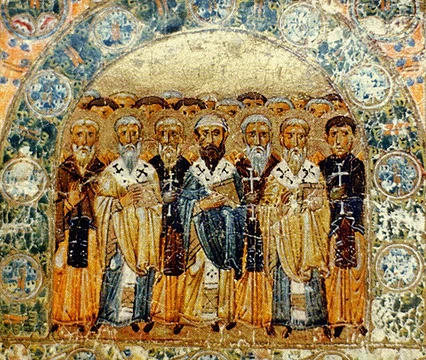
Matthew the Apostle
Last updated
Matthew the Apostle was a tax collector who was called by Jesus to become a disciple, as recorded in Matthew 9:9 and Matthew 10:3.[1] Matthew is recognized as a saint in the Roman Catholic, Eastern Orthodox, Lutheran and Anglican churches.[2] Mark 3:18, Luke 6:15, and Acts 1:13 each list him among the Twelve Disciples without describing his background.[1]
Life and work
Matthew, also known as Levi, was the son of Alphaeus, and Eastern Orthodox tradition holds that he and James, son of Alphaeus, were brothers.[3] While sitting at the "receipt of custom" in Capernaum, Matthew was called to follow Jesus.[1] According to the New Testament, Matthew followed Jesus during his time as a disciple.[4] Almost all sources mention Ethiopia as one of the countries where Matthew preached, though ancient writers disagree on which other countries these were.[5]
Both the Catholic Church and the Orthodox Church maintain a tradition that Matthew died a martyr's death.[6] The apostle Matthew is traditionally considered the author of the Gospel of Matthew, a view first attested by Papias of Hierapolis.[7]
What the cited sources add
The Cathedral of St. Matthew the Apostle in Washington, D.C. celebrates the Feast of St. Matthew on September 21 as a solemnity with music at the 12:10pm Mass.[8] A mural in the west transept of that cathedral, entitled The Calling of St. Matthew, depicts Christ calling Matthew, who appears astounded by the Master’s words.[8] A festival on September 21 is how the Anglican communion commemorates Matthew.[9] Druze tradition honors Matthew the Apostle as a prophet, and Druze doctrine regards the Gospel writers as "carriers of wisdom".[10]
References
- Wikipedia, "Matthew the Apostle" (CC BY-SA 4.0), which cites: ; ; , ,; , and .; ; (original not read by us) en.wikipedia.org
- Wikipedia, "Matthew the Apostle" (CC BY-SA 4.0), which cites: ELCA 2006, p. 57 (original not read by us) en.wikipedia.org
- Wikipedia, "Matthew the Apostle" (CC BY-SA 4.0), which cites: "Nikolaj Velimirović Prologue of Ohrid"; "Shams ibn Kabar The Lamp that Lights the Darkness in Clarifying the Service" (original not read by us) en.wikipedia.org
- Wikipedia, "Matthew the Apostle" (CC BY-SA 4.0), which cites: Freedman 2001, p. 130–133, 201; Jacquier 1911 (original not read by us) en.wikipedia.org
- Wikipedia, "Matthew the Apostle" (CC BY-SA 4.0), which cites: Jacquier 1911; Jacquier 1911 (original not read by us) en.wikipedia.org
- Wikipedia, "Matthew the Apostle" (CC BY-SA 4.0), which cites: Lardner 1838, p. 299; Bock 2002, p. 164 (original not read by us) en.wikipedia.org
- Wikipedia, "Matthew the Apostle" (CC BY-SA 4.0), which cites: Martin 2012; Turner 2008, p. 15–16; Bingham 1998, p. 64 (original not read by us) en.wikipedia.org
- "Cathedral of St. Matthew the Apostle, Washington, D.C.", Stmatthewscathedral.org, 2013-09-21. stmatthewscathedral.org
- Wikipedia, "Matthew the Apostle" (CC BY-SA 4.0), which cites: "The Calendar", The Church of England (original not read by us) en.wikipedia.org
- Wikipedia, "Matthew the Apostle" (CC BY-SA 4.0), which cites: S. Swayd, "The A to Z of the Druzes", Rowman & Littlefield, 2009, p. 109; S. Swayd, "The A to Z of the Druzes", Rowman & Littlefield, 2009, p. 109; "On the Horizon: The Strange World of the Druzes", 20 January 1956 (we also read that source) en.wikipedia.org
Each numbered sentence above was checked against the source it cites before publication. Sentences citing Wikipedia adapt text from the English Wikipedia article Matthew the Apostle (contributors), used under CC BY-SA 4.0; this entry is available under the same licence. Other sources were used for facts only.
More in Christian Saints & Early Church Fathers
Sources
Compiled from Wikipedia and the sources listed below. Text from Wikipedia is available under CC BY-SA 4.0; this entry is adapted from it.
- Wikipedia: Matthew the Apostle (CC BY-SA 4.0).
Spotted an error? Know more?
Reader corrections go straight into our review queue. Suggest an edit · How this site is sourced