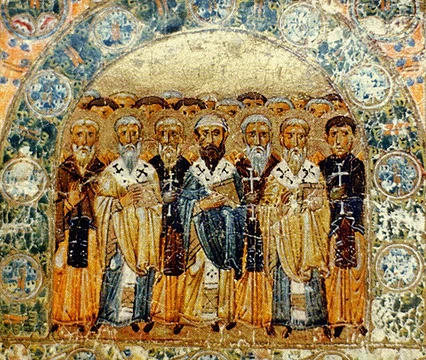
Nestorius
Archbishop of Constantinople whose Christological teachings led to lasting controversy.
He was condemned and deposed by the Council of Ephesus in 431, presided over by Cyril of Alexandria.[1] The Assyrian Church of the East reveres Nestorius as a saint, though the modern church does not subscribe to the entirety of Nestorian doctrine as traditionally understood in the West.[2] From 10 April 428 until 11 July 431, Nestorius held the position of Archbishop of Constantinople.[1]
Last updated 2026-10-12 from the source article.
Quick Facts
- Titles
- Archbishop of Constantinople
- Born
- c. 386
- Birthplace
- Germanicia, Province of Syria, Roman Empire (now Kahramanmaraş, Turkey)
- Died
- c. 451 (aged 64 or 65)
- Place of death
- Great Oasis of Hibis (al-Khargah), Egypt
- Issues
- Christology, Theotokos
- Venerated in
- Church of the East
Facts from the source article.
Life and work
According to Nestorius himself, the emperor Theodosius personally intervened to have him brought to the capital as an outsider.[3] He was ordained bishop on 10 April 428 and vigorously pursued pagans and heretics.[3] He refused to distance himself from his subordinates' beliefs about Theotokos and continued to quibble with its legitimacy.[3] Nestorius refrained from attending both Cyril's council and the counter-council convened by John of Antioch.[3]
He lived just outside of Antioch until an imperial order of 435 exiled him to Petra.[3] Evidence indicates Nestorius died in 451 in the Thebaid region of Egypt, not long after the Council of Chalcedon.[4]
What the cited sources add
The Gorgias Encyclopedic Dictionary of the Syriac Heritage notes there is no evidence Nestorius could speak or write Syriac, despite his family background.[3] The same source states that Syriac sources put his birthplace in Germanicea, though these may misunderstand the church historian Socrates.[3] Nestorius's subsequent insistence on the two natures firmly placed him within Theodore of Mopsuestia's intellectual milieu, though it is not clear he studied under Theodore directly.[3] The Gorgias account reports that Nestorius likely induced the emperor to issue a new edict against aberrant beliefs on 20 May 428.[3]
Members of Nestorius's cadre made denunciations of the appellation Theotokos for the Virgin Mary perhaps as early as summer 428.[3] Sermons to this effect began circulating among the monasteries of Egypt by winter 428/9, eliciting a critical reaction from Cyril of Alexandria.[3]
References
- Wikipedia, "Nestorius" (CC BY-SA 4.0), which cites: Seleznyov 2010, p. 165–190 (original not read by us) en.wikipedia.org
- Wikipedia, "Nestorius" (CC BY-SA 4.0), which cites: Hill 1988, p. 107 (original not read by us) en.wikipedia.org
- Bevan, "Gorgias Encyclopedic Dictionary of the Syriac Heritage". facts only, no text reused. gedsh.bethmardutho.org
- Wikipedia, "Nestorius" (CC BY-SA 4.0), which cites: Louth 2004, p. 348 (original not read by us) en.wikipedia.org
Each numbered sentence above was checked against the source it cites before publication. Sentences citing Wikipedia adapt text from the English Wikipedia article Nestorius (contributors), used under CC BY-SA 4.0; this entry is available under the same licence. Other sources were used for facts only; no text or images are copied from them.
More in Christian Saints & Early Church Fathers
Spotted an error? Know more?
Reader corrections go straight into our review queue. Suggest an edit · How this site is sourced