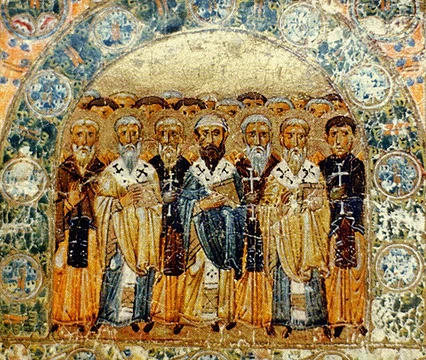
Polycarp
Last updated

PravoslavnyChristianin · via Wikipedia: Polycarp · CC0
According to the Martyrdom of Polycarp, the Smyrna bishop was killed by being tied up and set on fire, and when the flames did not destroy his body, he was pierced with a blade.[1] The claim that Polycarp learned from John the Apostle appears in writings by both Irenaeus and Tertullian.[2] Jerome's work On Illustrious Men identifies Polycarp as a disciple of John who was made bishop of Smyrna, and he is counted among the three main Apostolic Fathers together with Clement of Rome and Ignatius of Antioch.[3]
Life and work
The chief sources for Polycarp's life include the Martyrdom of Polycarp, Against Heresies, the Epistle to Florinus, the epistles of Ignatius, and his own letter to the Philippians.[4] The sole surviving work attributed to Polycarp is the Epistle of Polycarp to the Philippians.[5] Polycarp was burned at the stake and pierced with a spear for refusing to burn incense to the Roman emperor.[6] Irenaeus writes that as a young man he was fortunate to be acquainted with Polycarp, who at that time was very elderly.[7]
Irenaeus reports that Polycarp traveled to Rome to talk over variations between the church customs of Anatolia and those of Rome.[8] The Romans considered it a significant distinction when Anicetus permitted Polycarp to conduct the Eucharist in his own church.[8] Polycarp observed the Eastern custom of commemorating the feast on Nisan 14, whereas Anicetus followed the Western custom of holding it on a Sunday.[8] Saint Polycarp's feast day falls on 23 February in the Roman Catholic, Eastern Orthodox, and Greek Catholic Churches.[9]
What the cited sources add
Henry Wace's Dictionary states that a high value was attached to the witness Polycarp could give as to the genuine tradition of apostolic doctrine.[10] Irenaeus, writing in advanced life, tells how vivid his recollections were of having been a hearer of Polycarp, then an old man.[10] The Catholic Encyclopedia states that Polycarp kept Easter on the fourteenth day of the moon, following the tradition he claimed to have derived from St. John the Apostle.[11] The Grace Communion International account records that Polycarp and Anicetus took the Lord's Supper together.[12]
Irenaeus's Adversus Haereses states that Polycarp was appointed bishop of the Church in Smyrna by apostles in Asia.[13] Tertullian's De praescriptione hereticorum records that the church of Smyrna records that Polycarp was placed therein by John.[14] During Polycarp's journey to Rome, his witness led numerous followers of Marcion and Valentinus to convert.[10]
References
- Wikipedia, "Polycarp" (CC BY-SA 4.0), which cites: ; Henry Wace, Dictionary of Christian Biography and Literature to the End of the Sixth Century A.D., with an Account of the Principal Sects and Heresies, s.v. "Po (we also read that source) en.wikipedia.org
- Wikipedia, "Polycarp" (CC BY-SA 4.0), which cites: Irenaeus, Adversus Haereses III.3; Tertullian, De praescriptione hereticorum 32.2 (we also read that source) en.wikipedia.org
- Wikipedia, "Polycarp" (CC BY-SA 4.0), which cites: "Kirby, Peter. "St. Polycarp of Smyrna." Early Christian Writings. 2020. 10 January 2020" (original not read by us) en.wikipedia.org
- Wikipedia, "Polycarp" (CC BY-SA 4.0), which cites: Hartog, "Polycarp and the New Testament", Mohr Siebeck, 2002, p. 17 (we also read that source) en.wikipedia.org
- Wikipedia, "Polycarp" (CC BY-SA 4.0), which cites: ; Hill, "From the Lost Teaching of Polycarp: Identifying Irenaeus' Apostolic Presbyter and the Author of Ad Diognetum", Mohr Siebeck, 2006, p. v, 2–3, 7, 8ff (8–94) (original not read by us) en.wikipedia.org
- Wikipedia, "Polycarp" (CC BY-SA 4.0), which cites: Fr. Paolo O. Pirlo, SHMI, "My First Book of Saints", Sons of Holy Mary Immaculate – Quality Catholic Publications, 1997, p. 58–59; "Polycarp – Martyrdom", Polycarp.net; Fr. Paolo O. Pirlo, SHMI, "My First Book of Saints", Sons of Holy Mary Immaculate – Quality Catholic Publications, 1997, p. 58–59 (original not read by us) en.wikipedia.org
- Wikipedia, "Polycarp" (CC BY-SA 4.0), which cites: Liguori, Alphonsus. "St. Polycarp, Bishop of Smyrna", Victories of the Martyrs, (Eugene Grimm, ed.), New York, Benziger Brothers, 1888, p. 66 (original not read by us) en.wikipedia.org
- Wikipedia, "Polycarp" (CC BY-SA 4.0) en.wikipedia.org
- Wikipedia, "Polycarp" (CC BY-SA 4.0), which cites: "The Calendar", The Church of England; "Lutheran Service Book", Concordia Publishing House, 2006, p. xiii (we also read that source) en.wikipedia.org
- Henry Wace, Dictionary of Christian Biography and Literature to the End of the Sixth Century A.D., with an Account of the Principal Sects and Heresies, s.v. "Po. ccel.org
- "CATHOLIC ENCYCLOPEDIA: Easter Controversy", www.newadvent.org. newadvent.org
- "The Passover-Easter-Quartodeciman Controversy", Grace Communion International. gci.org
- Irenaeus, Adversus Haereses III.3. newadvent.org
- Tertullian, De praescriptione hereticorum 32.2. newadvent.org
Each numbered sentence above was checked against the source it cites before publication. Sentences citing Wikipedia adapt text from the English Wikipedia article Polycarp (contributors), used under CC BY-SA 4.0; this entry is available under the same licence. Other sources were used for facts only.
More in Christian Saints & Early Church Fathers
Sources
Compiled from Wikipedia and the sources listed below. Text from Wikipedia is available under CC BY-SA 4.0; this entry is adapted from it.
- Wikipedia: Polycarp (CC BY-SA 4.0).
Spotted an error? Know more?
Reader corrections go straight into our review queue. Suggest an edit · How this site is sourced