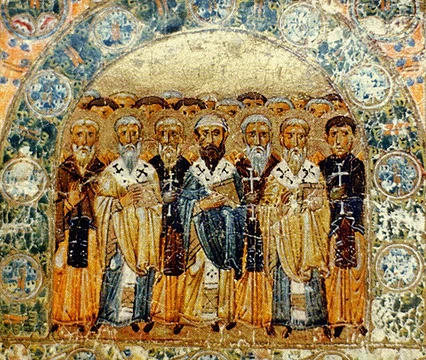
Lazarus of Bethany
Last updated
The raising of Lazarus is considered one of the miracles of Jesus and is the climactic narrative in John's sequence of seven signs.[1][2] Righteous Lazarus, the Four-Days Dead, is a venerated figure in Eastern Orthodox tradition.[1]
Life and work
The biblical narrative introduces Lazarus as a follower of Jesus living in Bethany near Jerusalem, identified as the brother of Mary and Martha.[3] Jesus met with Martha and Mary separately, and Martha affirmed her belief that Jesus is the Christ, the Son of God.[4] After the resurrection, Lazarus attended a supper served by Martha six days before the Passover, attracting the attention of many Jews.[3] The chief priests considered having Lazarus put to death because many people were believing in Jesus due to this miracle.[3]
According to Eastern Orthodox tradition, Lazarus was forced to flee Judea due to plots on his life and came to Cyprus.[5] Lazarus's sisters informed Jesus of his illness, and by the time Jesus reached Bethany, Lazarus had already been entombed for four days.[6][4] Barnabas and Paul appointed Lazarus as the initial bishop of Kition, which is now Larnaca, where he remained for three decades.[5]
What the cited sources add
Lysander Spooner wrote in 1836 that the Synoptic Gospels' omission of the raising of Lazarus seemed to indicate the Gospel of John's author was dishonest or recorded a baseless story.[7][8] Robert G. Ingersoll in 1892 found the narrative historically implausible, arguing that a resurrected Lazarus would have shared experiences more interesting than everything else in the New Testament.[8]
References
- Wikipedia, "Lazarus of Bethany" (CC BY-SA 4.0), which cites: Holland, "The Resurrection of Lazarus, the Four Days Dead, of Bethany", Pravoslavie.ru (we also read that source) en.wikipedia.org
- Wikipedia, "Lazarus of Bethany" (CC BY-SA 4.0), which cites: Tenney, "Zondervan NIV Bible Commentary", Zondervan Publishing House (original not read by us) en.wikipedia.org
- Wikipedia, "Lazarus of Bethany" (CC BY-SA 4.0), which cites: ; (original not read by us) en.wikipedia.org
- Wikipedia, "Lazarus of Bethany" (CC BY-SA 4.0), which cites: John 11:25, BSB; John 11:35, BSB (original not read by us) en.wikipedia.org
- Wikipedia, "Lazarus of Bethany" (CC BY-SA 4.0), which cites: Chev. C. Savona-Ventura (KLJ, CMLJ, BCrLJ). Lazarus of Bethany . Grand Priory of the Maltese Island: Military & Hospitaller Order of St. Lazarus of Jerusalem. D; Michaelides, "St. Lazarus The Friend Of Christ And First Bishop Of Kition, Cyprus", 1984}} Reprinted online by Fr. Demetrios Serfes: {{cite web (original not read by us) en.wikipedia.org
- Wikipedia, "Lazarus of Bethany" (CC BY-SA 4.0) en.wikipedia.org
- Spooner, "The Deist's Reply to the Alleged Supernatural Evidences of Christianity", 1836, p. 34. archive.org
- Wikipedia, "Lazarus of Bethany" (CC BY-SA 4.0), which cites: Spooner, "The Deist's Reply to the Alleged Supernatural Evidences of Christianity", 1836, p. 34; "Prose-Poems and Selection from the Writings and Sayings of Robert G. Ingersoll", C. P. Farrell, 1892, p. 84 (we also read that source) en.wikipedia.org
Each numbered sentence above was checked against the source it cites before publication. Sentences citing Wikipedia adapt text from the English Wikipedia article Lazarus of Bethany (contributors), used under CC BY-SA 4.0; this entry is available under the same licence. Other sources were used for facts only.
More in Christian Saints & Early Church Fathers
Sources
Compiled from Wikipedia and the sources listed below. Text from Wikipedia is available under CC BY-SA 4.0; this entry is adapted from it.
- Wikipedia: Lazarus of Bethany (CC BY-SA 4.0).
- Word definitions: the Codexery glossary, each quoted from its Wikipedia article.
Spotted an error? Know more?
Reader corrections go straight into our review queue. Suggest an edit · How this site is sourced