
Egg balancing
Eggs balance anywhere, anytime, despite folk beliefs.

AstroHurricane001 at en.wikipedia · Public domain
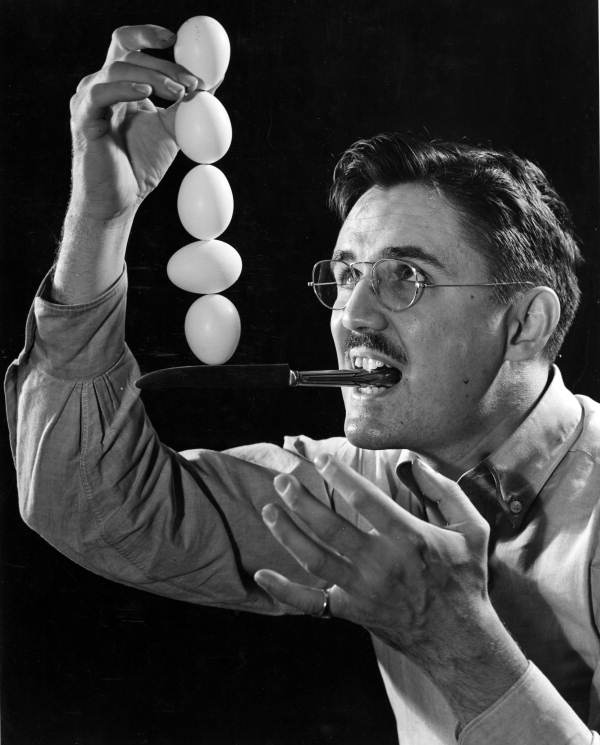
Egg balancing is a traditional Chinese practice of standing eggs on their ends, later popularized in the United States. While an egg’s irregular shape makes this tricky, its shell usually has enough tiny bumps and dimples that most eggs can be balanced on their broad ends with little trouble. According to folklore, this is only possible at specific times: the lunar new year in mainland China, the Dragon Boat Festival in Taiwan, or the vernal equinox in the United States. In truth, eggs can be balanced at any location and any time of year, and the practice has nothing to do with gravitational forces from the moon or sun.
- Field
- Folk practice and urban legend
- Known for
- Egg balancing associated with Lichun, Dragon Boat Festival, and vernal equinox
- Origin
- China, later popularized in the United States
Lore & Background
Egg balancing has been connected with Lichun, the solar term beginning Chinese spring on February 4 or 5 when the sun is at the celestial longitude of 315°. On this day, fresh chicken eggs were balanced on their broad end. In Taiwan, the practice is sometimes connected with the Dragon Boat Festival instead, on the fifth day of the fifth lunar month. A 1945 Life article reported on an egg-balancing craze among the population of Chongqing on that year's Lichun. That article and subsequent followings-up started a similar egg-balancing craze in the United States, but transposed to the vernal equinox beginning Western spring on March 20 or 21 when the sun is at the celestial longitude of 0°. The idea that an egg is easier to balance on the spring equinox has since become an American urban legend, and egg-balancing events are sometimes held on that date. In 1976, New York artist Donna Henes started organizing egg-balancing ceremonies with the stated goal of bringing about world peace and international harmony. These events, which often drew thousands of people, are still held annually by Henes in New York City.
Reader's Guide
Egg balancing illustrates how folk beliefs can persist despite scientific evidence. The practice, rooted in Chinese tradition and later adopted in the United States, has been experimentally debunked: physicist Ukichiro Nakaya verified in 1947 that eggs can be balanced with ease at any time of year, noting that eggshells have small bumps and dimples allowing three-point contact. Astronomer Frank D. Ghigo replicated these findings in 1984. Martin Gardner speculated that the folk beliefs inspired people to try harder and be more patient, possibly subconsciously sabotaging attempts on other days, comparing it to a ouija-board phenomenon. The practice's significance lies in its demonstration of how cultural transmission can create self-reinforcing delusions, and how a simple act—balancing an egg—can become a symbol of seasonal change or even world peace, as seen in Henes' ceremonies. No physical influence of celestial bodies affects the egg's balance; gravitational and electromagnetic forces are weaker than disturbances from a person's breathing and heartbeat.
Did You Know?
- A 1945 Life article about an egg-balancing craze in Chongqing started a similar craze in the United States, transposed to the vernal equinox.
- Martin Gardner compared the self-reinforcing delusion of egg-balancing folklore to a 'ouija-board phenomenon'.
Folklore & Cultural Origins
Egg balancing is rooted in traditional Chinese practice, where fresh chicken eggs were stood upright on their broad end during Lichun, the solar term marking the arrival of spring around February 4 or 5. In Taiwan, the custom is sometimes tied instead to the Dragon Boat Festival, falling on the fifth day of the fifth lunar month. Beyond these specific dates, a broader folklore claims that eggs can be balanced only at particular celestial moments—the lunar new year in mainland China, or even on the heads of nails at the equator. The underlying belief in all these variations is that some invisible cosmic alignment makes the impossible possible. In reality, none of these dates carry any special physical significance for the task. The practice has no connection to the gravitational pull of the moon or sun, and eggs will stand on their ends just as readily in July as they do in February. What the folklore captures, however, is a deep human desire to find hidden order and magical timing in the natural world.
The American Urban Legend & Donna Henes
The practice crossed the Pacific in an unexpected way. In 1945, Life magazine published a report on an egg-balancing craze sweeping Chongqing, China's interim wartime capital, during that year's Lichun. The article and its follow-ups sparked a parallel enthusiasm in the United States, but the timing was shifted to the vernal equinox—March 20 or 21—when the sun reaches celestial longitude of zero degrees. This transposition gave birth to a distinctly American urban legend: that the spring equinox somehow makes eggs easier to balance. The idea took on a spiritual dimension in 1976, when New York artist Donna Henes began organizing public egg-balancing ceremonies explicitly aimed at promoting world peace and international harmony. Her gatherings frequently attracted thousands of participants, and she continues to hold them annually in New York City. What began as a misread of a foreign custom became, in the American context, a communal ritual with its own identity and purpose.
The Physics of a Simple Trick
The reason eggs balance so readily has nothing to do with celestial mechanics and everything to do with geometry and texture. An eggshell is far from perfectly smooth; it is covered in tiny bumps and dimples. Japanese physicist Ukichiro Nakaya demonstrated this experimentally in 1947 after Japanese newspapers picked up the story. By rotating an egg in various directions, one can easily find an orientation where three of those small surface irregularities touch a flat surface simultaneously. As long as the egg's center of mass falls within the triangle formed by those three contact points, the egg stands upright. This is the same balancing condition that applies to any object. Astronomer Frank D. Ghigo of the University of Minnesota independently replicated Nakaya's findings in 1984. Meanwhile, the gravitational and electromagnetic forces exerted by the sun or moon are so weak and steady that they are dwarfed by the tiny disturbances caused by a person's own breathing and heartbeat. The magic of the equinox is, physically speaking, an illusion.
The Psychology of Belief
Perhaps the most fascinating aspect of egg balancing is not the physics but the psychology. Martin Gardner, the renowned mathematician and writer, offered a compelling explanation for why people genuinely believe the trick is harder on wrong days. He speculated that the folk belief itself changes behavior: on the supposedly magical date, people try a little harder, exercise more patience, and hold their hands steadier. On all other days, they may subconsciously sabotage their own attempts, giving up too quickly or expecting failure. Gardner likened this self-reinforcing delusion to a ouija-board phenomenon, where the participants' own expectations shape the outcome they perceive. The egg never changes, but the person does. This insight transforms egg balancing from a simple parlor trick into a small window into how belief, expectation, and confirmation bias can manufacture the very evidence they claim to explain.
Gallery
Frequently Asked Questions
What is egg balancing in Chinese folklore?
Egg balancing is a folk practice that originated in China, in which people try to stand an egg upright on a flat surface. It later spread to the United States, where it became a popular seasonal challenge linked to particular holidays.
Can you really only balance an egg on the vernal equinox?
No, that is a widely repeated myth. The tiny natural imperfections on an eggshell give it enough grip to stand upright at any time of year and in any location, with no special gravitational alignment involved.
Which holidays is egg balancing traditionally associated with?
In mainland China the practice is tied to Lichun and the Lunar New Year, while in Taiwan it is linked to the Dragon Boat Festival. In the United States it became most strongly connected to the vernal equinox.
Why is balancing an egg tricky if it can be done anytime?
An egg's smooth, rounded geometry makes it hard to find a stable contact point on a flat surface. That said, the shell's microscopic bumps and dimples provide just enough friction that most eggs can be steadied on their broader end with a little patience.
Is egg balancing a genuine folk tradition or just an urban legend?
It started as a real cultural practice in China but has since taken on the character of an urban legend, especially in the US, where the idea that it only works during a specific celestial moment spread through word of mouth and school activities.
More in Chinese folklore 1-24
Spotted an error? Know more?
Reader corrections go straight into our review queue. Suggest an edit · How this site is sourced