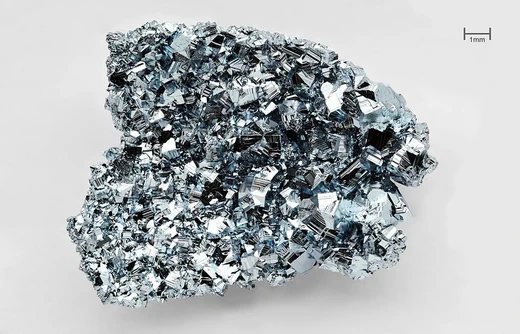
Rhenium
Rhenium is a rare, high-melting transition metal used in superalloys and catalysts.
Last updated
Rhenium is a rare, expensive metal used primarily in jet engine superalloys and as a catalyst for gasoline production.[1][2] Masataka Ogawa's 1908 discovery of what he thought was element 43, which he called nipponium, was actually element 75.[3][4] Walter Noddack, Ida Tacke, and Otto Berg rediscovered the element in 1925, naming it after the Rhine river.[3][5][6]
Quick Facts
- Atomic number
- 75
- Group
- 7
- Period
- 6
Facts from the source article.
Key facts and history
His work was often incorrectly cited because key results were published only in Japanese.[4] Kimura did not reveal this publicly because Japanese university culture before World War II frowned upon pointing out seniors' mistakes.[7] Rhenium is one of the rarest elements in Earth's crust with an average concentration of 1 ppb.[8] The first rhenium mineral, a rhenium sulfide, was identified in 1994 after condensing from a fumarole on the Kudriavy volcano in the Kuril Islands.[8]
What the research sources say
The University of Cambridge account states that second and third generation nickel-based superalloys contain about 3 wt% and 6 wt% of rhenium respectively.[9] Bhadeshia argues that rhenium improves creep strength and promotes rafting by partitioning into the γ phase, making the lattice misfit more negative.[9] It is also claimed that rhenium reduces the overall diffusion rate in nickel based superalloys.[9] The addition of rhenium promotes TCP formation, so alloys must have their chromium, cobalt, tungsten, or molybdenum concentrations reduced to compensate.[9]
Fully ionised rhenium-187 has a half-life of just 33 years, compared to 42 billion years for neutral rhenium-187.[10]
References
- Wikipedia, "Rhenium" (CC BY-SA 4.0), which cites: "BASF Catalysts - Metal Prices", apps.catalysts.basf.com (original not read by us) en.wikipedia.org
- Wikipedia, "Rhenium" (CC BY-SA 4.0), which cites: "Rhenium (Re) AMERICAN ELEMENTS ®", American Elements: The Materials Science Company; Naumov, "Rhythms of rhenium", Russian Journal of Non-Ferrous Metals, 2007, p. 418–423; Magyar, "2009 Mineral Yearbook: Rhenium", United States Geological Survey, April 2011 (original not read by us) en.wikipedia.org
- Wikipedia, "Rhenium" (CC BY-SA 4.0), which cites: "Die Ekamangane", Naturwissenschaften, 1925-06-01, p. 567–574 (original not read by us) en.wikipedia.org
- Wikipedia, "Rhenium" (CC BY-SA 4.0), which cites: Yoshihara, "Discovery of a new element 'nipponiumʼ: re-evaluation of pioneering works of Masataka Ogawa and his son Eijiro Ogawa", Spectrochimica Acta Part B: Atomic Spectroscopy, 2004, p. 1305–1310; Hisamatsu, "Ogawa's nipponium and its re-assignment to rhenium", Foundations of Chemistry, 2022, p. 15–57 (original not read by us) en.wikipedia.org
- Wikipedia, "Rhenium" (CC BY-SA 4.0), which cites: "From Hydrogen to Darmstadtium & More", American Chemical Society, 2003, p. 144 (original not read by us) en.wikipedia.org
- Wikipedia, "Rhenium" (CC BY-SA 4.0), which cites: Tilgner, "Forschen Suche und Sucht", Books on Demand, 2000 (original not read by us) en.wikipedia.org
- Wikipedia, "Rhenium" (CC BY-SA 4.0), which cites: Hisamatsu, "Ogawa's nipponium and its re-assignment to rhenium", Foundations of Chemistry, 2022, p. 15–57 (original not read by us) en.wikipedia.org
- Wikipedia, "Rhenium" (CC BY-SA 4.0), which cites: ; Emsley, "Nature's Building Blocks: An A-Z Guide to the Elements", Oxford University Press, 2001, p. 358–360; ; Rouschias, George, "Recent advances in the chemistry of rhenium", Chemical Reviews, 1974, p. 531; Anderson, "2005 Minerals Yearbook: Chile", United States Geological Survey; Korzhinsky, "Discovery of a pure rhenium mineral at Kudriavy volcano", Nature, 2004-05-05, p. 51–52; Kremenetsky, "Concentration of rhenium and other rare metals in gases of the Kudryavy Volcano (Iturup Island, Kurile Islands)", Doklady Earth Sciences, 2010, p. 1 en.wikipedia.org
- Bhadeshia, "Nickel Based Superalloys", University of Cambridge. facts only, no text reused. msm.cam.ac.uk
- Johnson, "How to Change Nuclear Decay Rates", math.ucr.edu, 1993. facts only, no text reused. math.ucr.edu
Each numbered sentence above was checked against the source it cites before publication. Sentences citing Wikipedia adapt text from the English Wikipedia article Rhenium (contributors), used under CC BY-SA 4.0; this entry is available under the same licence. Other sources were used for facts only; no text or images are copied from them.
More in Chemical Elements & Metals
Sources
Compiled from Wikipedia and the sources listed below. Text from Wikipedia is available under CC BY-SA 4.0; this entry is adapted from it.
- Wikipedia: Rhenium (CC BY-SA 4.0).
- Word definitions: the , each quoted from its Wikipedia article.
Spotted an error? Know more?
Reader corrections go straight into our review queue. Suggest an edit · How this site is sourced