Plutonium
Plutonium is the element with the highest atomic number known to occur in nature.
Last updated
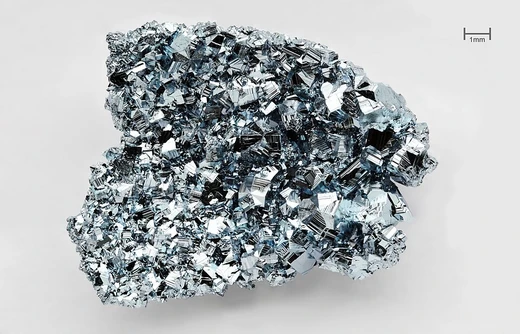
Plutonium is a chemical element with the symbol Pu and atomic number 94. It is a silvery-gray actinide metal that quickly tarnishes upon exposure to air, forming a dull oxidized coating.
Compounds and chemistry
The element normally exists in six allotropes and exhibits four oxidation states, and it reacts with carbon, halogens, nitrogen, silicon, and hydrogen. In moist air, it forms oxides and hydrides that can expand the sample by up to 70% in volume, flaking off into a pyrophoric powder that ignites spontaneously. Its radioactivity and tendency to accumulate in bones make handling dangerous.
Plutonium was first synthesized in late 1940 and early 1941 at the University of California, Berkeley, by bombarding uranium-238 with deuterons in a cyclotron. This produced neptunium-238, which beta-decayed into element 94 with atomic weight 238 and an 88-year half-life. Following the naming pattern of uranium (Uranus) and neptunium (Neptune), the new element was named after Pluto, then considered a planet. Wartime secrecy delayed publication of the discovery until 1948.
Occurrence
It is the element with the highest atomic number found naturally, occurring in trace amounts in uranium deposits when uranium-238 captures neutrons from other decaying atoms. Plutonium-244 has a half-life long enough that primordial traces from Earth’s formation should exist, though experiments have not yet detected them. Plutonium-239 and plutonium-241 are fissile, enabling nuclear chain reactions for weapons and reactors.
Plutonium-240 has a high spontaneous fission rate, raising neutron flux and limiting usability; its percentage determines the sample’s grade. Plutonium-238, with an 87.7-year half-life, emits alpha particles and serves as a heat source in radioisotope thermoelectric generators for spacecraft. Isotopes are expensive to separate and are typically manufactured in specialized reactors.
Producing plutonium in quantity was a major Manhattan Project goal. The Fat Man bombs used in the Trinity test and the Nagasaki bombing had plutonium cores. Post-war, human radiation experiments were conducted without consent, and criticality accidents occurred. Disposal of plutonium waste from power plants and dismantled Cold War weapons poses proliferation and environmental risks, while above-ground nuclear test fallout remains a source in the environment.
Quick Facts
- Atomic number
- 94
- Discovery location
- University of California, Berkeley
- Known for
- fissile material for nuclear weapons and reactors; heat source in radioisotope thermoelectric generators
Facts from the source article.
Lore & Background
Plutonium was first synthesized and isolated in late 1940 and early 1941, by deuteron bombardment of uranium-238 in the 1.5 m cyclotron at the University of California, Berkeley. First, neptunium-238 (half-life 2.1 days) was synthesized, which then beta-decayed to form the new element with atomic number 94 and atomic weight 238 (half-life 88 years). Since uranium had been named after the planet Uranus and neptunium after the planet Neptune, element 94 was named after Pluto, which at the time was also considered a planet. Wartime secrecy prevented the University of California team from publishing its discovery until 1948.
Plutonium is the element with the highest atomic number known to occur in nature. Trace quantities arise in natural uranium deposits when uranium-238 captures neutrons emitted by decay of other uranium-238 atoms. The heavy isotope plutonium-244 has a half-life long enough that extreme trace quantities should have survived primordially (from the Earth's formation) to the present, but so far experiments have not yet been sensitive enough to detect it.
Reader's Guide
Both plutonium-239 and plutonium-241 are fissile, meaning they can sustain a nuclear chain reaction, leading to applications in nuclear weapons and nuclear reactors. Plutonium-240 has a high rate of spontaneous fission, raising the neutron flux of any sample containing it. The presence of plutonium-240 limits a plutonium sample's usability for weapons or its quality as reactor fuel, and the percentage of plutonium-240 determines its grade (weapons-grade, fuel-grade, or reactor-grade). Plutonium-238 has a half-life of 87.7 years and emits alpha particles.
It is a heat source in radioisotope thermoelectric generators, which are used to power some spacecraft. Plutonium isotopes are expensive and inconvenient to separate, so particular isotopes are usually manufactured in specialized reactors. Producing plutonium in useful quantities for the first time was a major part of the Manhattan Project during World War II that developed the first atomic bombs.
The Fat Man bombs used in the Trinity nuclear test in July 1945, and in the bombing of Nagasaki in August 1945, had plutonium cores. Human radiation experiments studying plutonium were conducted without informed consent, and several criticality accidents, some lethal, occurred after the war. Disposal of plutonium waste from nuclear power plants and dismantled nuclear weapons built during the Cold War is a nuclear-proliferation and environmental concern. Other sources of plutonium in the environment are fallout from many above-ground nuclear tests, which are now banned.
Did You Know?
- Plutonium normally has six allotropes at ambient pressure and forms a seventh at high temperature within a limited pressure range.
- A 5 kg mass of plutonium-239 produces about 9.68 watts of power from alpha decay.
- Plutonium increases in density when it melts – by 2.5%.
- The α form of plutonium at room temperature is about as hard and brittle as gray cast iron.
Frequently Asked Questions
Who is Plutonium?
Plutonium (symbol Pu, atomic number 94) is a silvery-gray radioactive actinide metal that grows a dull oxide skin once it meets air. It sits just past uranium on the periodic table and is one of the most consequential transuranic elements ever identified.
What is Plutonium known for?
Its isotope Pu-239 is a fissile material at the heart of nuclear weapons and certain reactor cores. It also serves as the heat source inside radioisotope thermoelectric generators that keep deep-space probes running for decades.
Where and when was Plutonium discovered?
It was first synthesized and identified in 1940 at the University of California, Berkeley, by a team led by Glenn Seaborg and Arthur Wahl. The work was part of wartime research into elements heavier than uranium.
Also in the Codexery
More in Chemical Elements & Metals
Sources
Compiled from Wikipedia and the sources listed below. Text from Wikipedia is available under CC BY-SA 4.0; this entry is adapted from it.
- Wikipedia: Plutonium (CC BY-SA 4.0).
- Word definitions: the Codexery glossary, each quoted from its Wikipedia article.
Spotted an error? Know more?
Reader corrections go straight into our review queue. Suggest an edit · How this site is sourced