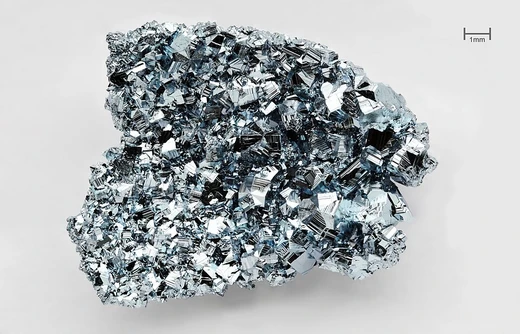
Scandium
Scandium: a silvery-white d-block element, usually classified as a rare-earth, used primarily in aluminium alloys.
Last updated
Scandium is a chemical element with the symbol Sc and atomic number 21, belonging to the d-block of the periodic table. It is a silvery-white, soft metal that develops a slightly yellowish or pinkish cast upon oxidation in air. Typically grouped with yttrium and the lanthanides as a rare-earth element, scandium was first identified in 1879 through spectral analysis of the minerals euxenite and gadolinite, which were sourced from Scandinavia.
Isotopes
In its natural state, scandium exists exclusively as the stable isotope ⁴⁵Sc, while known radioisotopes range from ³⁷Sc to ⁶³Sc, with the most stable being ⁴⁶Sc (half-life 83.76 days). Lighter isotopes primarily decay via electron capture or proton emission, while heavier ones undergo beta decay to form titanium isotopes. Scandium is created in supernovae via the r-process and also by cosmic ray spallation of iron-peak nuclei.
Occurrence
Though not rare in Earth’s crust—with estimates of 18 to 25 parts per million, comparable to cobalt—scandium is widely dispersed and found only in trace amounts in most minerals. Concentrated sources are limited to rare minerals like thortveitite, euxenite, and gadolinite from Scandinavia and Madagascar; thortveitite can contain up to 45% scandium oxide. Global production of scandium oxide is about 15 to 20 tonnes per year, with demand slightly higher and growing.
Production
Scandium is typically extracted as a byproduct from uranium, iron, rare-earth, or apatite mines, with notable facilities in Ukraine, China, Russia, and the Philippines. To obtain the metal, the oxide is converted to scandium fluoride and then reduced with calcium. The high cost and limited supply have restricted commercial applications, but its major use is in strengthening aluminium alloys with as little as 0.5% scandium.
Other
Scandium-stabilized zirconia is also gaining use as an electrolyte in solid oxide fuel cells. The properties of scandium compounds are intermediate between those of aluminium and yttrium, and a diagonal relationship exists with magnesium. The predominant oxidation state in its compounds is +3.
Quick Facts
- Atomic number
- 21
- Discoverers
- Lars Fredrik Nilson and his team
- Classification
- Rare-earth element
- Major application
- Aluminium alloys
Facts from the source article.
Lore & Background
Scandium is a silvery-white, soft metal that develops a slightly yellowish or pinkish cast upon exposure to air due to oxidation. It is susceptible to weathering and dissolves slowly in most dilute acids, though it resists dissolution in a 1:1 mixture of nitric and hydrofluoric acid, likely due to the formation of an impermeable passive layer. When ignited, scandium turnings burn with a brilliant yellow flame, producing scandium oxide.
In the Earth’s crust, scandium is not rare, with estimates ranging from 18 to 25 parts per million, comparable to the abundance of cobalt. However, it is distributed sparsely and occurs only in trace amounts in many minerals. The only known concentrated sources are rare minerals from Scandinavia and Madagascar, such as thortveitite, euxenite, and gadolinite, which also contain other rare earths; thortveitite can hold up to 45% scandium oxide.
Scandium is present in most deposits of rare-earth and uranium compounds but is extracted from only a few mines worldwide. Its stable form is created in supernovae via the r-process and also by cosmic ray spallation of iron-peak nuclei. The global trade of scandium oxide is 15–20 tonnes per year, with demand slightly higher and both increasing.
Reader's Guide
Scandium is a soft metal with a silvery appearance. It develops a slightly yellowish or pinkish cast when oxidized by air. It is susceptible to weathering and dissolves slowly in most dilute acids. It does not dissolve in a 1:1 mixture of nitric acid and 48.0% hydrofluoric acid, possibly due to the formation of an impermeable passive layer.
Scandium turnings ignite in the air with a brilliant yellow flame to form scandium oxide. In nature, scandium is found exclusively as the isotope 45Sc, which has a nuclear spin of 7⁄2; this is its only stable isotope. The known isotopes of scandium range from 37Sc to 63Sc.
The primary decay mode of ground-state scandium isotopes at masses lower than 45Sc is electron capture (or positron emission), but the lightest isotopes (37Sc to 39Sc) undergo proton emission instead. The primary decay mode for heavier isotopes is beta emission. Scandium chemistry is almost completely dominated by the trivalent ion. Compounds that feature scandium in oxidation states other than +3 are rare but well characterized.
More in Chemical Elements & Metals
Sources
Compiled from Wikipedia and the sources listed below. Text from Wikipedia is available under CC BY-SA 4.0; this entry is adapted from it.
- Wikipedia: Scandium (CC BY-SA 4.0).
- Word definitions: the Codexery glossary, each quoted from its Wikipedia article.
Spotted an error? Know more?
Reader corrections go straight into our review queue. Suggest an edit · How this site is sourced