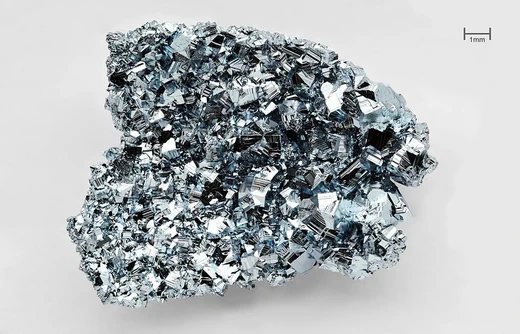
Samarium
A lanthanide metal used in magnets, medicine, and nuclear reactors.
Last updated
Zinc and samarium share comparable levels of hardness and density, according to the "Handbook of Chemistry and Physics" and "Lange's Handbook of Chemistry".[1][2][3] According to "Nature's Building Blocks", samarium salts exhibit slight toxicity and the element serves no biological function.[4][5] With a computed atomic radius of 238 pm, samarium ranks among the elements possessing the largest atomic radii, being exceeded only by potassium, praseodymium, barium, rubidium, and caesium.[6]
Quick Facts
- Atomic number
- 62
- Discovered by
- Paul-Émile Lecoq de Boisbaudran
- Series
- Lanthanide
- Common oxidation state
- +3
Facts from the source article.
Key facts and history
Detection of samarium was announced by several scientists in the late 19th century, but most sources credit French chemist Paul-Émile Lecoq de Boisbaudran.[7] Samarium is not found free in nature but is contained in minerals such as monazite and bastnäsite.[8] Working in Paris during 1879, Paul-Émile Lecoq de Boisbaudran extracted samarium oxide from samarskite and recognized a novel element through its distinct optical absorption lines.[7] The element's name, chosen by Boisbaudran, derives from samarskite, a mineral itself named for Vassili Samarsky-Bykhovets.[9]
Samarium holds the distinction of being the initial chemical element named in honor of an individual.[9] Eugène-Anatole Demarçay succeeded in creating pure samarium(III) oxide for the first time in 1901.[10] Globally, samarium resources are thought to total two million tonnes, with yearly production approximating 700 tonnes.[4] Samarium oxide, typically the form in which the element is marketed, ranks among the least expensive lanthanide oxides at roughly US$30 per kilogram.[11]
References
- Wikipedia, "Samarium" (CC BY-SA 4.0), which cites: "Lange's Handbook of Chemistry", McGraw-Hill, 1999; Hammond, "Handbook of Chemistry and Physics", CRC press, 2004-06-29, p. 4–27 (we also read that source) en.wikipedia.org
- Open Library record, ISBN 9780849304811 ("Handbook of Chemistry and Physics, 81st Edition"). CC0 (metadata); book content not read. openlibrary.org
- Open Library record, ISBN 9780070163843 ("Lange's Handbook of Chemistry"). CC0 (metadata); book content not read. openlibrary.org
- Wikipedia, "Samarium" (CC BY-SA 4.0), which cites: Emsley, "Nature's Building Blocks: An A–Z Guide to the Elements", Oxford University Press, 2001, p. 371–374 (we also read that source) en.wikipedia.org
- Open Library record, ISBN 0198503407 ("Nature's Building Blocks"). CC0 (metadata); book content not read. openlibrary.org
- Wikipedia, "Samarium" (CC BY-SA 4.0), which cites: Clementi, "Atomic Screening Constants from SCF Functions. II. Atoms with 37 to 86 Electrons", Journal of Chemical Physics, 1967, p. 1300–1307 (original not read by us) en.wikipedia.org
- Wikipedia, "Samarium" (CC BY-SA 4.0), which cites: Greenwood, p. 1229; Samarium, Encyclopædia Britannica on-line; Hammond, "Handbook of Chemistry and Physics", CRC press, 2004-06-29, p. 4–27; Delafontaine, "Sur le décepium, métal nouveau de la samarskite", Journal de pharmacie et de chimie, 1878, p. 540; Delafontaine, "Sur le décepium, métal nouveau de la samarskite", Comptes rendus hebdomadaires des séances de l'Académie des Sciences, 1878, p. 632; ; Delafontaine, "Sur le décipium et le samarium", Comptes rendus hebdomadaires des séances de l'Académie des Sciences, 1881, p. 63 (we also read t en.wikipedia.org
- Wikipedia, "Samarium" (CC BY-SA 4.0), which cites: Hammond, "Handbook of Chemistry and Physics", CRC press, 2004-06-29, p. 4–27 (we also read that source) en.wikipedia.org
- Wikipedia, "Samarium" (CC BY-SA 4.0), which cites: Samarskite, Great Soviet Encyclopedia (in Russian); Boisbaudran, "Recherches sur le samarium, radical d'une terre nouvelle extraite de la samarskite", Comptes rendus hebdomadaires des séances de l'Académie des sciences, 1879, p. 212–214; Shipley, Joseph Twadell. The Origins of English Words: A Discursive Dictionary of Indo-European Roots, JHU Press, 2001, p.90.; Samarium: History & Etymology. Elements.vanderkrogt.net. Retrieved on 2013-03-21.; "Chemistry in Its Element - Samarium"; Samarium: History & Etymology. Elements.vanderkrogt.net. Retri en.wikipedia.org
- Wikipedia, "Samarium" (CC BY-SA 4.0), which cites: Samarium: History & Etymology. Elements.vanderkrogt.net. Retrieved on 2013-03-21.; Weeks, "The discovery of the elements", Journal of Chemical Education, 1956; Weeks, "The discovery of the elements. XIII. Some elements predicted by Mendeleeff", Journal of Chemical Education, 1932, p. 1605–1619 (original not read by us) en.wikipedia.org
- Wikipedia, "Samarium" (CC BY-SA 4.0), which cites: Human Health Fact Sheet on Samarium , Los Alamos National Laboratory; "Rare Earths", United States Geological Survey, January 2010; What are their prices?, Lynas corp. (original not read by us) en.wikipedia.org
Each numbered sentence above was checked against the source it cites before publication. Sentences citing Wikipedia adapt text from the English Wikipedia article Samarium (contributors), used under CC BY-SA 4.0; this entry is available under the same licence. Other sources were used for facts only; no text or images are copied from them.
More in Chemical Elements & Metals
Sources
Compiled from Wikipedia and the sources listed below. Text from Wikipedia is available under CC BY-SA 4.0; this entry is adapted from it.
- Wikipedia: Samarium (CC BY-SA 4.0).
- Word definitions: the , each quoted from its Wikipedia article.
Spotted an error? Know more?
Reader corrections go straight into our review queue. Suggest an edit · How this site is sourced