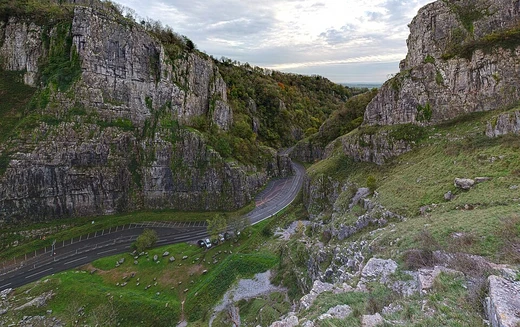
Eisriesenwelt
One of the world's largest ice caves, located in the Austrian Alps.
Last updated
Where it is
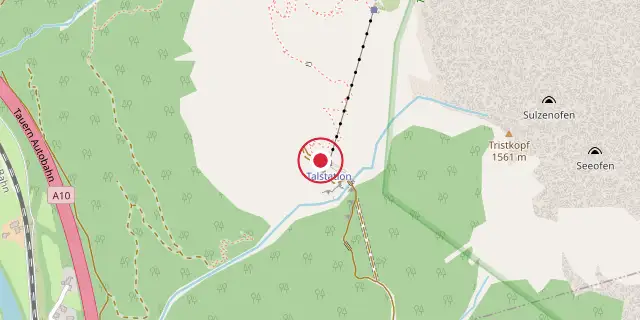
Coordinates: 47°30′11″N 13°11′24″E (47.5030, 13.1900) · Open in OpenStreetMap
Coordinates and connected clubs: the infobox of Wikipedia: Eisriesenwelt (CC BY-SA 4.0). Map: drawn by Codexery from OpenStreetMap tiles.
The Eisriesenwelt, which translates from German as “World of the Ice Giants,” is a natural cave of limestone and ice in Werfen, Austria, roughly 40 kilometers south of Salzburg. It sits inside the Hochkogel mountain, part of the Tennengebirge range in the Alps, and holds the title of the world’s largest ice cave, stretching over 42 kilometers. Each year, around 200,000 tourists visit.
The Tennengebirge mountains formed during the late Tertiary period, specifically the Würm glaciation of the Pleistocene. This range, one of the massifs in the Austrian Alps, is the largest karst plateau in the Salzburger Alps, and the Eisriesenwelt lies at the edge of this plateau. Although the cave measures 42 kilometers in length, only the first kilometer—the section open to tourists—is covered in ice; the rest is limestone.
The Salzach river carved the passageways, and the ice formations came from thawing snow that drained into the cave and froze in winter. Because the entrance stays open year-round, cold winter winds blow in and freeze the snow inside. In summer, a cold wind from the cave blows outward, keeping the formations from melting.
History
The cave was first officially discovered in 1879 by Anton Posselt, a natural scientist from Salzburg, who explored only the first 200 meters. Before that, locals knew of it but believed it was an entrance to Hell and refused to enter. Posselt published his findings in a mountaineering magazine in 1880, but the report was soon forgotten. Alexander von Mörk, a speleologist from Salzburg, remembered Posselt’s discovery and led several expeditions starting in 1912, followed by other explorers.
Von Mörk died in World War I in 1914, and an urn with his ashes rests in a niche inside the cave. In 1920, a cabin called Forscherhütte was built for explorers, and the first routes up the mountain were established, drawing tourists. Later, another cabin, the Dr. Oedl House, and paths from Werfen and Tenneck were added. A cable car was built in 1955, cutting the 90-minute climb to three minutes.
Today, the National Austrian Forest Commission owns the cave and has leased it to the Salzburg Association of Cave Exploration since 1928, still receiving a share of entrance fees.
Visiting
The cave is open from May 1 to October 26, with hours from 9:00 a.m. to 4:30 p.m. in July and August, and 9:00 a.m. to 3:30 p.m. in May/June and September/October. Temperatures inside are usually below freezing, so warm clothing is advised. Photography is not allowed once inside. The tour starts at the entrance and goes inward to Posselt Hall, a large room with a stalagmite called Posselt Tower at its center.
Past the tower, an ashen cross on the wall marks the farthest point Anton Posselt reached. From there, visitors see the Great Ice Embankment, a massive formation 25 meters high that shows the area of greatest ice growth. Next is Hymir’s Castle, named after a Norse giant, where stalactites form Frigga’s Veil, also called the Ice Organ. The tour then reaches the Alexander von Mörk Cathedral, one of the largest rooms in the cave and the resting place of von Mörk’s ashes.
The final stop is the Ice Palace, one kilometer into the cave and 400 meters underground. From there, visitors must turn back and walk through the caves to the entrance. The round trip takes about one hour and 15 minutes.
More in Caves & Gorges
Sources
Compiled from Wikipedia and the sources listed below. Text from Wikipedia is available under CC BY-SA 4.0; this entry is adapted from it.
- Wikipedia: Eisriesenwelt (CC BY-SA 4.0).
- Word definitions: the , each quoted from its Wikipedia article.
Spotted an error? Know more?
Reader corrections go straight into our review queue. Suggest an edit · How this site is sourced