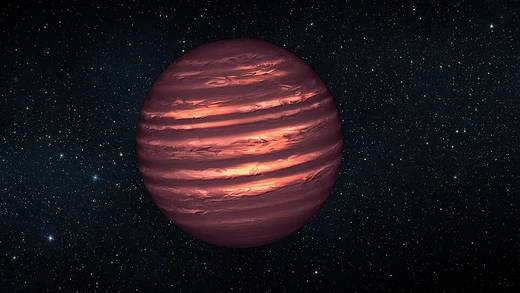
WISE 0359−5401
First Y-dwarf with a JWST spectral energy distribution.
Last updated
WISE 0359−5401 is a brown dwarf, sub-brown dwarf or rogue planet of spectral class Y0, located in the constellation Reticulum approximately 44 light-years from Earth. It is notable for being the first Y-dwarf with a spectral energy distribution measured by the James Webb Space Telescope, and for exhibiting strong variability with the shortest period among a sample of 14 Y-dwarfs.
Quick Facts
- Designation
- WISE J035934.06−540154.6 (abbreviated WISE 0359−5401)
- Spectral class
- Y0
- Constellation
- Reticulum
- Distance
- approximately 44 light-years
- Temperature
- 467 K (194 °C, 381 °F)
- Age
- about 2.5 billion years (from newer models)
Facts from the source article.
Lore & Background
WISE 0359−5401 was discovered in 2012 by J. Davy Kirkpatrick and colleagues from data collected by the Wide-field Infrared Survey Explorer (WISE) in the infrared at a wavelength of 4.6 μm. The discovery was published in a paper in The Astrophysical Journal that presented seven new Y-type brown dwarfs. A study with Spitzer found this Y-dwarf to be variable, with the shortest period of 2.44 hours among 14 Y-dwarfs and strong variability in all four light curves.
In June 2023, WISE 0359−5401 became the first Y-dwarf with a spectral energy distribution measured by JWST, including a spectrum from NIRSpec and MIRI LRS at 1 to 12 μm, and MIRI photometry at 15, 18 and 21 μm. The molecules water, methane, carbon monoxide, carbon dioxide and ammonia were detected. Methane is the main reservoir of carbon, but enough carbon exists for detectable carbon monoxide and carbon dioxide.
Mass and age were initially uncertain, with semi-empirical measurements suggesting a mass of about 9 to 31 Jupiter masses for an age of 1 to 10 billion years, while model fits suggested a mass of 1 Jupiter mass and an age of 20 million years due to low surface gravity. Newer ATMO2020++ models, which include disequilibrium chemistry and a non-adiabatic pressure-temperature profile, resolved the discrepancy, yielding a solar metallicity, surface gravity of log g = 4.5, age of about 2.5 billion years, and mass of about 14 Jupiter masses. Both old and new models fit better without phosphine in the atmosphere.
Reader's Guide
WISE 0359−5401 holds significance as the first Y-dwarf observed by JWST, providing a detailed spectral energy distribution from 1 to 21 μm. Its strong variability, with the shortest period among a sample of 14 Y-dwarfs, makes it a prime candidate for further variability studies with JWST. The detection of multiple molecules—water, methane, carbon monoxide, carbon dioxide, and ammonia—offers insights into the atmospheric chemistry of the coldest brown dwarfs. The initial disagreement between semi-empirical mass estimates and model fits highlighted challenges in modeling low-temperature atmospheres, which newer ATMO2020++ models resolved by incorporating disequilibrium chemistry and non-adiabatic pressure-temperature profiles.
These models produced a consistent age of about 2.5 billion years and mass of about 14 Jupiter masses, aligning with simulations predicting nearby Y-dwarfs to be old. The absence of phosphine, despite its presence in Solar System giants, suggests different atmospheric composition and gravity may alter phosphorus chemistry. Atmospheric retrieval of the JWST spectrum constrained the carbon-to-oxygen ratio to 0.548 ±0.002 and indicated vigorous vertical mixing. This object thus serves as a benchmark for understanding Y-dwarf atmospheres, variability, and the transition between brown dwarfs and planets.
More in Brown Dwarfs
Sources
Compiled from Wikipedia and the sources listed below. Text from Wikipedia is available under CC BY-SA 4.0; this entry is adapted from it.
- Wikipedia: WISE 0359−5401 (CC BY-SA 4.0).
Spotted an error? Know more?
Reader corrections go straight into our review queue. Suggest an edit · How this site is sourced