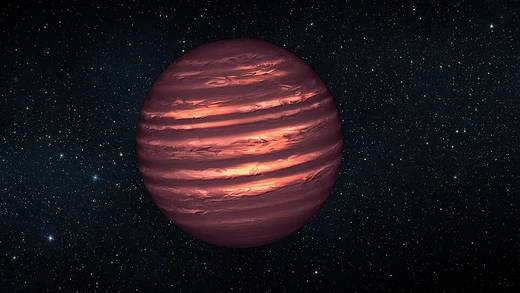
2MASS J04070752+1546457
One of the fastest-rotating brown dwarfs, nearing its breakup speed.
Last updated
2MASS J04070752+1546457, often shortened to 2MASS J0407+1546, is a brown dwarf in the constellation Taurus, roughly 119 light-years away. Classified as spectral type L3.5, it spins extremely fast: its rotation period is just 1.23 hours, making it one of the fastest-spinning brown dwarfs known.
Its rotational velocity exceeds 80 km/s, nearing the theoretical limit where centripetal forces would tear it apart. This rapid spin causes the object to bulge at its equator and flatten at its poles, similar to Saturn, the most oblate planet in our solar system. The fast rotation may also drive strong auroral radio emissions through interactions between particles and its magnetic field, a phenomenon seen in other rapidly spinning brown dwarfs.
The object first appeared as a point source in June 2003 during the Two Micron All-Sky Survey (2MASS), run by the University of Massachusetts Amherst and the Infrared Processing and Analysis Center at Caltech. In October 2005, I. Neill Reid and colleagues used near-infrared spectra from the Gemini North telescope at Mauna Kea Observatory in Hawaii to identify it as an L3.5 brown dwarf. Their discovery, along with 429 other ultracool dwarfs, was published in The Astronomical Journal in September 2008.
Its distance was measured by the Gaia spacecraft in 2018 via trigonometric parallax, yielding 36.4 parsecs (about 119 light-years). This closely matches Reid et al.'s 2008 spectrophotometric estimate of 33.1 parsecs, derived from the object's spectral type and near-infrared absolute magnitude. According to Gaia DR2 data, 2MASS J0407+1546 has a proper motion of 81.0 milliarcseconds per year at a position angle of 139.06 degrees, meaning it moves southeast across the sky.
Quick Facts
- Spectral class
- L3.5
- Constellation
- Taurus
- Distance
- 119 light-years
- Rotation period
- 1.23 hours
- Rotational velocity
- over 80 km/s
- Proper motion
- 81.0 mas/yr at position angle 139.06 degrees
Facts from the source article.
Lore & Background
2MASS J0407+1546 was first catalogued as a point source in June 2003 by the Two Micron All-Sky Survey (2MASS) organized by the University of Massachusetts Amherst and the Infrared Processing and Analysis Center under the California Institute of Technology. It was discovered to be a brown dwarf of spectral class L3.5 by I. Neill Reid and collaborators, based on near-infrared spectra obtained in October 2005 with the Gemini North at the Mauna Kea Observatory, Hawaii. Their discovery and spectroscopic characterization of 430 ultracool dwarfs including 2MASS J0407+1546 was published in The Astronomical Journal in September 2008.
Its rapid rotation, announced by a team of astronomers led by Megan E. Tannock in March 2021, makes it one of the fastest-rotating known brown dwarfs. With a rotational velocity of over 80 km/s, it is approaching the predicted rotational speed limit beyond which it would break apart due to centripetal forces. As a consequence, the brown dwarf is slightly flattened at its poles to a similar degree as Saturn, the most oblate planet in the Solar System. Its rapid rotation may enable strong auroral radio emissions via particle interactions in its magnetic field, as observed in other known rapidly-rotating brown dwarfs.
Discovery and Spectroscopic Identification
In June 2003, the Two Micron All-Sky Survey—a joint effort between the University of Massachusetts Amherst and the Infrared Processing and Analysis Center at Caltech—recorded a faint point source in the night sky that would later prove to be one of the most extreme rotating objects known. For more than two years, this object sat in the 2MASS catalogue without a definitive classification. The breakthrough came in October 2005, when I. Neill Reid and a team of collaborators captured near-infrared spectra using the Gemini North telescope atop Mauna Kea Observatory in Hawaii.
Those spectra revealed the object to be an ultracool dwarf of spectral class L3.5, confirming its identity as a brown dwarf rather than a star. Reid's group was simultaneously characterizing a much larger sample of 430 ultracool dwarfs, and 2MASS J0407+1546 was one member of that cohort. The full results, including the spectroscopic identification of this particular object, appeared in The Astronomical Journal in September 2008, cementing its place in the astronomical record.
Extreme Rotation and Planetary-Scale Oblateness
The defining characteristic that sets 2MASS J0407+1546 apart from the thousands of brown dwarfs already catalogued is its extraordinary spin. Photometric measurements yield a rotation period of just 1.23 hours, making it one of the fastest-rotating brown dwarfs ever announced—a result presented by a team led by Megan E. Tannock in March 2021. The surface velocity exceeds 80 kilometres per second (roughly 50 miles per second), pushing the object perilously close to the theoretical breakup threshold at which centrifugal forces would tear it apart.
The physical consequence of such extreme rotation is visible in the dwarf's shape: it is measurably flattened at its poles, an oblateness comparable to that of Saturn, the most egg-shaped planet in our own Solar System. Beyond geometry, the rapid spin may drive powerful auroral radio emissions as charged particles interact with the object's magnetic field, a phenomenon already documented in other fast-spinning brown dwarfs. In this way, the object's rotation simultaneously shapes its structure and potentially its electromagnetic signature.
Position, Distance, and Sky Motion
Situated in the constellation Taurus, 2MASS J0407+1546 lies approximately 119 light-years from Earth, making it a relatively nearby object in galactic terms. The most precise distance determination came from the Gaia spacecraft, which in 2018 measured a trigonometric parallax of 27.4408 ± 1.7735 milliarcseconds, translating to 36.4 ± 2.4 parsecs (118.7 ± 7.8 light-years). This astrometric figure aligns closely with an earlier spectrophotometric estimate published by Reid and colleagues in 2008, who derived 33.1 ± 3.3 parsecs (108 ± 11 light-years) from the object's L3.5 spectral type and its near-infrared absolute magnitude.
The two independent methods thus bracket the true distance within a comfortable margin. Gaia's second data release also provides a net proper motion of 81.0 milliarcseconds per year at a position angle of 139.06 degrees, indicating that the brown dwarf is drifting toward the south-east across the celestial sphere. Together, these measurements anchor the object's three-dimensional location and trajectory within the local neighbourhood of the Milky Way.
A Trio at the Edge of Stability
When Tannock and her collaborators announced their findings in March 2021, 2MASS J0407+1546 was not presented in isolation. It formed part of a trio of exceptionally fast-spinning brown dwarfs whose collective properties may illuminate a fundamental rotational speed limit for these substellar objects.
Its two companions in the announcement include 2MASS J12195156+3128497, an L8 dwarf rotating with a period of 1.14 hours, and 2MASS J03480772−6022270, a T7 dwarf spinning even faster at roughly 1.08 hours. The fact that all three objects approach the same theoretical breakup boundary—where centripetal forces can no longer hold the material together—suggests a universal physical ceiling rather than a coincidence of individual circumstances. The discovery attracted immediate attention from the broader astronomical community: the Jet Propulsion Laboratory, the University of Western Ontario, and NOIRLab all issued public summaries in early April 2021, with the latter describing the objects as caught speeding and the former referring to them as the fastest-spinning failed stars ever identified.
Reader's Guide
2MASS J0407+1546 is significant as one of the fastest-rotating brown dwarfs known, with a rotation period of just 1.23 hours. Its rotational velocity exceeding 80 km/s places it near the theoretical breakup limit, offering a natural laboratory for studying the structural limits of substellar objects. The flattening at its poles, comparable to Saturn, provides direct observational evidence of centrifugal deformation in a brown dwarf. The possibility of strong auroral radio emissions linked to its rapid rotation connects this object to broader studies of magnetic activity and particle acceleration in ultracool atmospheres.
Its discovery as part of a large survey of ultracool dwarfs and subsequent characterization by the Tannock team in 2021 highlight ongoing efforts to probe the extremes of brown dwarf rotation. The object's proper motion of 81.0 mas/yr, measured by Gaia DR2, adds to its kinematic profile. As a benchmark for rotational speed limits, 2MASS J0407+1546 helps refine models of brown dwarf interiors and atmospheric dynamics, and its legacy lies in pushing the boundaries of what is known about the fastest-spinning failed stars.
More in Brown Dwarfs
Sources
Compiled from Wikipedia and the sources listed below. Text from Wikipedia is available under CC BY-SA 4.0; this entry is adapted from it.
- Wikipedia: 2MASS J04070752+1546457 (CC BY-SA 4.0).
Spotted an error? Know more?
Reader corrections go straight into our review queue. Suggest an edit · How this site is sourced