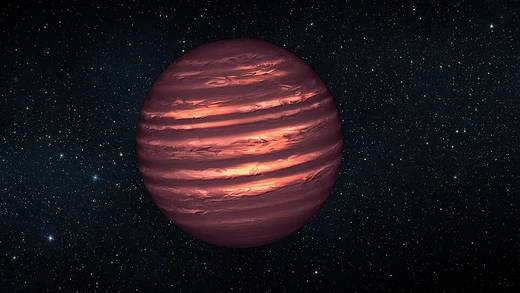
2MASS J03480772−6022270
Fastest-rotating brown dwarf, nearing its break-up speed.
Last updated

NASA/JPL-Caltech · Public domain
2MASS J03480772−6022270, often shortened to 2MASS J0348−6022, is a brown dwarf with a spectral classification of T7. It sits in the constellation Reticulum, about 27.2 light-years away from the Sun. This object holds the record as the fastest-rotating brown dwarf ever confirmed, spinning once every 1.08 hours.
Physical effects
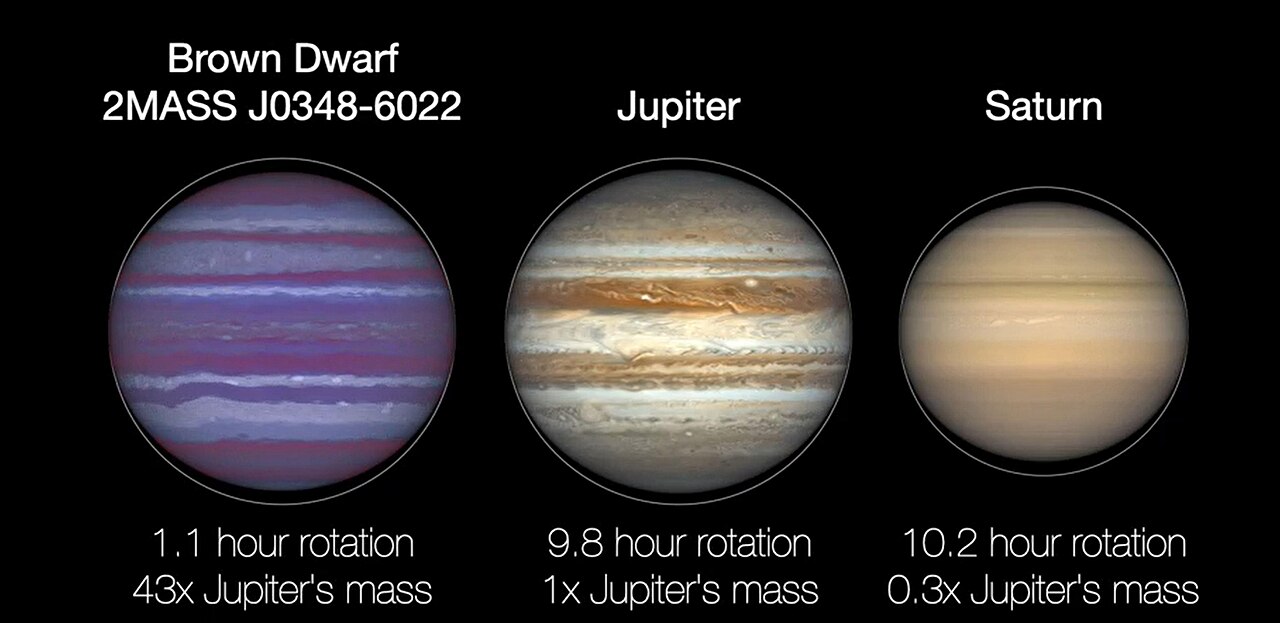
Its equatorial rotation speed tops 100 km/s, edging close to the theoretical limit where centripetal forces would tear it apart. Because it spins so quickly, the brown dwarf is slightly squashed at its poles, with a flattening similar to Saturn, the most oblate planet in our solar system. This rapid spin might also generate strong auroral radio emissions, driven by charged particles interacting with its magnetic field—a phenomenon seen in other fast-spinning brown dwarfs.
Discovery
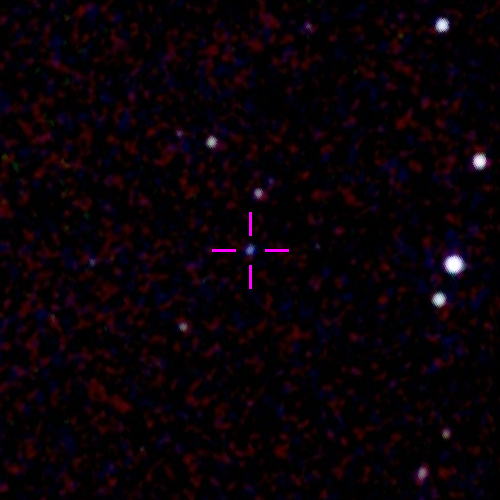
The object first appeared as a point source in June 2003 during the Two Micron All-Sky Survey (2MASS), run by the University of Massachusetts Amherst and the Infrared Processing and Analysis Center at Caltech. Astronomer Adam Burgasser and his team with the 2MASS Wide-Field T Dwarf Search identified it as a T7 brown dwarf using near-infrared spectra taken in September 2002 with the Víctor M. Blanco Telescope at Cerro Tololo Inter-American Observatory in Chile. Their findings, which also included two other T dwarfs in the southern sky, were published in The Astronomical Journal in November 2003.
Location and proper motion
In the sky, 2MASS J0348−6022 lies in the southern constellation Reticulum. Its J2000 equatorial coordinates—right ascension and declination—are encoded in its identifier: 2MASS J03480772−6022270. The New Technology Telescope (NTT) measured its trigonometric parallax from 16 observations over 6.4 years, yielding a distance of about 8.33 parsecs (27.2 light-years).
An earlier estimate by Burgasser’s team, based on spectral type and near-infrared brightness, had put the distance at roughly 9 parsecs. The NTT also tracked its proper motion, showing it moving southwest across the sky. From the parallax distance, its tangential velocity matches the typical motion of stars in the Galactic disk.
Spectral class
Spectrally, 2MASS J0348−6022 is a late T-type dwarf, class T7, marked by strong methane (CH₄) and water (H₂O) absorption bands in its near-infrared spectrum between 1.2 and 2.35 μm. Its spectrum also shows narrow absorption lines from neutral potassium (K I) at 1.243 and 1.252 μm.
Quick Facts
- Spectral class
- T7
- Constellation
- Reticulum
- Distance from sun
- 27.2 light-years
- Rotation period
- 1.08 hours
- Equatorial rotational velocity
- over 100 km/s
- Oblateness
- 0.08
Facts from the source article.
Lore & Background
2MASS J0348−6022 was first catalogued as a point source in June 2003 by the Two Micron All-Sky Survey (2MASS). It was discovered to be a brown dwarf of spectral class T7 by Adam Burgasser and collaborators of the 2MASS Wide-Field T Dwarf Search, based on near-infrared spectra obtained in September 2002 with the Víctor M. Blanco Telescope at the Cerro Tololo Inter-American Observatory, Chile. The discovery and characterization, along with two other T dwarfs in the southern celestial hemisphere, was published in The Astronomical Journal in November 2003.
The brown dwarf is located in the southern celestial hemisphere in the constellation Reticulum. Its trigonometric parallax, measured from 16 observations by the New Technology Telescope (NTT) over 6.4 years, corresponds to a distance of 8.33 parsecs. A previous spectrophotometric estimate by Burgasser and collaborators gave a distance of 9 parsecs. The NTT also measured its proper motion, indicating motion in a south-west direction on the sky, with a tangential velocity consistent with the kinematics of Galactic disk stars.
2MASS J0348−6022 is classified as a late T-type brown dwarf with spectral class T7, distinguished by strong methane (CH4) and water (H2O) absorption bands in its near-infrared spectrum. Its spectrum also shows narrow absorption lines of neutral potassium (K I) at 1.243 and 1.252 μm, which appear relatively faded due to its late spectral type. Absorption bands of iron(I) hydride (FeH) are present between 1.72–1.78 μm. The brown dwarf's near-infrared color indices indicate it appears brighter at longer (redder) wavelengths.
Discovery and Identification
In June 2003, the Two Micron All-Sky Survey—a joint effort between the University of Massachusetts Amherst and the Infrared Processing and Analysis Center at Caltech—first logged 2MASS J0348−6022 as an unclassified point source in its all-sky catalogue. The object's true nature was revealed a year later when astronomer Adam Burgasser and his team, working under the 2MASS Wide-Field T Dwarf Search programme, analysed near-infrared spectra captured in September 2002 with the Víctor M. Blanco Telescope at Cerro Tololo Inter-American Observatory in Chile.
Those spectra confirmed the object as a brown dwarf of spectral class T7. Burgasser's group published the discovery and full characterization of 2MASS J0348−6022, together with two additional T dwarfs in the southern sky, in The Astronomical Journal in November 2003. The identification was significant because it added another member to the still-sparse population of late T-type objects known at the time, and it anchored the object's position in the constellation Reticulum, roughly 27 light-years from Earth.
Record-Breaking Rotation
As of 2022, 2MASS J0348−6022 holds the record for the fastest confirmed rotation among all known brown dwarfs, completing one full spin in just 1.08 hours. Its equatorial surface speed exceeds 100 kilometres per second—roughly 62 miles per second—placing it perilously close to the theoretical breakup velocity at which centrifugal forces would tear the object apart. The extreme spin has visibly deformed its shape: the brown dwarf is measurably flattened at its poles, with an oblateness comparable to that of Saturn, the most squashed planet in our Solar System.
The double-peaked pattern in its light curve, measured using Spitzer Space Telescope data by Megan Tannock and colleagues in 2021, hints at two large photospheric spots sitting on opposite hemispheres. Beyond its structural effects, such rapid rotation may drive powerful auroral radio emissions through the interaction of charged particles with the object's magnetic field, a phenomenon already detected in other fast-spinning brown dwarfs. Photometric variability was first flagged in 2008 by Fraser Clarke and collaborators using the New Technology Telescope, who reported a J-band amplitude below one percent over a six-hour window.
Spectral Classification and Atmospheric Chemistry
Classified as a T7 brown dwarf, 2MASS J0348−6022 sits at the cool, late end of the T spectral sequence. Its near-infrared spectrum, spanning wavelengths from 1.2 to 2.35 micrometres, is dominated by broad absorption features produced by methane and water vapour in its atmosphere. Two narrow lines at 1.243 and 1.252 micrometres reveal the presence of neutral potassium, though this potassium doublet appears noticeably weaker than in earlier T dwarfs or in late L and M types, a signature consistent with its advanced evolutionary cooling.
Between 1.72 and 1.78 micrometres, absorption bands attributable to iron hydride (FeH) add further molecular complexity to the spectral fingerprint. The object's overall optical and near-infrared appearance is intensely red: its 2MASS colour indices (J−H = −0.24 and H−K = −0.04) confirm that it shines more brightly at longer, redder wavelengths than at shorter ones, a hallmark of cool, methane-rich atmospheres. These combined spectral markers make 2MASS J0348−6022 a valuable reference point for modelling the atmospheres of the coolest brown dwarfs.
Physical Properties and Evolutionary State
Photospheric modelling of 2MASS J0348−6022's near-infrared spectrum, carried out by Megan Tannock and collaborators in 2021, yielded an effective temperature of 880 ± 110 kelvin and a surface gravity of log g = 5.1 ± 0.3 dex—roughly 10^5.1 times Earth's gravitational acceleration. Interpolating brown-dwarf evolutionary tracks with those two parameters gives a mass of about 43 Jupiter masses (0.041 solar masses), a Jupiter-like equatorial radius of approximately 69,700 kilometres, and a remarkably high age of 3.5 billion years (with an uncertainty extending up to 15 billion).
That advanced age is expected for a late T-type object, since such spectral classes correspond to the cooler, later stages of brown-dwarf evolution. The object's distance was pinned down to 8.3 ± 0.1 parsecs (27.2 ± 0.4 light-years) through a trigonometric parallax of 120.1 ± 1.8 milliarcseconds, measured from 16 observations by the New Technology Telescope over 6.4 years. Its proper motion of roughly 280 and 770 milliarcseconds per year in right ascension and declination, respectively, translates to a tangential velocity of 32.3 ± 0.5 km/s, fully consistent with the kinematics of ordinary Galactic-disk stars.
Reader's Guide
2MASS J0348−6022 holds significance as the fastest-rotating brown dwarf confirmed, with a rotation period of 1.08 hours. Its rapid rotation causes it to be slightly flattened at the poles, with an oblateness of 0.08, comparable to Saturn (oblateness 0.10), the most oblate planet in the Solar System. The rotational velocity at its equator exceeds 100 km/s, approaching the predicted limit beyond which it would break apart. This rapid rotation may enable strong auroral radio emissions via charged particle interactions in its magnetic field, as observed in other known rapidly-rotating brown dwarfs.
Photometric variability in 2MASS J0348−6022 was first reported in 2008, with an upper limit J-band amplitude of less than 1% in a six-hour observation period. Later analyses gave a J-band amplitude of less than 2%, with a spuriously high amplitude initially derived due to systematic errors. Infrared observations by the Spitzer Space Telescope show that its brightness appears flat in the 3.6 μm band and only exhibits discernible variability in the 4.5 μm band, a behavior typical of previously observed T dwarfs, explained by the presence of methane in its atmosphere.
The spectral lines in its spectrum are Doppler-broadened due to rapid rotation, with a projected rotational velocity (v sin i) estimated at 103.5 ± 7.4 km/s. While it has the highest reported v sin i value of all known ultra-cool dwarfs, its equatorial rotational velocity is second after the L8 dwarf 2MASS J1219+3128. The high equatorial rotational velocity decreases surface gravity at the equator due to centrifugal acceleration, though this has a negligible effect on the nominal surface gravity inferred from photospheric modeling.
Frequently Asked Questions
Who is 2MASS J03480772−6022270?
It is a T7-class brown dwarf sitting roughly 27.2 light-years from the Sun in the southern constellation Reticulum. The community almost always goes by the shortened handle 2MASS J0348−6022.
What makes 2MASS J0348−6022 so famous among fans?
It is the fastest-spinning brown dwarf ever confirmed, completing a full rotation in only 1.08 hours with an equatorial speed above 100 km/s. That puts it perilously close to the centrifugal break-up limit, a threshold no other brown dwarf has been shown to approach.
Where should I look to find 2MASS J0348−6022 in the sky?
It resides in the faint southern constellation Reticulum, about 27.2 light-years away. As a cool T7 object it is far too dim for casual backyard viewing, so fans typically track it through professional survey data rather than through a telescope.
More in Brown Dwarfs
Sources
Compiled from Wikipedia and the sources listed below. Text from Wikipedia is available under CC BY-SA 4.0; this entry is adapted from it.
- Wikipedia: 2MASS J03480772−6022270 (CC BY-SA 4.0).
Spotted an error? Know more?
Reader corrections go straight into our review queue. Suggest an edit · How this site is sourced