Schwarzschild radius
Radius defining the event horizon of a non-rotating black hole.
Last updated
The Schwarzschild radius is a value that appears in the Schwarzschild solution to Einstein's field equations. It describes the radius of a sphere in flat space whose surface area matches that of the event horizon for a Schwarzschild black hole of a specific mass. Any amount of mass can be associated with this characteristic length. The term honors the German astronomer Karl Schwarzschild, who derived this solution for general relativity in 1916.
The Schwarzschild radius is proportional to an object's mass. For example, the Sun’s Schwarzschild radius is about 3.0 kilometers, Earth’s is roughly 9 millimeters, and the Moon’s is approximately 0.1 millimeters.
Any object with a radius smaller than its Schwarzschild radius is considered a black hole. For a non-rotating body, the surface at this radius acts as an event horizon—neither light nor particles can escape from inside it. Rotating black holes behave slightly differently.
Black holes can be categorized by their Schwarzschild radius or, equivalently, by their density (mass divided by the volume of the Schwarzschild sphere). Because the Schwarzschild radius scales linearly with mass, while volume scales with the cube of the radius, small black holes are far denser than large ones. The event horizon of the most massive black holes encloses a volume with an average density lower than that of main sequence stars.
Supermassive black hole
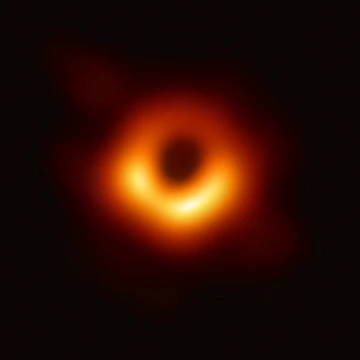
Supermassive black holes (SMBHs) are the largest type, typically ranging from hundreds of thousands to billions of solar masses. Some, like NGC 4889, reach up to 21 billion solar masses. Unlike stellar-mass black holes, supermassive black holes have low average densities—sometimes less than water’s density.
(A non-rotating black hole is a spherical region around a central singularity, not the singularity itself.) If matter accumulates at a constant density, the Schwarzschild radius grows faster than the physical radius. For a body with the density of water, the Schwarzschild radius overtakes the physical radius when the mass reaches about 136 million solar masses, forming a supermassive black hole. Such black holes likely do not form from a single star cluster collapse; they probably start as smaller stellar-mass black holes and grow by accreting matter or merging with other black holes.
Quick Facts
- Field
- General relativity, astrophysics
- Known for
- Schwarzschild radius, Schwarzschild solution to Einstein's field equations
Facts from the source article.
Lore & Background
In 1916, Karl Schwarzschild obtained an exact solution to the Einstein field equations for the gravitational field outside a non-rotating, spherically symmetric body with mass. The solution contained terms of the form which have singularities at certain radii.
The parameter has come to be known as the Schwarzschild radius. The physical significance of these singularities was debated for decades; it was found that one singularity is a coordinate singularity, an artifact of the particular coordinate system used, while the other is a spacetime singularity that cannot be removed. The Schwarzschild radius is nonetheless a physically relevant quantity.
Any object whose radius is smaller than its Schwarzschild radius is called a black hole. The surface at the Schwarzschild radius acts as an event horizon in a non-rotating body (a rotating black hole operates slightly differently).
Neither light nor particles can escape through this surface from the region inside. Black holes can be classified based on their Schwarzschild radius, or equivalently, by their density. Small black holes are much more dense than large ones; the volume enclosed in the event horizon of the most massive black holes has an average density lower than main sequence stars.
The Schwarzschild radius of an object is proportional to its mass. The Sun has a Schwarzschild radius of approximately 3.0 km, Earth's is approximately 9 mm, and the Moon's is approximately 0.1 mm. The Schwarzschild radius of the supermassive black hole at the Galactic Center of the Milky Way is approximately 12 million kilometres.
Reader's Guide
The Schwarzschild radius is a fundamental concept in general relativity and black hole physics. It defines the event horizon for a non-rotating black hole, marking the boundary beyond which no light or matter can escape. This radius is directly proportional to mass, meaning that any object compressed within its Schwarzschild radius becomes a black hole. The concept allows classification of black holes by mass: supermassive black holes (with masses of hundreds of thousands to billions of solar masses) have low average densities, sometimes less than water, while stellar black holes have much higher densities.
Micro black holes, if they exist, would have extremely small Schwarzschild radii and densities so high that no known mechanism could form them; they might have formed in the early universe after the Big Bang. The Schwarzschild radius also appears in gravitational time dilation approximations and intersects with the Compton wavelength at the Planck scale, indicating where quantum gravity corrections become necessary. The term 'gravitational radius' is sometimes used as a synonym, though it can also refer to a constant half as large, leading to its avoidance in educational settings.
More in Black holes
Sources
Compiled from Wikipedia and the sources listed below. Text from Wikipedia is available under CC BY-SA 4.0; this entry is adapted from it.
- Wikipedia: Schwarzschild radius (CC BY-SA 4.0).
- Word definitions: the Codexery glossary, each quoted from its Wikipedia article.
Spotted an error? Know more?
Reader corrections go straight into our review queue. Suggest an edit · How this site is sourced