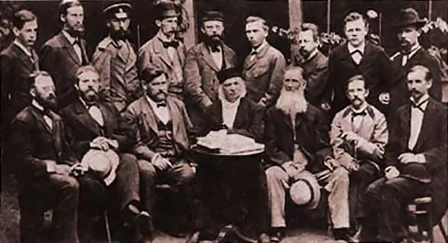
Karl Schwarzschild
German physicist who gave the first exact solution to general relativity.

via Wikipedia: Black hole · see source
Only a few months after Einstein published the field equations describing general relativity, Schwarzschild set out to apply the idea to stars. He assumed spherical symmetry with no spin and found a solution to Einstein's equations. At a certain radius from the centre of the mass, the Schwarzschild solution became singular, meaning that some of the terms in the Einstein equations became infinite. The nature of this radius, which later became known as the Schwarzschild radius, was not understood at the time. Schwarzschild accomplished this groundbreaking work in 1915, the same year Einstein first introduced general relativity, while serving in the German army during World War I. He had volunteered for service despite being over forty, working on ballistic calculations on both the western and eastern fronts. While on the Russian front, he developed pemphigus, a rare and painful autoimmune skin disease. Despite his illness, he managed to write three important papers—two on relativity and one on quantum theory. His solutions produced the first exact solutions to the Einstein field equations for the limited case of a single spherical non-rotating mass, leading to the derivation of the Schwarzschild radius, which defines the size of the event horizon of a non-rotating black hole. However, Schwarzschild himself believed this finding was a mathematical curiosity with no practical relevance. He left military service in March 1916 due to his illness and returned to Göttingen, where he died on 11 May 1916, at the age of 42, from complications related to his autoimmune disease.
- died
- 11 May 1916, age 42
- field
- Physics, Astronomy
- nationality
- German
- known_for
- Schwarzschild solution, Schwarzschild metric, Schwarzschild radius
Verified Timeline
Lore & Background
He provided the first exact solution to the Einstein field equations of general relativity, for the limited case of a single spherical non-rotating mass, in 1915, the same year Einstein first introduced general relativity. His work led to the derivation of the Schwarzschild radius, the size of the event horizon of a non-rotating black hole. A few months after Schwarzschild, Johannes Droste, a student of Hendrik Lorentz, independently gave the same solution. Many physicists of the early 20th century were sceptical of the existence of black holes. In a 1926 popular science book, Arthur Eddington critiqued the idea of a star with mass compressed to its Schwarzschild radius as a flaw in the then-poorly-understood theory of general relativity.
Reader's Guide
Schwarzschild's solutions to the Einstein field equations are fundamental to the study of gravitation. While serving in the German army during World War I, he wrote three important papers, two on relativity and one on quantum theory, producing the first exact solutions to the Einstein field equations and identifying the Schwarzschild radius. He wrongly believed this finding to be a mathematical curiosity with no practical relevance; twenty-three years after his death, J. Robert Oppenheimer and Hartland Snyder correctly predicted the existence of black holes. He introduced the correct Lagrangian formalism of the electromagnetic field and a field free variational formulation of electrodynamics.
Did You Know?
- Only a few months after Einstein published the field equations describing general relativity, Schwarzschild found the first exact solution for a spherical non-rotating mass.
- A few months after Schwarzschild, Johannes Droste independently gave the same solution.
- The Schwarzschild radius was not understood at the time; many physicists were sceptical of black holes.
- Arthur Eddington in 1926 called the idea of a star compressed to its Schwarzschild radius a flaw in general relativity.
- Schwarzschild died in 1916, twenty-three years before Oppenheimer and Snyder correctly predicted black holes.
More in Astronomers And Cosmologists 1-24
Spotted an error? Know more?
This is a living reference — every entry is fact-audited, and reader corrections feed straight into our audit queue. Suggest an edit · See this site's audit record